Moët Hennessy has suffered a disappointing year of sales thus far. Industry analysts are now suggesting that a spinoff may be the best solution for LVMH’s struggling wine & spirits unit.
Last week, luxury goods group LVMH won back its spot as the largest stock in Europe. On 17 January, the French company saw its market valuation reach US$356bn.
However, LVMH’s wine & spirits division, Moët Hennessy, has – like many others in beverage alcohol of late – seen its sales waver in recent months. In October, the Hennessy cognac owner booked its fifth quarter in the last six of negative sales.
The 7% decrease in sales from the three months to the end of September represented an improvement on the 12% sales slump in the first quarter of 2024, but came in worse than Q2’s 5% fall. Subsequently, Moët Hennessy stands at -8% for the year to date and will be hoping for a decent Q4 when it reports its full-year numbers on 28 January.
On the flip side, LVMH’s fashion & leather goods division has grown to become more than ten times bigger than Moët Hennessy in profit generation, according to investment management firm Bernstein. Led by Luca Solca and Trevor Stirling, the company’s alcohol analysts noted that the wine & spirits division works “according to a very different logic from everything else within LVMH”.
“The LVMH value creation ‘recipe’ is based on product innovation, direct control of distribution, brand enhancing communication,” the analysts wrote in a client note this week. “This has worked well for fashion and leather goods… But this ‘recipe’ is orthogonal to what one can do in wines and spirits: distribution is through wholesale, product innovation is limited to packaging, as what is in the bottle has to be the same year over year, while communication on spirits is in most markets much more highly regulated.”
Not only does Moët Hennessy appear to be ill-suited to its owner’s long-term business plan, but it also provides LVMH with a headache from an investment point of view; many funds cannot invest in the group because of its alcohol arm, according to Solca and Stirling. “This is not limited to asset managers in the Middle East, for obvious reasons,” they noted. “This impacts an increasing number of investors embracing ESG criteria in their investment processes and stock selection.”
Looking forward, LVMH may well – and should, according to some analysts – consider splitting Moët Hennessy and distributing its shares to the group’s shareholders. A similar, successful move was undertaken in 2008 by Switzerland-based luxury goods holding company Richemont with its tobacco business.
It’s at this point that consideration of Moët Hennessy’s minority stakeholder needs to make its entry: Diageo owns 34% of the wine & spirits business, while LVMH oversees its day-to-day operations. If LVMH were to spin off the division, then Agache, the holding company of the ruling Arnault family’s stake in LVMH, would own 32.3% (the remaining 33.7% would be owned by independent shareholders).
“A plain vanilla share distribution would put [LVMH’s] control of Moët Hennessy in jeopardy,” Solca and Stirling believe. “A sale to Diageo would probably raise more cash in the short-term (if Diageo were able to pass the no-doubt very elevated political objections and raise the funds).”
That said, the pair are right to flag that LVMH is not in need of cash, while they also suspect that the ruling Arnault family “would be loath to lose control of a heritage asset”.
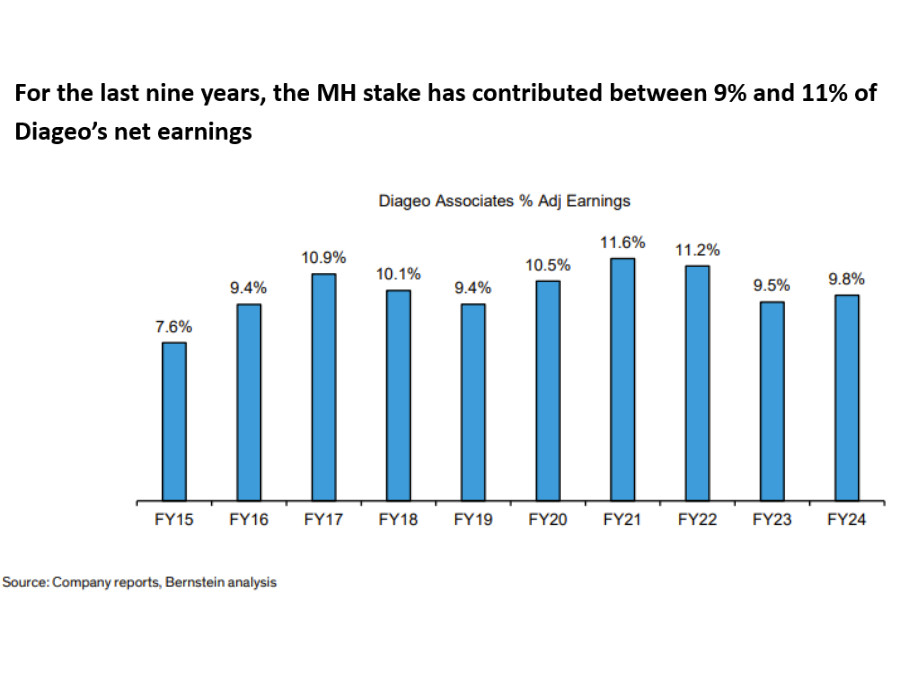
In the recent past, Diageo has made no secret of its preparedness to take full control of Moët Hennessy and integrate it into the group. That likely remains the case today, although a transaction would not be without its challenges. “Such a deal would severely stretch the Diageo balance sheet, possibly necessitating a very reluctant disposal of beer/Guinness,” Bernstein’s analysts said.
If a deal were to take place – and it’s a big ‘if’ – it is conceivable that Diageo could look to take control of the spirit assets while Agache retains the champagnes and wines. However, it’s worth noting that Moët Hennessy’s cognac & spirits operations are significantly underperforming compared to champagne & wine. Over the last five years, according to Bernstein’s research, the spirits unit, which includes Hennessy, Ardbeg, Glenmorangie and Belvedere (among others), has delivered -2% CAGR in sales – that compares to +4.6% from champagne & wine.
Nonetheless, Solca and Stirling maintain they can see “the bare bones of a win-win structure” if Diageo can avoid the sale of Guinness.
The analysts concluded: “We guess that (maximising value whilst retaining control) could be a key item for the new leadership of Moët Hennessy … . In this light, it does make sense to have the former CFO, Jean Jacques Guiony, at the helm: he may not be a native spirits executive, but he knows an awful lot about M&A.”
Despite the persistent rumours – as recently as today, indeed – it’s highly unlikely that Diageo would let go of Guinness. That removes one possible answer to the question LVMH will be asking of Guiony: How do you solve a problem like Moët Hennessy?