

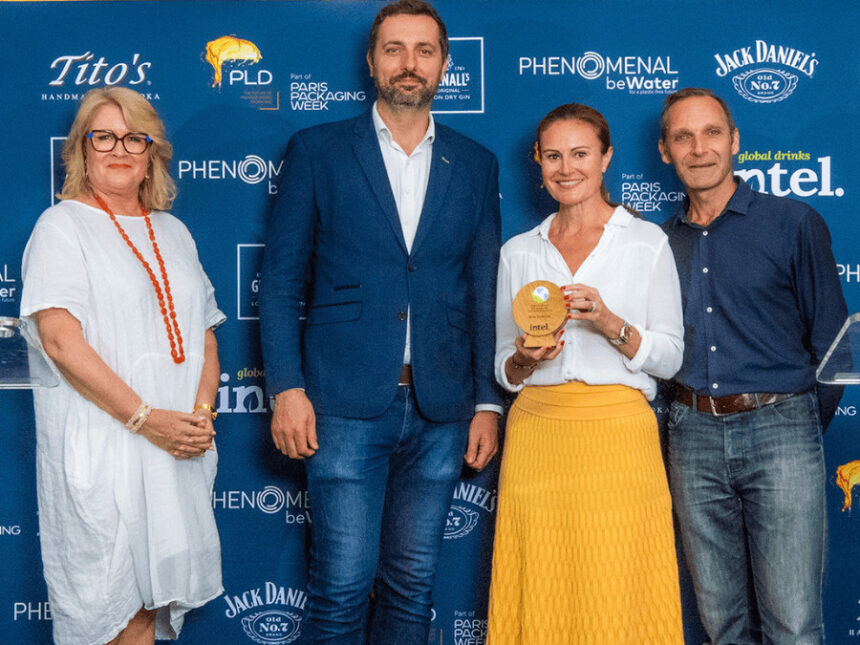
Earlier this month, Global Drinks Intel announced the winners of its inaugural ESG Awards. Here’s a look at why the winners won.
Green Packaging Initiative – Rémy Cointreau
The main aim of Rémy Cointreau’s ‘Sustainable Exception’ programme is the reduction of the carbon footprint for products and packaging by 50% per bottle by 2030.
In 2022, the group removed secondary packaging from 78% of its bottles – compared to 21% in 2019. All brand divisions are contributing, but some – Champagne Telmont and the Cointreau and Belle de Brillet liqueurs – have chosen to eliminate giftboxes entirely. The target is to reach 85% of “naked bottles” by 2025.
Following successful testing last year, Telmont will gradually replace its bottles with a lighter version, which weighs 800g – 35g lighter than previously. According to Rémy Cointreau, this will be the lightest bottle in the Champagne category. Mount Gay rum, St-Rémy brandy and Belle de Brillet also benefited from reductions of between -2% and -11%. The target is to have ‘eco-designed’ 80% of the bottles for the full portfolio by 2025 [the current level is 67%].
Over the last two years, the company’s development-packaging teams have been working on bottle recyclability, both in terms of the materials used and their separability. Rémy Cointreau is already approaching its target of 100% recyclable or reusable bottles by 2025, hitting 98% in 2022.
In late 2022, the group commenced its ‘One Bottle for Eternity’ project with the launch of three pilots to explore different circularity formats.
- Mount Gay is testing a deposit system in its home market, Barbados. Empty bottles are collected, cleaned and refilled and the brand aims to be able to reuse 30% to 40% of bottles locally, with an estimated CO saving of 60% per bottle.
- In the UK, Mount Gay has joined with Cointreau for a partnership with Ecospirits to promote greater circularity in the country’s on-premise. Since the start of this year, 4.5-litre ‘Ecototes’ have been deployed in a selection of London bars, restaurants and hotels. Once empty, the bags are collected, cleaned and refilled. The pilot aims to reduce back-room storage by 30% to 50% and cut glass and cardboard waste by 95%. Furthermore, initial estimates indicate a reduction of 80% in associated carbon emissions. “With this launch,” the group says, “Cointreau becomes the first international liqueur to partner with Ecospirits and Rémy Cointreau, the first partner group in the UK”.
- Since November last year, high-end Cognac brand Louis XIII has been offering consumers the possibility to refill its carafe an unlimited number of times in its Cognac store. This service – dubbed ‘the Infinity Wheel’ – has since been rolled out to all Louis XIII-branded outlets.
Special Commendation – Beam Suntory
Beam Suntory’s Courvoisier Cognac brand underwent a packaging refresh in 2021, which “reinforced its commitment to sustainability”. The move included a switch to lighter glass bottles, stoppers made of biopolymer rather than fossil fuel-based plastic, the removal of foiled papers and the introduction of 100% Forest Stewardship Council (FSC)/Programme for the Endorsement of Forest Certification (PEFC) certified materials for paper products.
Then, last year, Courvoisier worked with winegrowers to plant around 250 different species of plants as crop cover. The project will allow rainwater to be filtered into groundwater, which removes pollutants and develops biodiversity, while also expanding the habitat for insect populations and fauna.
Special Commendation – The Boatyard Distillery
Northern Ireland’s Boatyard Distillery earned a Special Commendation for its introduction of 2.8-litre pouches for its namesake gin and vodka expressions. The pouches, designed for the on-premise, have set the scene for a consumer-facing trial of smaller versions that can be returned to the company by post for either refill or recycling.
Also catching the judges’ eyes was a refill bottle scheme where any 70cl bottle can be filled at the distillery for GBP10 [US$12] cheaper than a Boatyard-branded pack. Finally, the installation of ‘milk jars’ to refill bottles at the distillery has resulted in the volume of bottles that were used for bar stock declining impressively.
Subscribe to Global Drinks Intel in October for 50% off the usual annual cost