The on-premise channel remains a vital touchpoint for drinks brands in their pursuit of growth, recovery and long-term success. Focusing your strategy on ‘markets’, ‘moments’ and ‘motivations’ will help your brand unlock the channel’s potential.
The global on-premise continues to face financial pressures. Despite these challenges, the channel remains resilient and continues to serve as a strong channel for both sales and brand building.
Drawing on insights from CGA by NIQ’s global ‘Reach’ study, most core metrics are indeed stable or only slightly down on last year. Visitation has declined modestly, down 3.4%, but consumer sentiment suggests that a recovery is ahead. More than eight in ten LDA consumers still visit the on-premise within a typical three-month period, while a quarter expect to increase their visits over the next 12 months, outnumbering those who anticipate visiting less often.
Value sales remain steady at just 0.6% lower than last year, while average monthly spend has inched up to US$127.06 (+0.24%). This indicates that, although consumers may be going out slightly less often, they are spending meaningfully when they do.
Indeed, 58% of consumers say they are willing to pay extra for a better-quality drink, up two percentage points (pp) from last year. This willingness to trade up is tempered by a growing focus on value for money, which makes careful positioning essential for brands: products must deliver both a sense of experience and perceived worth.
It’s an increasingly delicate balance, but one well worth investing in, as the on-premise remains indispensable to the global beverage alcohol market, accounting for the majority of total sales across the on- and off-premise channels combined. It also plays a pivotal role in shaping consumer perceptions and purchasing behaviour, both when out of and at home.
To unlock this potential, strategies should centre on three key areas of focus: ‘markets’, ‘moments’ and ‘motivations’, each critical to capturing future growth in the on-premise.
Markets
Success in the on-premise depends on tailoring a brand’s approach to the channel precisely to the needs of each target market, using locally relevant tactics. A first grouping of countries comprises long-established, developed markets such as the US, China, Spain, Germany and the UK. Given their immense scale, maturity and trendsetting influence, these are critical for brands to maintain and nurture their presence in.
The US, for instance, is seeing weaker visitation but still represents enormous value potential, with its on-premise accounting for $94bn in alcohol sales, more than Australia, Germany, France, Canada and the UK combined ($78.8bn). This immense market offers particularly strong opportunities in the cocktail space, with 33% of users enjoying cocktails out of home and the average stockist generating quarterly sales of $14,713 from the category.
Meanwhile, in China, the channel thrives on a deeply ingrained social culture, but category preferences are evolving. Western spirits like whiskey/whisky, brandy and vodka are gaining traction with younger visitors, who are increasingly looking beyond the drinks that have traditionally dominated consumption.
A second group consists of emerging markets such as Kenya, Indonesia and India, which are experiencing rapid growth driven by expanding populations and rising wealth. Nowhere are these trends more striking than in Nigeria, where nearly half of all consumers are under the age of 30. Here, the high-tempo occasion reigns supreme, with consumers favouring nightclubs and late-night visits to bars where brands have opportunities with table and bottle service, as well as premium offerings.
Finally, we have a third tier of modernising markets, including those in Latin America, Eastern Europe, Japan and South Korea. These are steadily evolving towards contemporary, premium-led bar cultures that place increasing emphasis on quality, design and experience.
Moments
With visits to the on-premise down worldwide by 3.4% year on year, brands need to focus closely on the consumption occasions that offer the greatest potential to drive sales, which ‘Reach’ suggests are increasingly high-value and high-tempo.
Last year, the top ten trading days accounted for 5pp more of total annual sales than in 2023, meaning that consumers may well be going out less frequently, but are spending more when they do on major occasions.
During these moments, drinkers are indeed more deliberate in their choices, more receptive to influence and more willing to trade up for quality. Their drink repertoires expand, averaging 6% more categories compared with routine visits. In fact, experimentation is a hallmark of these visits and bartenders play a particularly influential role, with their impact on choice rising by 6pp during event-led occasions.
Admittedly, the ‘Reach’ study also revealed that volume is shifting in the opposite direction, with routine, lower-tempo occasions such as after-work drinks or casual meet-ups now accounting for 53% of visits (up from 47% in 2024). These occasions are becoming more frequent, even if they generate lower spend per visit.
For brand owners, this translates into two clear imperatives: ensure visibility and activation on the biggest trading days, when value share is highest, while also remaining distinctive and mentally available during the everyday, lower-tempo moments that now dominate consumer visits.
Motivations
Having examined the significance of markets and occasions, a third key focus for brands is understanding what motivates consumers to visit bars, pubs and restaurants and what influences their choices while they are there.
Consumers increasingly view the on-premise as a sanctuary, a space to disconnect from the noise of everyday life, step away from digital overload and prioritise their own wellbeing. Essentially, bars, hotels and restaurants are venues that allow their patrons to put themselves first, spend time well and enjoy meaningful moments of connection.
Indeed, when asked why they visit the on-premise, people most often cite spending time with family, friends or colleagues (49%), followed by relaxing (43%) and simply enjoying themselves (42%). A sense of ‘treat & reward’ remains strong, with 37% visiting as a form of indulgence and to celebrate (36%), reinforcing the idea that on-premise venues offer an important sense of escapism and emotional value.
Upon closer examination of the data, four key motivations become apparent. First, the desire for connection with others and disconnection from the outside world. Unsurprisingly, the concept of ‘disconnection bars’ is gaining traction, with 48% of consumers finding them appealing, especially those who are highly active on social media. Meanwhile, 39% find ‘social media-friendly’ venues appealing, showing that the same consumer can seek both digital escapism and shareable experiences, depending on the occasion.
A second motivation is a growing focus on self-care and mindful indulgence. Forty per cent of consumers say leading a healthy lifestyle is among their top priorities, while 63% report moderating their alcohol intake.
Interestingly, among Gen Z consumers, 22% of those moderating now only drink when visiting the on-premise (a rise of 4pp year on year), so brands can find a keen audience in the younger demographic. Furthermore, it must be stressed that this shift is not just about zero-alcohol options; low and mid-strength serves are thriving, appealing to consumers who still want to drink but not overindulge.
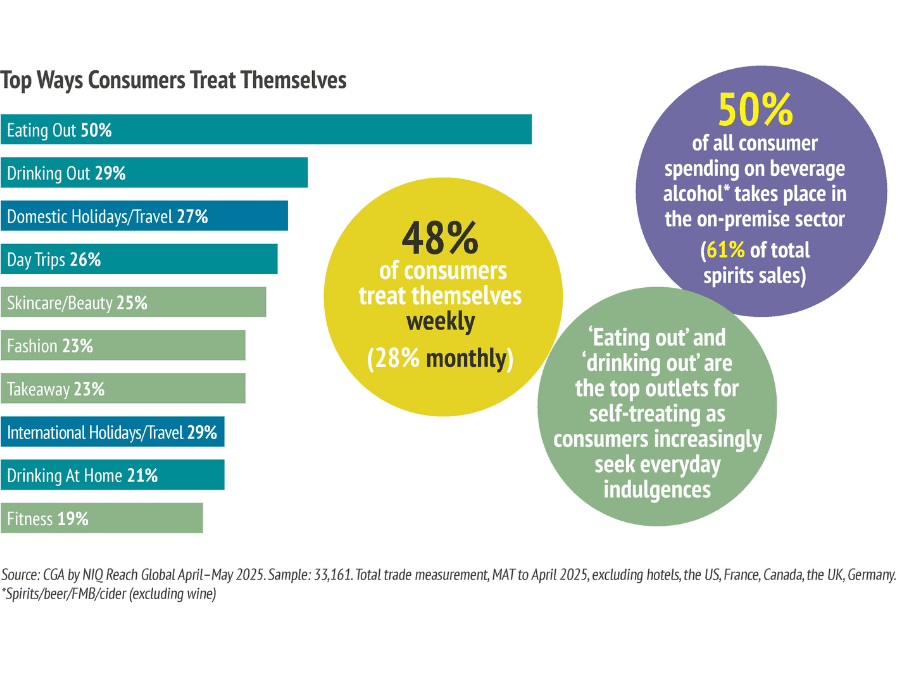
The third motivation identified is about the drive to treat and reward oneself by trading up for better quality and everyday luxury. Nearly half of consumers treat themselves weekly, with ‘eating out’ and ‘drinking out’ ranking as the top outlets for everyday indulgence.
The final key motivation is the consumer’s appetite for exploring, learning and experimenting through drinks, with one in three regularly trying new drinks brands or categories in the on-premise. Bartender advocacy plays a crucial role in shaping consumer choices and encouraging trade-up behaviour: 88% of bartenders make at least one drink recommendation every shift, while 56% of users say they enjoy learning from knowledgeable staff.
Ultimately, the on-premise remains an integral part of consumers’ lives, where connection, health & wellness, indulgence and discovery converge. To win on motivations, brands must recognise that the channel’s strength lies not only in its role as a place to drink, but also as a space to feel, explore and spend time well.
CGA by NIQ’s consumer research offers a comprehensive suite of tools for on-premise businesses to make informed decisions and drive success. The platform provides insights into category, channel, occasion and brand questions, aiding in sales and marketing strategy optimisation in various on-premise markets.
Expert in-country analysis is available to help understand local nuances and tailor strategies to key territories.
Head here to learn more about CGA’s capabilities across the European on-premise market, visit or email CGA by NIQ’s MD of international markets, Jonny Jones, by clicking here.