Three years into his co-founded vodka brand’s journey, Mohit Singh cut his JP Morgan cord to focus solely on Desi Daru in June 2024. Sixteen months on, he shares the adventure so far for his high-end ‘Indian booze’ with Global Drinks Intel editor Olly Wehring.
Where were you before Desi Daru?
I don’t have a drinks background. I studied mathematics at university, did a master’s in financial mathematics and then did a PhD in mathematical finance. I wanted to work in a bank as a quantitative analyst. I got a job at Deutsche Bank for two years, then joined a start-up hedge fund, but that didn’t take off so I was only there for nine months before moving to JP Morgan for seven-and-a-half years. During that time, I knew I wanted to do something different.
My father was a serial entrepreneur, so I knew my genes had some entrepreneurial spirit! I understood that starting a business and making it profitable is the ultimate challenge, especially in the drinks world. I liked vodka, but could see that flavoured vodka had such a bad reputation.
In 2021, I told my manager at JP Morgan I wanted to start a vodka brand and call it Desi Daru. I got two consultants in to help me – one of them was Nick King, who contributed to the WSET textbook for spirits! We launched in July 2022, while I was still at JP Morgan – I only resigned last year. I wanted to grow Desi Daru as much as possible while still working, because losing a salary when you have a new brand that isn’t cashflow positive when you’re trying to expand is a big deal.
My passion has always been to create things of high quality and my skill set is research.
Why did you choose vodka?
I wasn’t thinking about how competitive the vodka category is, I was just thinking how much better I could do than other people in the market at that point.
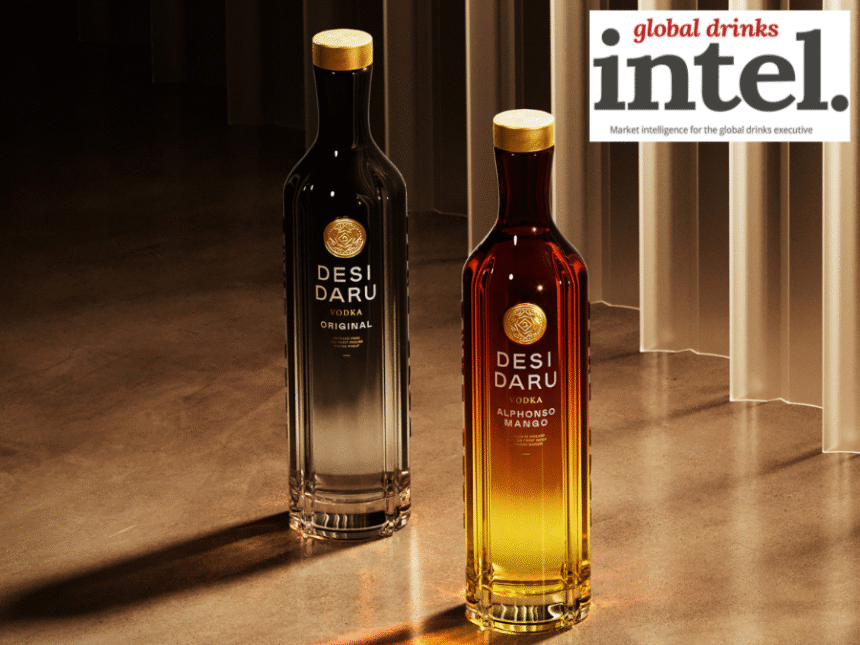
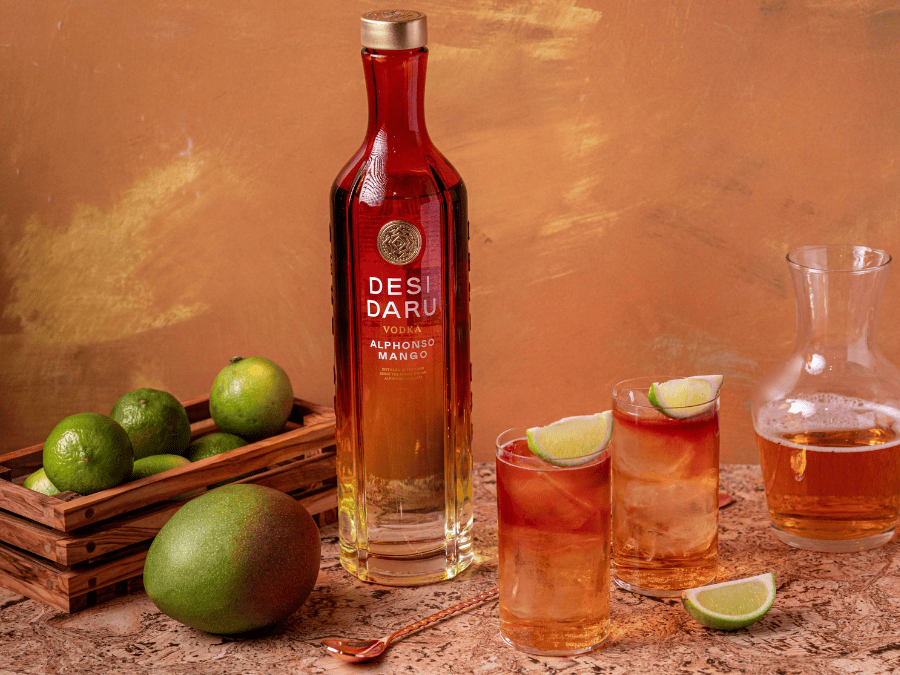
My wife (co-founder, Aneet Kaur) and I have always loved Alphonso mangos, For us to create an Alphonso mango vodka was such an exciting thing. I’ve created something that I myself would like to drink. Although it’s a competitive category, I felt the opportunity was higher because I didn’t see many handcrafted, great quality vodkas on the market.
Where does the brand name come from?
The idea was to use something that resonates with our heritage. The direct translation from Hindi into English means ‘Indian booze’. Desi Daru was also used historically to refer to moonshine spirit.
We liked the name not only because we thought it sounded cool, but we’ve also turned its local meaning on its head to apply to a premium vodka. It’s also really easy to say!
Who do you identify as your competition?
There’s not too much competition out there for a mango vodka – it’s almost like its own category.
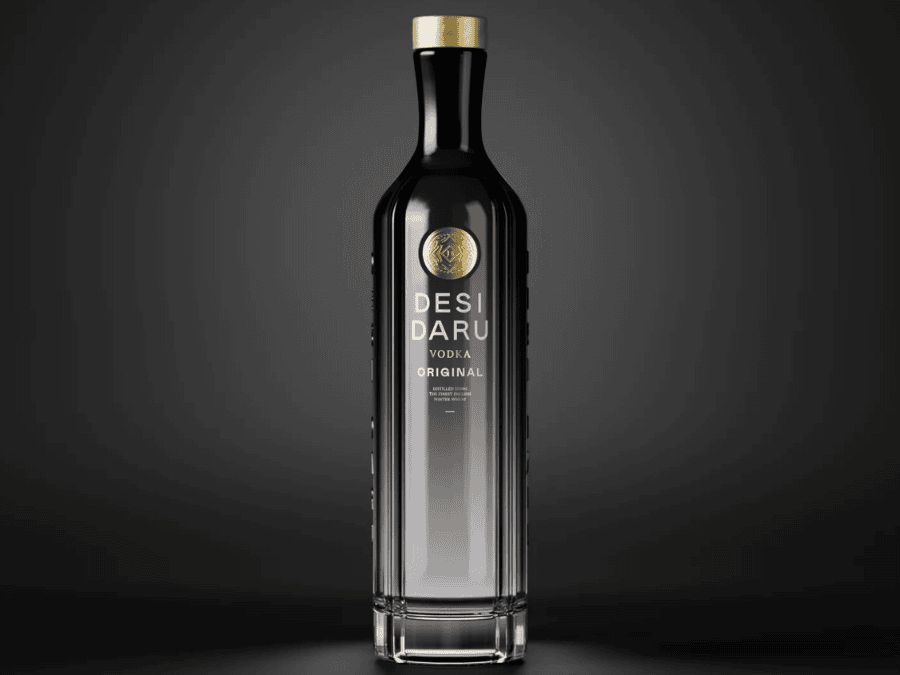
For our original vodka, there are loads! The brands of a similar scale that are also targeting the on-trade here in the UK are Konik’s Tail and Sapling, so that’s who I feel we’re pitching against.
We’re doing things differently to other brands by trying to make it fun: We run a cocktail competition, for example, where bartenders have to use one ingredient from India and one ingredient from their home country. Desi Daru is our culture collision of England and India; what’s your culture collision?
What has Desi Daru’s production journey been?
The idea wasn’t ever to make it myself – I didn’t have the capital for it and I didn’t have the know-how. I visited loads of distilleries across the UK and eventually narrowed it down to two – One in Scotland and one in the Cotswolds (in southern England). I went with the latter, Wood Brothers Distillery Co, which is on a sixth-generation farm – it feels real and I love working with them.
I then started looking at sourcing mangoes from India, which is an area of the business that I’m still involved in.
Is the plan to expand into different flavours?
I’m a bit uncertain. We’re the only brand that has just one flavour; that’s quite a novelty. I don’t want to become a brand where we have to keep releasing new flavours. It’s so easy to get distracted.
That said, I do loads of research and development because I’d rather have a recipe in my back pocket if we need it for commercial reasons. It’s always good to have options. The priority right now, though, is to really grow the mango.
What’s the size of the company at the moment?
It’s me and Aneet along with two full-time employees – a director of operations and a sales & marketing guy.
Volumes-wise, July was our best month; we sold around 200 cases in the on-trade. For the next six months, we want to be selling around 200-to-300 cases per month. We’re still quite young – and premium – so we’re working hard to build our volumes. For bars, we’re priced at around the same level as Grey Goose. I want to grow the brand sustainably.
I left JP Morgan – and my parents were not happy, let me tell you! – because I knew that I wasn’t going to really push myself until I put myself under immense pressure. That pressure happens when there isn’t any money coming in. If Desi Daru doesn’t go to plan – although I really hope it does and I’m doing everything I can – I won’t feel bad because I know I gave it my all.
What was your funding journey?
Until I resigned from JP Morgan, I was totally self-funded, up to around April last year. Then, I started raising money through friends and family, to the tune of around GBP500,000 (US$673,000). That puts me under even more pressure – you don’t want to lose your family’s money, right?!
I’ll admit that I’m not very good at raising money; I was super naive. I put a post on LinkedIn saying I was raising money and me being the delusional person I was at that point, I thought the money was just going to come in.
We’re okay for funding at this point in time. I may do a crowdfunding round in the future, but we’ve raised enough money for the time being that we can breathe. We have enough runway.
What’s been your impression of the drinks industry?
One thing I didn’t realise when I joined was how in London, the high-end on-premise venues charge brands for their listing. In one of my first meetings, for example, I was told it would cost me GBP2,000 per year for Desi Daru to be on the venue’s cocktail menu. Now, I don’t have a hospitality background, so it took me some time to get my head around this arrangement. I need to pay you to use my drink?!
In London, all these big brands are throwing money at venues because they see it as marketing spend. You’ve got to have your brand in the top cocktail bars, no matter what it takes, and the bars can command a lot of money from these brands.
I certainly didn’t realise how competitive the industry is. That was a big eye-opener for me. So, we have to be more innovative and a bit smarter in how we do things.
What’s your exit strategy?
To be very honest, I think the idea would be to sell the company at some point, probably in the next five to seven years. We want to build the brand up enough in that time to be something that people love – and so that it’s worth a lot. That’s the goal.
Are you enjoying yourself?
Yes, but it’s stressful. The grass is always greener on the other side, right? When I left JP Morgan, I was looking forward to being my own boss and to having time for my family. ‘This is going to be so good’, I remember thinking.
I need to go back in time and tell myself: Oh, my God, no. That is not going to happen! I’m way more stressed because all the decisions are on me, and I have less time for the family because everything is always manic.
I do think it will get better – We’re not at the point where I can delegate decisions yet – but for sure it’s been very stressful so far.
I will say this, though: When I see bartenders showing their passion for the brand, that means so much to me.