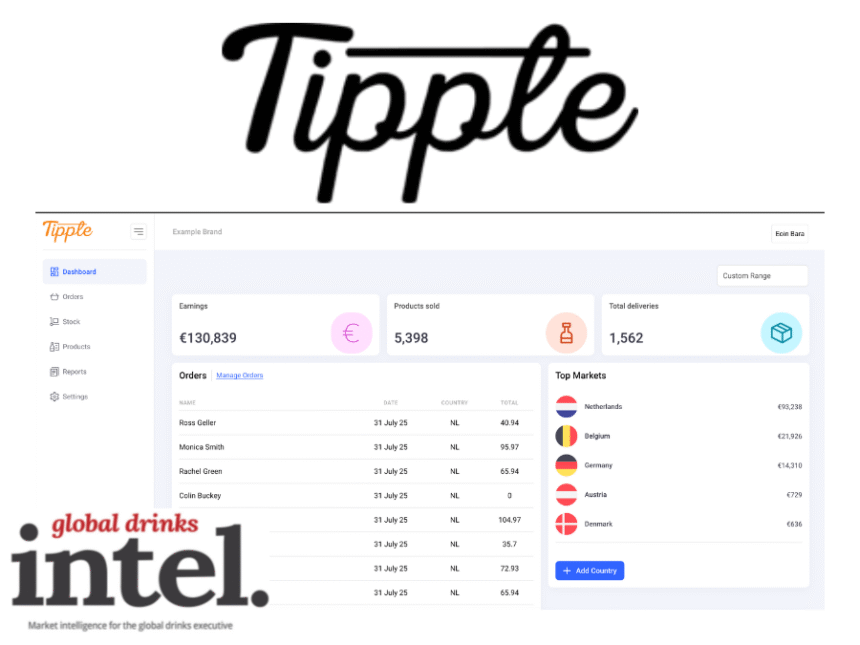
After almost seven years of trying to grow his Irish gin brand, Mór, Eoin Bara launched Tipple, a platform designed to simplify online sales of alcohol beyond one’s home market. Last month, Bara talked editor Olly Wehring through his and Tipple’s journey to today.
What is Tipple and how does it work?
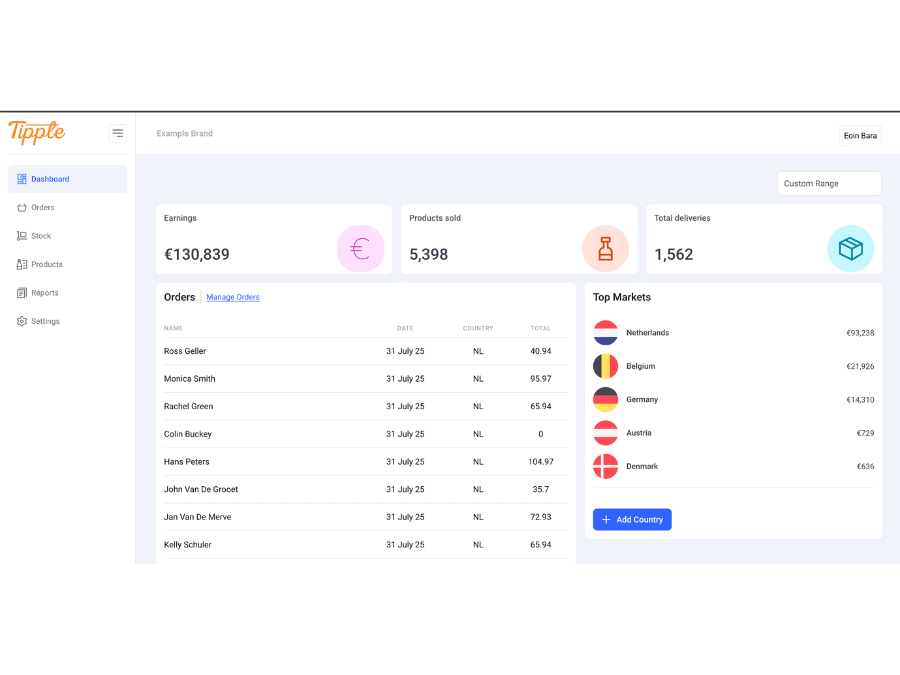
We enable brands to be able to sell online. Things like tax and excise are incredibly difficult – especially cross-border. Tipple makes it simple. It’s a quick plug-in on platforms such as Shopify or WooCommerce that allows a brand to sell across a border compliantly. We handle all the VAT, the excise, the picking, the packing and the shipping.

How did you identify the problem that you felt Tipple could solve?
I was solving this problem for myself: I had a distillery in Ireland and an Irish gin brand – the fourth biggest in the country, at one stage – called Mór. We had tourists coming to Ireland who really liked it and wanted to buy it in, say, Germany, but we didn’t have a distributor in Germany. If we were to sell online, then the shipping from Ireland was going to cost around GBP30 (US$40), and we had no way of paying the VAT or taxes in Germany. This was back in 2019.
When we went to look at warehouses in Germany, no one wanted to deal with us because we were too small to be interesting for them. Besides, it would have been crazy or us to have warehousing in every country. So, we looked into how we could fulfil orders out of one warehouse, like Amazon does, and do cross-border. Now, that’s a way more difficult question.
It took us about two years to figure out how to do it, and when we did, I had to ask myself why I was making gin, when this was a much bigger problem that other people were having too. So that’s what I did. I sold off the gin brand and went all in on this. So, I was scratching my own itch.
Is Tipple just for smaller brands?
No. We do everything from two guys in a shed to Brown-Forman and Diageo – we do all sizes. Pricewise, the most expensive bottle we sell is GBP45,000 (US$60,477), so it’s the whole range.
How did you make the move from solving this problem for yourself to creating a platform in its own right?
When we first thought about doing this for ourselves, we realised how much it was going to cost to set it up. Then, to make it viable, we needed the volumes to get the carrier prices down. The only way to do that was with scale and with multiple people. So we built it as an infrastructure from the start.
As a brand owner, I’d seen this work in the US, but it didn’t exist in Europe. We needed to find warehouse partners, although it was quite difficult finding a bonded warehouse that could do pick and pack. We also needed to find tax partners, who knew the taxes in their localities. Then, we built the technology to automate the pulling of orders, the paying of taxes, the dispatch and then being able to track everything in one place.
I really set out to solve the problems that I faced in the alcohol industry and direct-to-consumer was just the first one I came across.
Where has Tipple got to today?
We went to market in 2021, and today we have three warehouses in Europe – Amsterdam, Antwerp and Paris – one in the UK, and another one coming online in Ireland. We’ve also got one in New Jersey and we have another coming online in Sydney, Australia.
We started working with Diageo in 2023, with Brown-Forman last year and with Au vodka earlier this year.
I’m based in Tullamore in Ireland and we have an office in Dublin as well as staff in Portugal and Scotland. We’re building a global business. Our headcount at the moment is at seven. As we launch our B2B product, there’s going to be a big rise – we’re probably going to hire another seven in the next three to four months, then probably another ten next year. It’s going well.
Who initiates your conversations with the brand owners?
A lot of this is inbound now, so people come to us. We do outbound as well, but it’s easier when it’s inbound because these people have a problem that they need to solve. We’ve found the larger customers come to us, because they’re problem-aware; they saw a spike in e-commerce during Covid and recognise they need to take advantage of this.
What’s hugely important about us for the large enterprise brands is that there’s no brand interruption – You never really see us.
Before the tariffs, we were getting a lot of American brands wanting to come to Europe because they can make far more money – people are surprised at how much more margin they can make by selling direct versus selling through traditional routes.
Presumably you’ve made the offer of better margins your USP.
Getting a distributor has become much more difficult since Covid, because they’ve become more risk adverse – they want to see market demand. But, if you can’t get a distributor to get into a market, how do you prove market demand? You can prove it through direct-to-consumer. We had a brand that ran a really good D2C campaign in Germany recently, which resulted in two distributors fighting over it – That’s unheard of in the drinks industry.
What has your funding journey been like?
Back in 2022, we took on GBP400,000 from some ‘angels’, who included Des Traynor (co-founder of Intercom) and Adii Pienaar (co-founder of WooCommerce). We used that money to build Tipple out to be more scalable. Then, last year, we raised GBP4m.
What’s been the hardest part of the project so far?
Here in Europe, the first thing is that brands aren’t really aware that this can be done. The second is that they haven’t counted D2C as a route to market. Everybody does D2C in the US because they have to, but they don’t make money on it because it goes through the three-tier system.
Europe has been slower to see D2C as a possibility; they’ve been trying to sell direct through Amazon but in doing so, they’re driving traffic to Amazon – they don’t get the customer data and they don’t get to remarket to them. By going direct, you ‘acquire’ your customer; you can build a relationship and get a really good lifetime value out of them.
That’s been a mindset shift when we’re talking to brands. All they cared about was selling bottles, but this way, you can sell your customer one bottle, then sell them a new release and keep them coming back.
How do you line up brand owners to stay with you for the longer term?
We’re very transparent from the start. We start with a ‘discovery’ call, where we see what they want to do. If it’s a good fit, we’ll move to a second ‘P&L’ call, where we show them very transparently how long they’re going to be losing money for until they start making money. You have to invest in the market to get the volumes up in order for this to make sense.
From there, we basically act like an outsourced e-commerce manager; we’ll have a call once a month and highlight what we see working for their brand across areas such as email marketing. We see it like a partnership where we try and help them. Our incentive is our commission, so when they’re selling, we’re making money. The incentives are aligned.
What’s your exit strategy?
There isn’t one. The idea here is that we build the infrastructure for the alcohol industry. We started with D2C and now we’re going into B2B, which is a beast of a thing. We’ve got a unique way of doing it that should make it better for everybody; distributors can make more money, so can brands and so can the on-trade.
From a liquidity perspective, our next move would be an IPO rather than a trade sale. Our idea is to provide an independent infrastructure for everybody, not just for one large player. We don’t want to keep anyone out of the market, we want to make it as easy to enter a market as one click.
Is your business model recession-proof?
After 2008, we saw people cut down on going out but still buying a nice bottle of whiskey/whisky or wine to help make life suck less, because there was a recession going on. We’re perfectly poised for that because we’re the people who can supply that little luxury.
But then, we don’t know until the tide has gone out – we could see consumer behaviour go completely the other way. If the cost of living keeps going up, and taxes don’t come down, then people aren’t going to have the money to spend.
At the same time, we tax the logistics and underlying infrastructure. There’s always going to be this money moving. With B2B, you still have to get the product to a store; you still have to enable all of this. We expect B2B will allow us to smooth out some of the seasonality and become properly recession-proof.
Knowing what you now know about the industry, what advice would you give to anyone looking to start out?
Do the numbers! There are so many times that we speak to brands and they’re selling the product for something like GBP40, but it costs GBP22 to make – That’s a net margin of 5% or 6%, and that’s a huge problem.
The other thing is to look at the trends. We’re seeing quite a lot of taste exploration, for example, and people want to try things first. A lot of brands have only got 70cl, which means a consumer has to commit GBP40 to GBP50 to find out if it’s good or not.
Also, invest in your branding. So many people cheap out on their label or they hire a bad designer – consumers buy with their eyes first and then the taste keeps them coming back. First, you have to stand out on-shelf – You have to look at your product and where it’s going to be.
A lot of people dive in headfirst with this romantic notion of making booze and think it’s going to be great. You really have to do the numbers beforehand. And bear in mind, everything’s going to take you five times longer than you think it’s going to. It’s going to be way more competitive.