

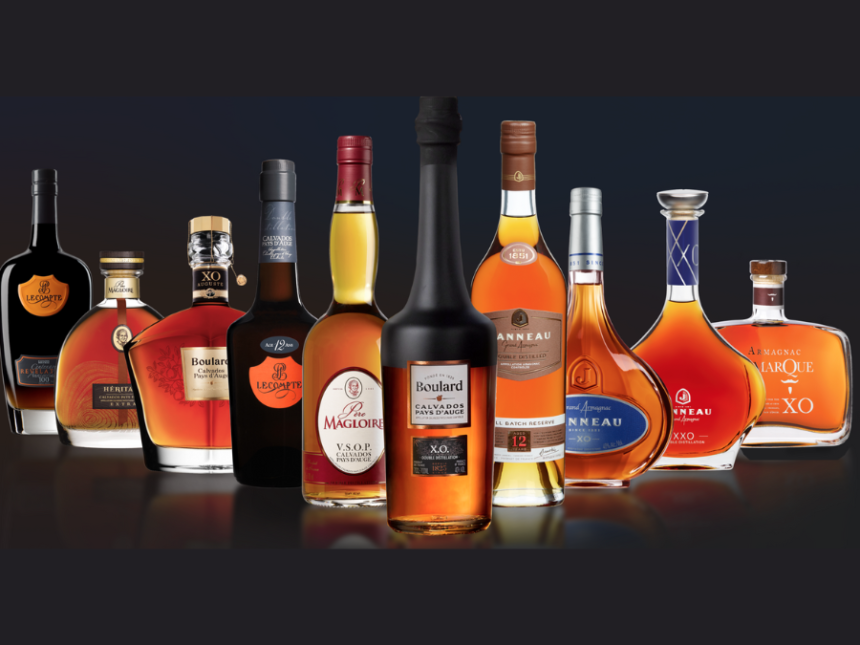
As Spirit France celebrates the 200th anniversary of its flagship Calvados Boulard, CEO Serge Der-Sahaguian looks back over the group’s history and explains why its armagnac and calvados brands make excellent bedfellows.
What’s the history of Spirit France?
The group was established in the 1990s through the merger of two Normandy-based families: the Boulards, who owned Calvados Boulard, and the Pellerins, who owned Calvados Lecompte. Their goal was to acquire Père Magloire – the leading calvados brand at the time – which belonged to Veuve Clicquot, part of Moët Hennessy.
Strategically, the acquisition made perfect sense: Père Magloire was the top-selling brand in France and strong in several export markets, Boulard was the leading export brand, while Lecompte positioned itself as a high-end boutique label. Bringing these brands together created a balanced portfolio with category leadership across segments.
The founding families eventually sold the business. In 2014, we expanded our scope by acquiring Armagnac Janneau, to expand our footprint across the broader French AOC (Appellation d’Origine Contrôlée) brandy landscape.
What proportion of the group’s sales are domestic?
While the calvados category is typically split 50/50 between domestic and export sales, that’s not the case for us. France accounts for less than 20% of our sales. Our key export markets include North America, Scandinavia, and Japan.
How do the calvados and armagnac categories differ?
Fundamentally, the two are distinct in their base ingredients – calvados is an apple-based brandy, while armagnac is made from grapes. This naturally results in different organoleptic profiles. That said, both fall under the premium spirits category and share a commitment to quality.
Calvados remains our core business, accounting for 70% of our sales, while armagnac represents the remaining 30%. Their market structures are quite different. In armagnac, around 40% of sales come from vintage expressions, while in calvados, the majority – about 85% – is made up of VS (Very Special) and VSOP (Very Superior Old Pale) offerings.
Consumption occasions also vary. Armagnac is still largely enjoyed as a traditional digestif, whereas calvados is more versatile – it’s increasingly used in cocktails and consumed both before and after meals.
Commercially, the two categories complement each other well. Calvados offers a naturally expressive apple-based spirit, and armagnac delivers a more classic, grape-based profile. There’s no overlap or cannibalisation – in fact, calvados is generally easier to sell because it stands apart, whereas armagnac often gets compared directly to cognac.
Do you see your competition as limited to your respective categories?
Not at all – we look across the broader brown spirits category, from cognac to single malt to rum.
Calvados stands out with its naturally expressive apple character, while armagnac tends to be more robust and aromatic compared to other brown spirits. Cognac, for all its sophistication, can be overly complex and hard for some consumers to grasp. Armagnac, by contrast, is more straightforward – it’s a traditional brandy that’s easier to understand.
Who is the typical calvados or armagnac consumer?
There’s significant crossover with brown spirits drinkers. People who enjoy aged whiskies and rums will often find similar flavour notes in calvados and armagnac. Calvados also attracts flavoured spirits consumers who are seeking more depth and authenticity. It’s a premium alternative to things like apple-flavoured vodka, offering a far more refined experience.
How successful has Spirit France been in attracting new consumers?
Today’s bartenders are much more knowledgeable than in the past. Most of them have encountered calvados at some point in their careers, and I think they immediately see its potential – its complexity, apple notes and unique character make it unlike any other brown spirit, whether from grain or grape.
Because of its versatility, calvados allows bartenders to expand what they can offer. It fits seamlessly into any classic brown spirit cocktail. For example, an old fashioned made with calvados instead of bourbon or rye brings a fresh, fruity twist.
What does the typical consumer journey look like for your brands?
In many of our markets, we lead the calvados category – Boulard is the world’s best-selling calvados. When brown spirits drinkers discover Boulard in a bar and experience its versatility, I think they would consider calvados as a way to expand their repertoire. Rum and whisky can sometimes be polarising, but calvados is quite easy to share.
In markets like France and Belgium, some consumers go to a shop specifically looking for a more sophisticated calvados. Boulard is a perfect fit in those cases. It’s a Pays d’Auge calvados, which means it’s double-distilled, resulting in greater complexity. It’s a sophisticated product, but still easy to approach – whether served neat, over ice, or in a cocktail, Boulard works from every angle.
Boulard is celebrating its 200th anniversary this year. How are you marking the occasion?
We’re marking the milestone with several initiatives. First, we’ve launched new packaging that brings the brand into a more modern, premium space – it’s a major visual upgrade.
We’re also releasing the 200th Anniversary Cuvée, a limited-edition calvados crafted from a selection of our finest eaux-de-vie. It’s an 18-year-old Pays d’Auge expression, and we’re only releasing 7,000 bottles. We’re especially proud that it was awarded a silver medal at the 2025 San Francisco World Spirits Competition – a recognition that underlines the excellence of this anniversary release.
This special cuvée is a true reflection of what Boulard represents in terms of quality and consumer experience. Just a sip reveals its depth – and its long, evolving finish speaks to the calibre of its ageing. It’s the kind of spirit that captures the heart of any brown spirit enthusiast – refined in character, rich in expression, and meant to linger.