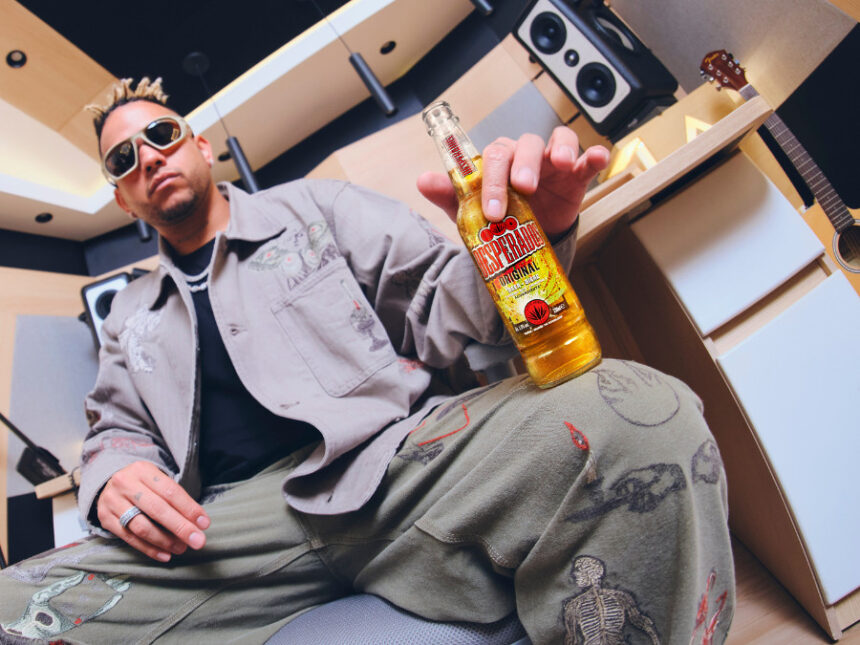
Last month, Heineken released details of a worldwide campaign for Desperados, the group’s agave spirit-flavoured beer. Shortly afterwards, the brand’s global head, Ligia Patrocinio, talked Global Drinks Intel editor Olly Wehring through the strategy.
How long have you been with Heineken?
It’s been 14 years this week! I’m originally from Brazil, which is where I started with the company – I was part of the team that launched Desperados in Brazil. Then I moved into global as head of innovation for Desperados. When the craft trend was big in 2014-16, I became global craft beer marketing manager, before heading up Dos Equis in the US. I’ve been back in Amsterdam for about a year and a half as head of Desperados.
Before joining Heineken, I spent ten years with Unilever in Brazil. I’m a loyalist!

Where does Desperados sit within the group?
Desperados is one of the small but mighty brands among the mothership. The brand launched in 1995 as the first beer to be a mix with some sort of spirit. We’ve always had a bit of a pioneering, edgy approach, focusing mostly on younger legal drinking age (LDA) consumers.
Consumers change and categories evolve, so what we’re working to do now is reconnecting with our consumers in a way that speaks to their hearts – Desperados is well-loved, especially in its strongholds, such as France. That’s where we’ve started a complete repositioning of the brand. The Gen Z consumer is really the core for Desperados – We really needed to understand their tensions; what do they need from a brand?
The younger generations do drink beer, but they also want to have control. They want to have fun, but they’re also afraid of going overboard and being cancelled, for example. This is a very interesting tension, because Desperados is all about vibrancy, bringing people together and having a good time.
The new positioning of the brand, then, is about inviting consumers to get out of their heads and follow their hearts – after all, life constrained is life unlived! This is a unique positioning, not just within Heineken but also in the beer industry. Desperados brings the Latin vibe with the main objective of inspiring consumers to have fun.
Who do you see as Desperados’ competition?
That’s one of the key questions we have. We know that, according to Nielsen, we source volume from other lagers and other flavoured beers as well as from spirits and now from RTDs. We source from different brands and different categories.
It depends not only on the market but also on the consumption occasion and the consumer need. Another difference with this young generation is that they’re not super-linear on what they drink; It’s about the moment and what they want out of a drink. They start the night potentially with a light beer, something lower ABV, then they accelerate a little bit. When they feel that they’re getting out of control, they recalibrate with things like mocktails, 0.0 propositions or even water. Then, they go back to alcohol again. So, even during the night, my competitor can change completely.
Desperados has a unique positioning – Nobody’s been able to copy the liquid. For Heineken, having a brand that’s so different and distinct from the rest is really interesting, but can also be a blind side on who we’re competing against.
We’re expanding the Desperados portfolio to fulfil consumers’ needs, but we know that eventually they go away because they need something else.
What’s the scale of the brand?
Worldwide, Desperados is at around 4.5m hectolitres, mainly in Europe. The biggest market is France, where it was launched in 1995, second is Poland, and third is Nigeria, where we only launched three years ago. We see a lot of consumer appetite for Desperados in Nigeria.
The other two in the top five are Germany and the UK.
How does Desperados perform in the US?
We don’t play in the US.
Why not?
There are portfolio discussions going on. Of course, Heineken is the main brand for the US. We’re going to wait for the upcoming decision.
Is geography the major growth opportunity for Desperados?
With Desperados, we go where the younger consumers are. Not only have we been exploring what consumers are looking for, we’re also looking at where the young generation will be geographically in five to ten years – 72% of LDA-to-35 consumers worldwide is in Africa and Asia. Now we want to expand because that’s where the young generation is.
Africa & Middle East and Asia are really interesting playgrounds for Desperados in terms of expansion.
What impact does the weather have on Desperados?
As for any beer, summer always peaks for Desperados because that’s when consumers are consuming more. But, we have less of a seasonal impact. Our consumers go to parties all year round; They also go to festivals, both indoors and outdoors.
What role does innovation play for the brand?
Another part of the new strategy for Desperados is to reshape the portfolio to deliver on the consumer needs I was talking about earlier. Everything we do as a company is about finding the consumer insight. Finding the journey for Gen Z consumers was really an ‘a-ha’ moment for me.
I can’t open the entire innovation pipeline for you yet. We’re rebuilding the portfolio in a way that we have the core – Desperados original and some other cocktail flavours, such as mojito – and very soon, you’re going to see lighter versions of Desperados, with fewer calories and less sugar, as well as stronger versions.
We’re building the brand in a way that we can really deliver to consumer needs.
What impact did the explosion of RTDs have on Desperados earlier in the decade?
We can’t be blind to it. But RTDs aren’t a symmetric competitor – we still have a beer base. We see RTDs more as complementary than fighting with us. Interactions happen, but not to the point that could jeopardise the brand.
When a consumer is looking for Desperados, they’re looking still for a beer. When they go for an RTD, they’re looking for a different consumption occasion and a different need. Absolutely, we respect the category, but we truly believe they’re complementary at this point.
Given Heineken’s heritage as a company, operating in a traditional, established category, Desperados must be seen internally as a young upstart.
It’s beautiful! We have the licence to innovate and try new things. That’s one of the things I love about my job. While we’re obsessed with beer and tradition, we’re also obsessed with pioneering and innovating. Desperados has the flag to work on one of the things the company wants, which is to shape the future of ‘beer & beyond’.
If there’s one brand that can do that, it’s Desperados.
I probably annoy a lot of my colleagues because the energy you’re seeing here is my day-to-day! We are loud and we make fun. We’re also trying to break the mould and leave our insight – Get out of your head, follow your heart.
What more can you share about the global marketing activation you announced last month?
The way we’ve put this campaign together is completely non-traditional in that it’s being led by creators. I’ve never had a music producer on a campaign’s creative team before. On top of that, we’re collaborating with another roughly 70 influencers around the world. It’s quite scary!
Usually, if you do a TV ad and something goes wrong, you call the network and they take it out. When you do something like this, when it’s out there, it’s out there. So it’s really challenging, but if you want to talk to the target consumers now, being authentic and being part of culture is really important.
It’s all about bringing consumers together, building their memories and trying to be a part of their day-to-day in an authentic and honest way.
This article is available to Global Drinks Intel members only.
Click below for details on how to join the Global Drinks Intel community.
Already a member?
Log in here to read the article in full.
If you work for any of the following corporate subscribers to Global Drinks Intel, head here to activate your access.
- AB InBev
- Bacardi
- Campari Group
- Diageo
- Moët Hennessy
- Pernod Ricard
- Proximo Spirits
- Suntory Global Spirits
- William Grant & Sons