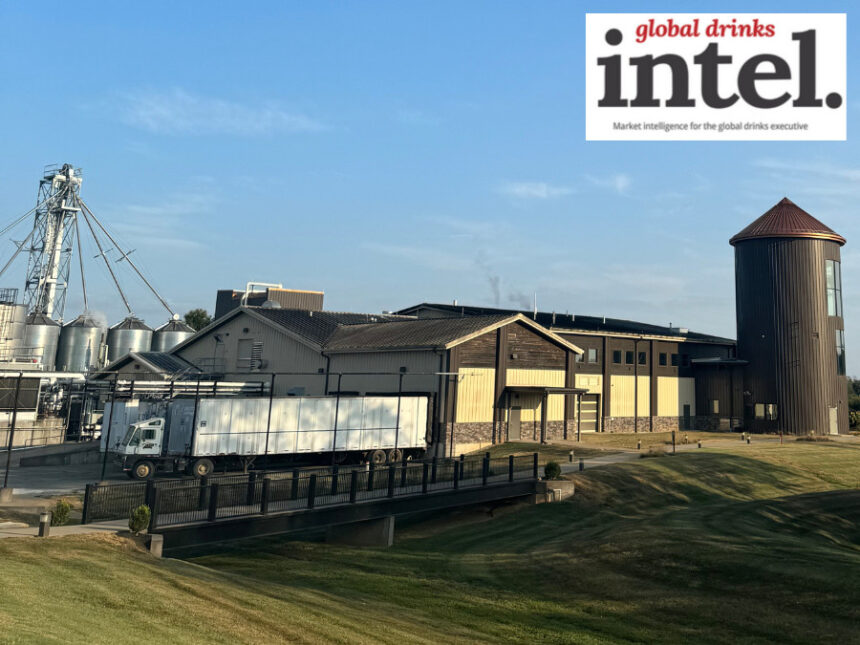
“How many barrels do you think you can get from one oak tree?” asks Landon Foster, visitor centre manager at Lux Row Distillers. We’re standing in a filling hall surrounded by new that are about to embark on their mission as maturation vessels. It’s towards the end of a tour at the enormous Lux Row production complex just outside of Bardstown, Kentucky.
The build project was first announced by the then-family-owned business in 2016. Since then, Lux Row has seen major expansion projects as well as an acquisition by leading third-party producer MGP Ingredients.
Today, the company fills 100,000 barrels of American whiskey a year. “No-one know?” Foster continues. The answer is a shockingly small one-and-a-half. To put the production scale in context, Lux Row alone requires over 150,000 oak trees a year to meet its maturation requirements.
What’s striking is that Lux Row, which owns brands including Ezra Brooks, Rebel and Blood Oath, is far from the only American whiskey producer of this scale. When complete, Heaven Hill’s vast new production complex will eventually fill 150,000 casks a year. Bardstown Bourbon Co also fills over 100,000. That’s before you consider the likes of long-standing giants Brown-Forman, Beam Global Spirits and the many others.
The vast majority of all this American whiskey is still consumed in the US (67%, according to IWSR data). But that’s changing – and it’s one of the factors fuelling the frantic-feeling building and expansion projects across Kentucky and beyond.
Last year, according to the Distilled Spirits Council of the US (Discus), the UK alone imported US$86m worth of American whiskey. And it’s not just the established brands that are contributing. Speaking at a Discus event in London in September, Christine LoCascio, the trade association’s chief of policy, strategy & membership, noted that 38 states are now shipping internationally.
“It (American whiskey) doesn’t just come from Kentucky and Tennessee, although a lot of it does, of course,” she said. “It really shows the diversity and the availability and the interest in American whiskey.”
Interestingly, despite the momentum and enthusiasm from distillers large and small, the current landscape is a little more mixed. Volume sales in the US and UK actually slipped by 1% in 2023, according to IWSR.
Germany, the largest export market for American whiskey, was flat, with Australia, another major importer, seeing volumes slide by 5%. On the plus side, however, Japan, which ranks just behind the UK for imports, saw 11% gains, while the rest of the world saw a 5% uptick.
The general mood in Kentucky, then, is that this represents little more than a bump in the road. Expansion projects continue apace, and few come bigger than the new build at Heaven Hill.
‘I guess we’ll build a distillery’
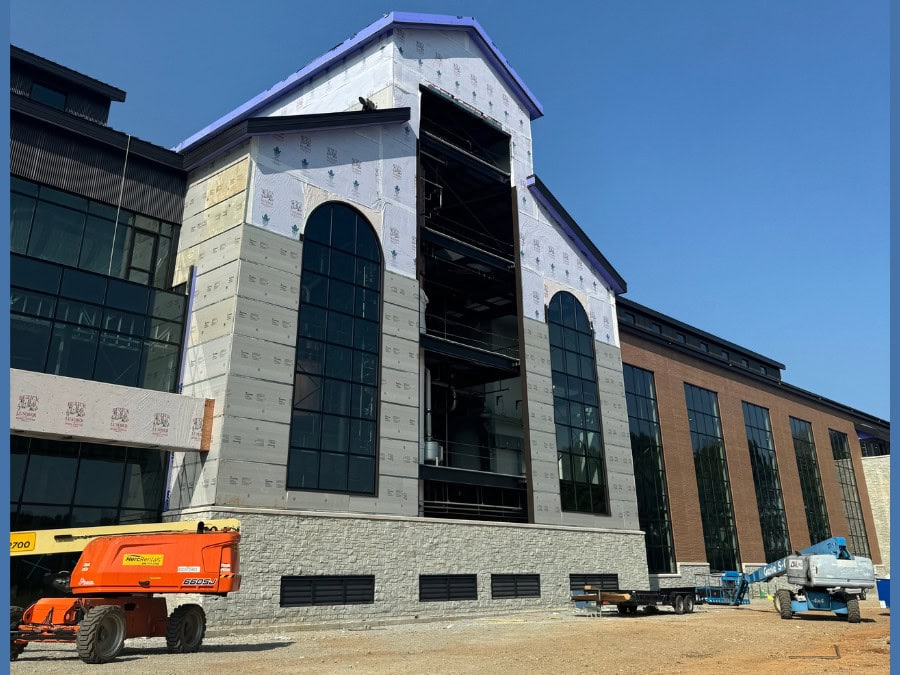
Summer in Kentucky brings with it oppressive heat. Giant industrial fans are essential to keep the construction workers cool as they scurry around Heaven Hill’s Old Bloomfield site (below).
Just a short drive from Bardstown, the walls aren’t fully up yet. Step inside the shell, and concrete pipework lies uninstalled, in pieces across the unfinished concrete floors. The tanks for what will be a future yeast laboratory are in place and the stills are just going in.
Ground was broken less than two years ago and commissioning will get under way in the coming months. The site is so large that phase one alone is budgeted to cost US$185m. Two more will follow as production ramps up.
Heaven Hill master distiller Conor O’Driscoll proudly shows us around the site, pacing the hangar-like space with an evangelical-like fervour. For him, it’s the thirst for American whiskey domestically that meant a new distillery was going to be needed “by 2024 or 2025”. Apparently, it was an easy sell to Heaven Hill’s president at the time, Max Shapira.
“We put the project into a PowerPoint and put an hour in the calendar,” O’Driscoll recalls. “Twenty minutes in, he’d asked all the hard questions. He put his chair back and said, ‘I guess we’ll build a distillery’.”
The new facility will supercharge Heaven Hill’s production. But who will drink it? “We have a lot of fans overseas,” he continues. “Even a small increase over there is going to be very, very beneficial.”
A ‘new’ older generation of whiskey drinkers
Who exactly is forecast to develop a taste for American whiskey? For Lux Holdings CEO Donn Lux, this isn’t going to be about recruiting the younger age demographics. While they may have kicked off the interest in craft distilling – and in many ways have already been won over – it’s about looking more broadly across the age spectrum.
The consumers who are expressing an interest in distilling and a thirst for education and understanding are shifting. “That’s translated to the older generation now,” Lux says, as we sit outside the distillery. “I was here all day, and most of the people were [aged] 45 to 60. They’re fascinated by it, because it’s completely new for them.”
He agrees that American whiskey growth will come from international markets. “The next great wave for the bourbon industry is international. Jim Beam and Jack Daniel’s have done a great job on American whiskey worldwide, and Wild Turkey a little bit. But the rest, people around the world don’t really understand bourbon and American whiskey, so our big challenge is to accomplish that over the next ten years.”
For Discus’s LoCascio, it’s important to consider gender as well. “I was looking at some statistics that said anywhere between 30% and 40% of whiskey consumers are women.” One wouldn’t necessarily know that from the comm’s and marketing, she adds.
Changing shape of the production landscape
It isn’t just the shifting demographics that place American whiskey at such a fascinating crossroads. Third-party production models have shifted too. “Contract distilling was rampant in the early 2000s, 2010s,” explains Dan Callaway, VP product development at Bardstown Bourbon Co, as we tour the sleek, modern facility. It was fuelled by the “big guys” selling their excess. “We kind of changed the picture,” he says.
Bardstown was the first to meaningfully offer custom distillation rather than contract production. “We produce over 60 recipes a year, so different everything, from the yeast, the grain, temperature off the still, fermentation time – there’s 500 points of production that we tweak and adjust.” This isn’t about shifting excess stock; it’s making whiskey for partners through a collaborative model. Bardstown makes around 10m proof gallons a year, which, by Callaway’s calculations, ranks the maker fifth overall in the US.
Another major change driving whiskey tourism in Kentucky has been the 2017 law change that allows distillers to sell direct to consumers outside of the three-tier system. Whiskey tourism wasn’t quite as big then, but now distilleries can serve drinks and sell bottles without having to go via a third-party distributor.
Bringing whiskey to the masses
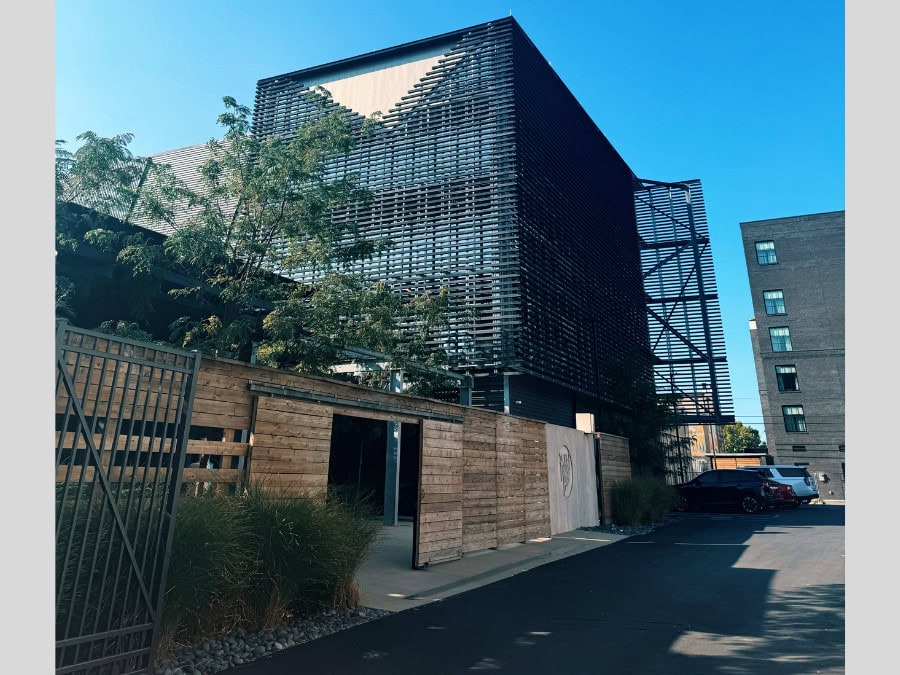
One company that sums up the changes in the market is Rabbit Hole. Founded by Kaveh Zamanian in 2012, the company officially opened its distillery (above) – a modern, industrial yet cathedral-like space in downtown Louisville – in 2018. Zamanian’s vision was to bring whiskey to the masses, creating everything from scratch in a traditional style.
“I wanted Americans to actually get educated on their own native spirit,” he says. “When we first started, I was amazed how few Americans even recognised bourbon as an American spirit.
“What’s changed in the last decade-plus, and in the end, ultimately, it’s about entertaining and bringing people together,” Zamanian continues. “The idea with the design was transparency, entertainment and education.” It’s a strategy that’s working: Pernod Ricard bought into the distillery in 2019 and as of this summer, Zamanian has become chief whiskey officer at the group’s recently-created North American Distillers division.
The pace of change on the ground for American whiskey is astonishing. Against a backdrop of flattened sales, distillers remain convinced that the category will continue to grow.
There’s about to be a lot of new whiskey on the market – one way or another, the thirst needs to continue.