
Equally welcome is the opportunity the milder economic climate offers marketing teams to both reflect this fundamental mood shift and accelerate it further.
Around the world, the cost of living crisis, fuelled by inflation, war and the lingering economic after-effects of the Covid-19 pandemic, has hit significant numbers of consumers hard and left many struggling. At the start of last year, for example, GfK’s longstanding Consumer Confidence Index showed consumer confidence in the UK hitting its lowest point since the monthly tracker began in 1974.
But, behind the gloom and doom headlines that dominated so many markets in 2023, something has changed – and, thankfully, for the better.
By December, the Ipsos Global Consumer Confidence Index reported its first significant month-over-month positive lift in nine months, with confidence on the rise in Europe, the Middle East and Africa. By April, the index was stable and up three points year on year, with seven of the 29 economies tracked showing “significant gains” in consumer sentiment and just four showing “notable decline”.
Meanwhile in the UK, the Deloitte Consumer Tracker showed that in the first quarter of this year, consumer confidence had increased to its highest level since Q3 2021.
As we enter the summer here in the Northern Hemisphere, caution still prevails, but evidence of an improved economy is growing, albeit tentatively. In April, UK housebuilder Taylor Wimpey announced a rise in sales during the key spring selling season and reiterated its optimistic outlook for the full year. The same month also saw the eurozone bounce back out of recession after a stronger-than-expected Q1 performance by its ‘big four’ economies – France, Germany, Italy and Spain. The UK achieved the same feat a month later, thanks to the country’s fastest economic growth in almost three years as GDP increased by 0.6% in the first three months.
Brand owners – in food and beverage, in particular – appear to be quietly confident of a healthy summer, thanks in part to the UEFA Euro 2024 soccer tournament in Germany and the Olympic Games in France. Historically, large sporting events have had a halo effect on the consumer’s mood. The 2020 Euros, which took place in the summer of 2021, reportedly generated a 4.2% surge in UK F&B sales, driven by extra spending ahead of the games. Elsewhere, the Women’s Euros in 2022 was estimated to have added GBP1.2bn (then-US$1.5bn) to the UK economy – including an extra GBP761.2m on food and drink.
There are other signs that beverage brand owners are preparing for strong future performances; Just over two months ago, for example, Campari Group lined up a EUR75m (US$80m) investment in expanding its Novi Ligure facility in Italy, doubling the production capacity for its flagship Aperol brand.
The message, then, is clear: economics and consumer confidence go hand in hand with marketing budgets, strategies and creative direction. At the same time, upbeat noises from economists have a subsequent knock-on effect on the consumer’s optimism.
Consumer confidence directly impacts spending patterns, and when brand owners and agencies feel buoyant, they’re more likely to make bolder and braver decisions – in doing so, they both reflect and enhance the consumer’s general mood.
It’s a virtuous circle, and a growing number of indicators show that we’re at the early stage of this cycle – one being the style and confidence we’re starting to see come through in drinks advertising.
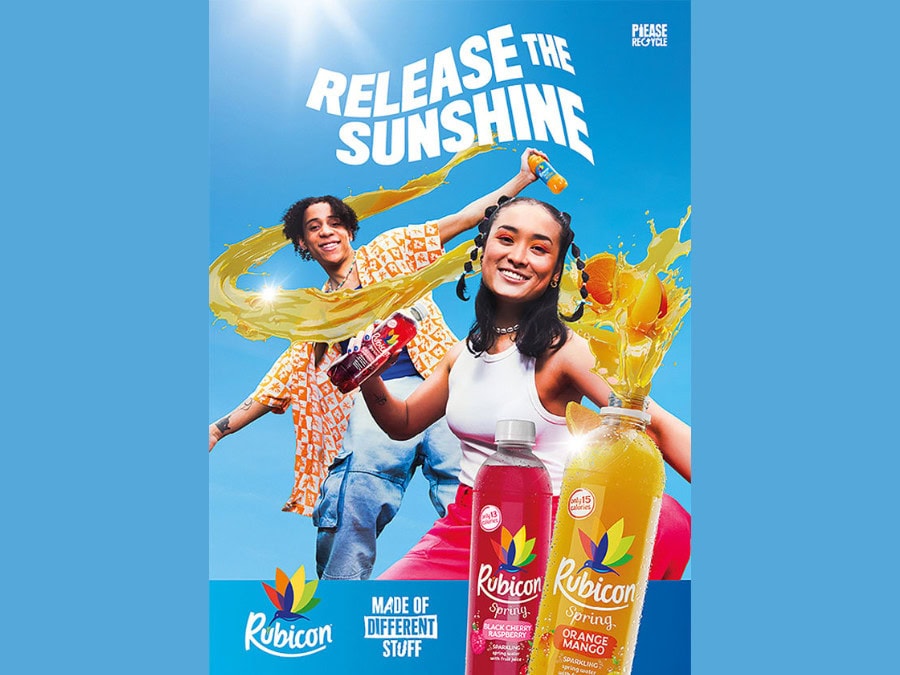
Consider ‘Release the Sunshine’, Rubicon’s recently-launched activation that forms part of owner AG Barr’s strategy to position the soft drink as the brand of summer. The early executions are eye-poppingly colourful, big, bold and brash. There’s also Müller-owned milkshake brand FRijj’s arresting ‘Resist the URjj’ campaign – its first major push in eight years. Eye-catching billboards challenge passers-by to look away, while others feature a FRijj bottle-shaped hole in the middle, giving the illusion that someone has been unable to resist and ripped it straight from the poster.
Both are strong examples of brands seizing the moment to present themselves in a shouty, but positive, way.
It’s not just soft drinks; no- & low-alcohol brands are also running bold creative executions to get noticed. A good example is Lucky Saint’s Dry January campaign, now in its second year. Shot by UK photographer Rankin, the creative plays on the idea of abstinence being a virtue, using Christian imagery alongside slogans such as ‘Lead me not into temptation’ and ‘Rejoice’.
The style of all three brands’ positionings is confidence and optimism. The good news is that, according to neuroscience, confidence is contagious.
The time to ride the rising wave of positivity, then, is now upon us.
This article is available to Global Drinks Intel members only.
Click below for details on how to join the Global Drinks Intel community.
Already a member?
Log in here to read the article in full.
If you work for any of the following corporate subscribers to Global Drinks Intel, head here to activate your access.
- AB InBev
- Bacardi
- Campari Group
- Diageo
- Moët Hennessy
- Pernod Ricard
- Proximo Spirits
- Suntory Global Spirits
- William Grant & Sons