

In recent years, much of the buzz surrounding the buoyant sparkling wine category has focused on two segments mainly located at opposing ends of the price ladder: champagne and prosecco. Today, with champagne shipments dipping in 2023 and signs of ‘prosecco fatigue’ in markets such as the UK, might this be the moment for fizz from other origins to take centre stage?
Trends were mixed last year: despite outperforming the overall wine category – which remains in long-term global decline – sparkling wine still endured a few difficulties, explains Ferrari Trento export director Manuela Savardi. “During 2023, there was a trend of steadily decreasing sales that began in July,” she says. “Unfortunately, the Christmas period was not sufficient to recover sales and we closed 2023 with a negative sales percentage. However, our negative percentage for 2023 was -4%, which is smaller compared to the general trend in wine sales of -10%, so we’re still happy with the result, despite the external factors.”
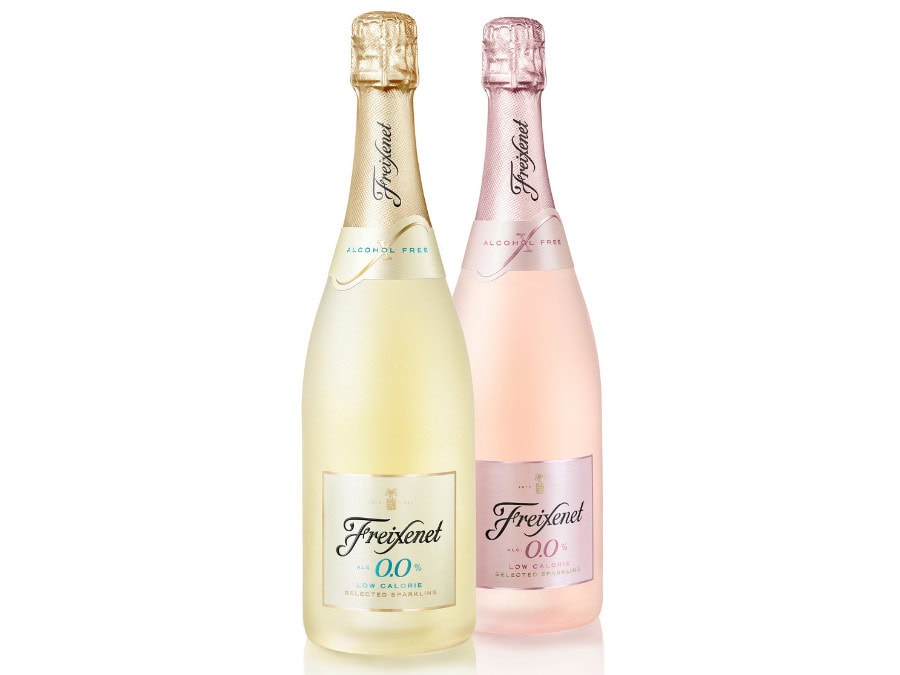
For sparkling wine giant Henkell Freixenet, key growth drivers include the rosé and no-alcohol segments, in both of which, the group’s broad portfolio – including cavas Freixenet Alcohol Free 0.0% and Freixenet Alcohol Free Rosé 0.0% (below) – is well-positioned. That said, according to head of communication Vanessa Lehmann: “Overall, the sparkling wine, [still] wine and spirits industry faced a challenging year [in] 2023, due to a tense market environment, characterised by inflation in many markets and the resulting change in consumer behaviour.”
A spokesperson for Spain’s DO Cava, meanwhile, describes relatively sluggish growth for exports in January to September last year, with leading market Germany up 1.3% year-on-year, and No.2 market Belgium rising 2.1%. Third-ranked market the UK, however, reported robust growth of 19.3% – encouraging the belief that cava’s recent regulatory shake-up and a renewed focus on quality credentials is beginning to bear fruit.
The regulatory changes include the ratification and gradual transition to new segments such as Guarda Superior, where all cavas will be 100% organic from next year, sourced from vineyards that are at least ten years old, and required to display the vintage on the label.
Transition from ‘luxury to more accessible premium price points’
For many sparkling regions, premiumisation remains a priority, even amid signs of down-trading as a result of the squeeze on disposable incomes.
Jansz Tasmania marketing manager Christine Phillips says premiumisation is still prevalent, “although we’ve seen a transition away from luxury to more accessible premium price points”. Phillips sees “significant opportunities” for Jansz in Europe and beyond this year, with growth driven by Australia’s off-premise, followed by the US and the UK. “The casualisation of sparkling consumption and consumers seeking more attainable luxuries is driving the ‘at-home’ occasion, challenging the traditional ritual that sparkling is only for celebrations,” she adds.
This trend, says the sales manager for Langlois in the Loire Valley, Laurent Onillon, has coincided with rising champagne prices, fuelling a 1m-bottle increase in the sales of crémant in 2023, as well as evidence – albeit anecdotal – from various markets that prosecco is losing share to cava or crémant.
“We have this feeling of a very positive trend globally for crémant,” Onillon, says, “but we still need to see a real translation in the shipment figures.”
The prosecco–champagne price gap
Crémant’s success implies that there is a price opportunity in between prosecco and champagne – and a broadening one, given recent price rises for the latter. Indeed, this is an area of the category that many sparkling wine operators are targeting.
“Certainly, there exists a distinct pricing gap, with consumers often seeking more affordable alternatives to champagne, while still desiring a high-quality sparkling profile rooted in traditional methods,” says the UK & Ireland head at Spanish wine & cava producer Codorníu, Pablo Caamaño. “Our strategic focus centres on our Codorníu Ars Collecta range and select Reserva cavas, strategically positioned to fill this pricing gap.
“This approach aims to not only capture share in this segment, but also elevate the overall image and perception of cava in these target markets.”
In similar fashion, Ferrari Trento’s entry-level wines are roughly 25% cheaper than the lowest-priced champagnes, and about 30% above the premium level of prosecco. “We have found a happy middle for the average consumer,” says Savardi. “However, our selection does include wines in the premium range, such as Giulio Ferrari, that reach the same price as some of the top champagnes.”
Not everybody is targeting the prosecco–champagne price gap anyway. Sussex-based English sparkling producer Wiston Estate has seen its year-on-year exports soar 43%, says export manager Nick Beck, with Scandinavia the most-buoyant region and the US a major target for the year ahead.
“From a pricepoint perspective,” Back adds, “we go toe-to-toe with grower champagne, but even then it can be hard to compete. The ‘champagne’ brand is very strong, and English sparkling wine is still in its infancy when it comes to global recognition. Wiston’s range sits in that category and for now, I wouldn’t anticipate us looking at lower price points to find a gap.”
‘Change of mindset’ as fizz used to ‘elevate’ the everyday
At a time of economic and market uncertainty, maintaining that strategy requires nerve. Each producer has their own way of approaching this particular challenge, from Henkell Freixenet’s belief in the reassuring security of familiar brands to Ferrari Trento’s leveraging of international partnerships, such as its Formula 1 sponsorship.
At Codorníu, Caamaño runs through a list of strategic priorities, including product innovation, communication, the promotion of sparkling wine as “an affordable luxury”, digital marketing and a growing emphasis on sustainability – from eco-friendly practices in the vineyard to alternative packaging formats.
Meanwhile, Langlois’ Onillon highlights the UK as a market where sales are growing, although at lower price points. The company is targeting by-the-glass sales in the on-premise, backed by a new brand identity and a plan to recruit some of its on-premise customers as ambassadors.
Whatever the short-term market difficulties, Onillon remains bullish about the potential for mid-market sparkling that sits above prosecco and below champagne. “We’re at the very beginning of this market trend, and we’ll see how champagne prices will develop in 2024,” he says. “However, there’s a change of consumer mindset. Most of the time, they now have no hesitation in drinking or offering a bottle of crémant. When you have friends visiting or if you want to relax after your working day, you can open a bottle of Langlois Crémant de Loire Brut Réserve.
“You can ‘elevate’ the moment.”