
The European vodka market is changing in intriguing ways. While talk of a major revival overstates the situation, perceptions of what remains a backbar staple are shifting in some quarters.
On the one hand, volume-driven, price-sensitive markets such as Poland and the Baltic states continue to decline in volume and the cost-of-living squeeze is forcing some consumers to trade down to standard and value brands. On the other, premium-plus vodkas are making outstanding progress despite the difficult trading conditions, growing 19% in 2022, according to IWSR Drinks Market Analysis.
Multinational-owned brands such as Belvedere, Cîroc and Grey Goose dominate this premium-plus tier, but smaller, craft brands, often trumpeting their sustainability credentials, provenance or alternative base ingredient, are also cutting through.
In 2023, according to Speciality Drinks’ head of marketing, Adriana Morris-Pérez, the UK wine & spirits wholesaler’s on-premise vodka sales rose 4%. “The growth in our on-trade channel was primarily due to super-premium vodka price points, GBP50-plus [US$63], still very much driven by the classic big brands Belvedere and Grey Goose. We’re also seeing more craft, premium products appearing in the market, which are gaining a lot of traction.”
Ukiyo Japanese Rice Vodka, owned by Belfast-based Drinksology Kirker Greer (DKG), is one of this new breed of vodkas, winning the title of ‘Vodka of the Year’ at the London Spirits Competition last year. Chief commercial & strategy officer Ryan McFarland says: “In markets with highly developed on-premise segments, the wider image of vodka is undergoing a transformation and becoming more trendy, interesting and diverse, fuelled by evolving consumer preferences and the emergence of premium and craft offerings – that’s where we see Ukiyo having a role to play.
“The rise of mixology and craft cocktails is creating a renaissance for the category, positioning it as a versatile base for innovative drink creations,” he adds. “Both bartenders and consumers are experimenting with different flavours, infusions and presentations, showcasing vodka in a more fashionable and contemporary light.”
Flavoured vodkas ditch the sugar
The perceptions around flavoured vodkas are changing too. More exotic flavours are trending and there is a stronger focus on natural ingredients and sugar level reduction.
A good example is the mango-flavoured variant from English wheat vodka Desi Daru. “We’ve been overwhelmed with the response to Alphonso Mango Vodka, which highlights the Indian Alphonso mango,” says the brand’s founder, Mohit Singh. “This vodka showcases traditional Indian flavours – the mangos are sourced from Ratnagiri, Maharashtra – with smooth and creamy English wheat, offered in a premium way.”
“We want to challenge the idea that flavoured vodkas can’t be premium, and have created something that tastes authentic and not full of sugar.”

Premium-plus on rise in France
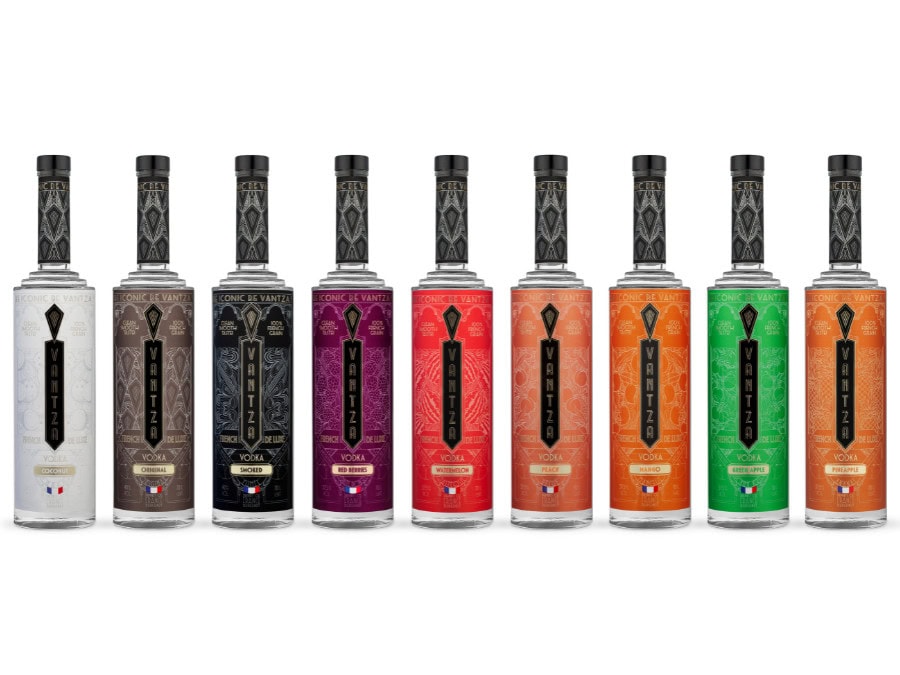
France remains Europe’s fourth-largest vodka market and premium-plus vodkas are thriving there too, growing nearly 28% in 2022, according to IWSR. One recently-launched super-premium brand eager to capitalise on this trend is Vantza Vodka – a 1920s-inspired brand released domestically in October by Bordeaux-based owner BBC Spirits. With its Art Nouveau packaging, the range comprises nine expressions, all sourced from French wheat and distilled in the country’s Burgundy region.
“We’ve already sold over 30,000 units,” reveals BBC Spirits’ marketing director, Cécile Frapsauce. “Our first focus for this range is the off-trade with hypermarkets and supermarkets. Our second step will be the on-trade through wholesalers mainly. The on-shelf price positioning is EUR29.99 [US$32.33].”
Frapsauce is confident the premiumisation trend remains healthy in France, with Millennial consumers, in particular, taking more interest in the category. Yet the figures show standard-priced brands still dominate, such as Bacardí’s Eristoff and market-leader Poliakov, owned by La Martiniquaise-Bardinet.
Last year, inflationary pressures led to a 2% dip in overall vodka volumes in France, but the dip outperformed the overall spirits market in France, which fell 4%, according to Poliakov international brand manager Maéva Fonsino.
“Poliakov showed strong growth in France in 2023, boosted by its value for money, promotions, multichannel media campaigns and the launch of its lime-flavoured innovation,” Fonsino adds. “This allowed the brand to further extend its leadership in the category, reaching 41% volume market share in the off-trade.”
Tourism revival sparks Southern European growth
In 2022, the mass return of international tourism – and resulting revival of the global travel retail channel – coupled with the reopening of the on-premise after years of Covid-related disruption to drive outstanding vodka sales in the likes of Turkey (+27.5%), Italy (+25.3%), Greece (+24.6%) and Spain (+38.3%), according to IWSR.
The same trend accelerated last year, with tourism in the EU exceeding pre-pandemic levels, according to Eurostat, the EU’s statistical office. One vodka brand to benefit was Tito’s Handmade Vodka. “American tourists and business travellers are very important to our business in Europe,” says the brand’s international MD John McDonnell. “People travelling abroad still want to enjoy their favourite vodka even when they’re away from home.
“Our duty-free business performed quite well in 2023 too, as more Americans continued to return to Europe after Covid travel restrictions,” he adds. “We’re currently in negotiation to appoint new distributors in some key markets. We also recently appointed Spirit Cartel to represent Tito’s in the UK. Our team of brand ambassadors have been busy across Europe, training bartenders and hospitality staff, and that will certainly continue into 2024. We’ve also increased our social media presence in a number of European markets, including Ireland, the Netherlands and Greece.”
Another brand thriving in Southern Europe is Diageo’s super-premium Cîroc. Later this year, the brand will release Cîroc Limonata, a lemon-flavoured extension described as “evoking the sun-drenched landscapes of the Mediterranean”. A Diageo spokesperson says: “Cîroc continues to play within the celebration space, focusing on mid- and high-tempo occasions, particularly in the on-trade.
“In markets such as Southern Europe, executing a key city strategy while activating it in our on-trade heartland has paid dividends, making Cîroc the fastest-growing super-premium vodka in Spain.”
Climate action proves a win-win
Vodka brands that place sustainability at the forefront of their marketing are increasingly driving the category’s overall direction of travel. Eco-conscious vodka launches are becoming more common, a recent example being Respirited, a sustainable British vodka made from repurposed grain spirit from the gin production process produced by Hayman’s Gin.
Meanwhile, Nordic wine and spirits group Anora is having success with its flagship expression, Koskenkorva Vodka Climate Action, described as the “world’s first vodka made from regeneratively farmed barley”.
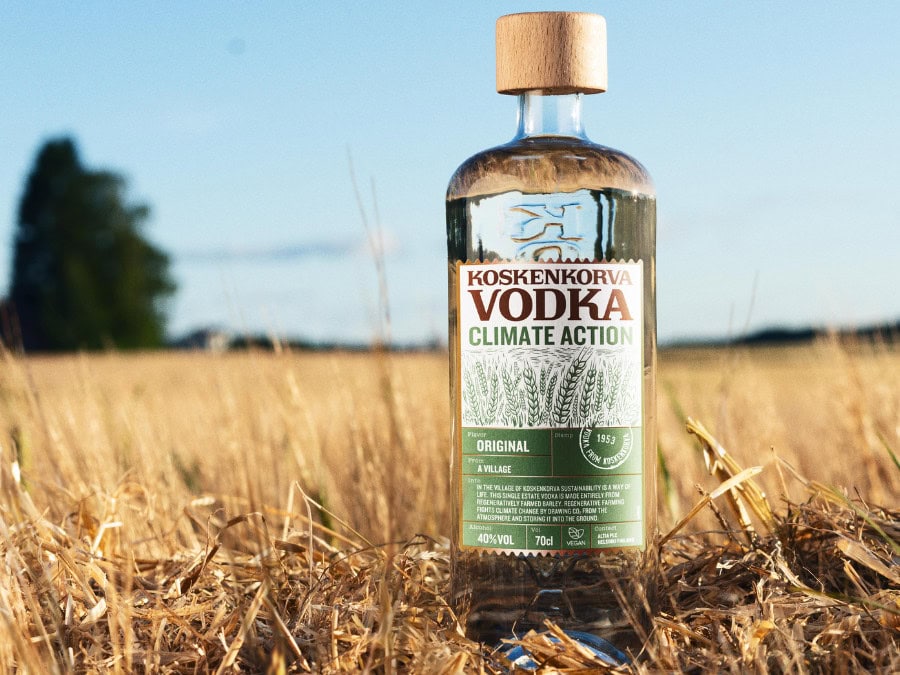
Anora’s marketing director for spirits, Suvi Reinikkala, explains: “Regenerative farming is a systematic approach to adopting sustainable farming practices that impact biodiversity and the climate positively. It aims to turn fields from emission sources to carbon sinks by increasing CO2 sequestration.
“Regenerative farming methods can offer a solution to climate-change mitigation that also benefits farmers: they help them cut greenhouse gas emissions and protect their soils, while delivering increased yields and improving crop quality. It really is a win-win.”
Last year, Reinikkala says, Koskenkorva delivered a double-digit jump in sales, with strong European growth recorded in the brand’s home markets of the Nordics and Baltics, as well as in Germany, Ukraine, Slovakia, Georgia and Switzerland.
Vodka may not be generating headlines like the trendy agave-based spirits, but farsighted brands are moving with the times by adopting the causes of Millennial and Gen Z consumers. This shift can only help the category over the long term.
This article is available to Global Drinks Intel members only.
Click below for details on how to join the Global Drinks Intel community.
Already a member?
Log in here to read the article in full.
If you work for any of the following corporate subscribers to Global Drinks Intel, head here to activate your access.
- AB InBev
- Bacardi
- Campari Group
- Diageo
- Moët Hennessy
- Pernod Ricard
- Proximo Spirits
- Suntory Global Spirits
- William Grant & Sons