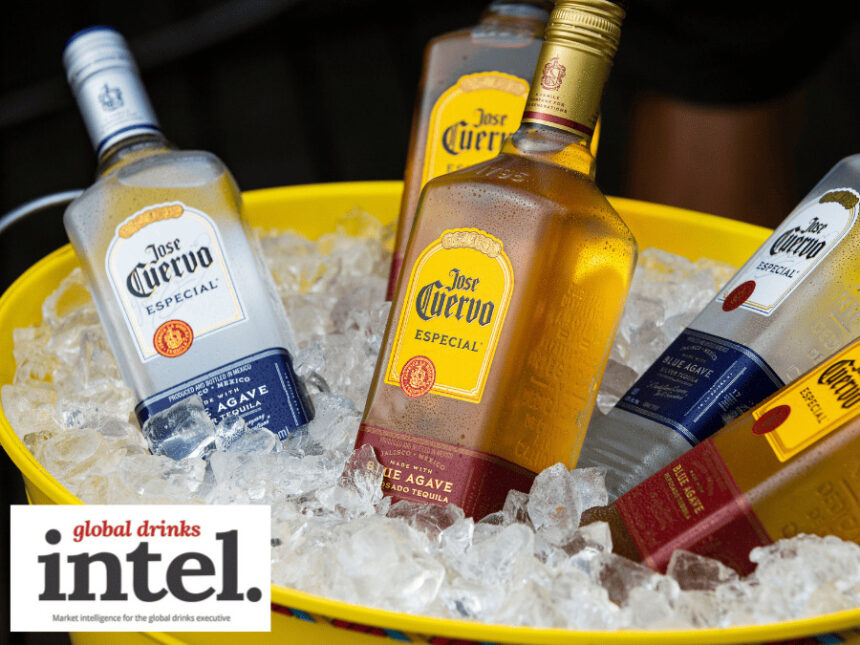
At the height of the pandemic, Proximo Spirits saw the sales of its flagship Jose Cuervo tequila brand soar. To find out how Cuervo is coping post-Covid, Global Drinks Intel met up with Manuel Orive Guajardo, Proximo’s global director for tequila & mezcal.

Global Drinks Intel: What do you do and how did you get here?
Manuel Orive Guajardo: I’ve been with Proximo here in Dublin for a year. Previously, I was based in Cuervo’s Mexico head office for more than two years.
My entire career prior to that was in FMCG, with three years in Keurig Dr Pepper and 12 years in Kimberly-Clark Mexico. I went from personal care to soft drinks to spirits.
GDI: How has your FMCG background helped in this very traditional industry and category?
MOG: Spirits and soft drinks are a marriage! Premiumisation is key – The entire experience behind luxury and premium is a world apart from soft drinks.
What I bring to the industry is the classic FMCG rigour of analysis. There’s definitely a crossover and there are benefits to both parties.
GDI: Jose Cuervo enjoyed booming sales during the height of the pandemic. Did that catch you by surprise or was this the brand’s direction of travel anyway?
MOG: Our efforts before the pandemic, when the team started working on expanding consumption occasions, paved the way. The perception among consumers had been that the shot was tequila’s signature serve. From around 2019, we started expanding Cuervo’s drinking occasions – we have refreshment, meal extensions, social extensions, long drinks, cocktails.
When home consumption peaked and people had more time to prepare drinks, a nice option for that was Jose Cuervo. Of the traditionally most popular cocktail serves, two of them are the Margarita and the Paloma; we basically own those spaces.
So, there’s a correlation between our efforts before the pandemic, the home-mixing repertoire opportunity and being the brand behind those cocktails.
GDI: Any examples of Jose Cuervo’s strategy pivot to refreshment?
MOG: For consumers who drink Gin & Tonic, for example, it’s not a big stretch to have tequila with a mixer. There’s also been a strong effort behind seasonality – the best way in, obviously, is in the hot seasons. There’s a big refreshment opportunity during spring and summer. We leveraged both the Margarita and the Paloma as offering refreshment.
The image became more about having a nice time with friends than about the late-night experience. That transformed growth both for us and for the category. As the biggest player, it’s our job to drive category performance.
It’s not an accident that the perception of tequila has changed rapidly because we’ve been driving that story ourselves.
GDI: How did you see home consumption panning out when the on-premise returned?
MOG: Home consumption provided the opportunity to educate consumers about tequila as they had time to make cocktails and try different brands and spirits. When they came out of lockdowns, they continued with that exploration.
Obviously, the pandemic itself wasn’t good, but in terms of awareness and education, Cuervo played a big role and that continued after the pandemic.
GDI: In the US, where are Jose Cuervo’s new consumers coming from? Are they existing spirits drinkers migrating across, or new entrants altogether?
MOG: It’s a bit of both. There’s a decrease in some categories such as vodka, so we’ve had recruitment there.
Given the education and awareness of tequila, we’ve done a pretty good job in securing the point of market entry. This strategy behind pushing not only shots but also refreshment has made things easier for new consumers to enter the category because there are different options.
GDI: How are you getting on with the younger, sober-curious consumers?
MOG: The key piece is education. In previous years, tequila was underpinned by ‘gold’ and ‘silver’. Now, people are more aware there’s more to it, such as ageing and cask finishes. There’s a long journey within tequila that people weren’t too aware of. Education has been pivotal to that exploration for both current and new consumers.
The consumer’s mindset is shifting from seeing tequila for shots and for getting drunk. There’s now a correlation between the journeys in whiskey/whisky and tequila, such as ageing, cask finishes, unique blends and premiumisation.
GDI: How do you premiumise a brand that is prevalent in 1.5-litre bottles on supermarket shelves?
MOG: It has to be the entire proposition. For Jose Cuervo, we have Reserva de la Familia, which is the brand’s prestige expression. We look to differentiate it from Cuervo Especial through the liquid as well as its credentials, provenance and heritage.
We’ve been making tequila for over 220 years – We’re the roots of tequila. Reserva de la Familia tells that story, not just in price but in the entire proposition.
In the US, Cuervo is a mainstream, good-quality, standard brand. In other markets, it’s very much approaching premium and already has quality credentials that we’ve built over time.
Now that tequila’s moved away from just shots, it’s being seen as more interesting. It’s also considered a very natural product with an exotic nature – that adds value. So, Cuervo’s in a good place with strong equity in most of our markets and with a ladder for consumers to trade up.
The future outside the US will be a strong Cuervo brand, with brands like 1800 building much faster in a different segment.
GDI: How are Proximo’s more-premium tequilas performing both in the US and outside of your key markets?
MOG: 1800, which sits in super-premium, is a good example. In 2022, the brand hit almost 2m cases in the US. That’s a strong base, if you take into account the entire agave-based spirits worldwide is around 48m cases.
That’s the power within our portfolio in different tiers. We have Jose Cuervo to secure the standard segment, and then another brand that’s doing a tremendous job securing super-premium and upwards.
GDI: Does the current macroeconomic environment provide a challenge for consumers moving up the price ladder?
MOG: Year-over-year for agave-based spirits, prestige tequila’s mix is pretty much the same at around 1%. The stronghold remains within standard, premium and super-premium. There’s still an appetite among consumers to spend more as long as the proposition and the benefits are clear.
As an industry, we’ve been lucky that when there have been recessions, we haven’t seen a big drop off in premiumisation. So far, we haven’t seen a lot of evidence of trading down. The great thing is we have a big tequila portfolio, so if there was a move down to standard, we can benefit from that.
We’re not as exposed as a company that is purely super-premium-plus. We have a wide portfolio deployment.
GDI: What proportion of Cuervo’s tequila sales are in the US and Mexico compared to the rest of the world?
MOG: Combined, it’s 83% – 26% is Mexico and the remaining [57%] is the US and Canada.
GDI: How comfortable are you with being that reliant on so few markets?
MOG: The group’s very happy that Europe, the Middle East & Africa and Asia Pacific are growing fast. The US is obviously a monster and has done extraordinarily well for the company. In terms of base percentages, though, the other regions tend to grow faster. Finally, after all these years, these other regions are future hotspots of growth for tequila.
In the US, tequila accounts for about 15% of total spirits – in the rest of the world, it’s at around 1.5%. It’ll take time to match those US percentages, but if Tequila got to 5%, then that would be massive. There’s a lot of green space out there and a much lower level of competition – Tequila companies globally aren’t quite as embedded as they are in the US.
GDI: What’s keeping you occupied in mezcal?
MOG: Mezcal’s proportion of agave-based spirits is still small. We’re getting a lot of bartenders becoming interested in mezcal and we have an extensive range to offer – from our 400 Conejos brand to Creyente, which is its trade-up. There are connoisseurs who are aware of the category, but it’s hard for people to become aware of mezcal without having an awareness of tequila. Once you understand what tequila’s about, you also understand mezcal.
It’s a lovely bonus for us – we’ve got this big job to do on tequila, so mezcal’s the cherry on top. It’ll be organic discovery rather than the industry pushing it heavily, a bit like single malt whisky.