

This interview was published for Global Drinks Intel subscribers in August. For details on how to join them, click here.
It’s World Water Week and to mark the occasion, Global Drinks Intel sat down with Michael Alexander, the head of water, environment & agriculture sustainability at Diageo.

Global Drinks Intel: What areas do you oversee?
Diageo global head of water, environment & agriculture sustainability Michael Alexander: In 2021, we published ‘Spirit of Progress’, our third ESG plan, which sets out our commitments and priorities for the next ten years. It includes our net zero carbon plan, positive drinking, diversity & inclusion and what we call grain-to-glass sustainability. There’s also a lot on water, packaging and regenerative agriculture.
I have overall responsibility for the climate and water agenda, but that hooks into a lot of other areas – it’s about people, climate, nature and the environment. That integration is really important, to make sure we don’t lose sight of the fact that we need to have a consolidated approach and not be siloed. That’s core to our strategy.
Diageo’s got a big footprint in the southern hemisphere, in highly water-stressed areas such as Mexico, Brazil, Nigeria, Kenya, India and Turkey. The impact of climate change is apparent right now and we’re responding proactively.
GDI: Have you become much busier in recent years?
MA: I’ve always been busy but in the earlier years – I joined Diageo in 2007 – there were fewer of us. There are more of us in the global sustainability team now, and also the bar’s been raised in terms of external expectations and disclosure-wise. It’s a very different playing field now compared to, say, 2010. The acceleration has been very fast in the last five years.
GDI: Beyond looking out of the window, what – or who – has driven your rise of profile in the business?
MA: There was a big sea change three or four years ago, partly due to disclosure requirements and regulations. The setting up of the Task Force on Climate-Related Financial Disclosures [TCFD] was a game changer. It’s now mandatory for us to report on our climate risk and what we’re doing about it.
There’s definitely been increased investor interest, especially from ESG analysts working for investment managers. Our stakeholder expectations have risen.
The jury is probably still out on consumers. We don’t get a lot of consumer inquiries about the carbon footprint of a pint of Guinness, for example. But, I think that’s coming. We’ve done some research recently that indicates that water and climate are accelerating in consumers’ interests.
GDI: As a listed company, though, Diageo has a duty to its investors to deliver growth.
MA: Our approach is to try to decouple growth from environmental impact. In Kenya, for example, we’ve invested significantly in biomass – we’re using macadamia nut husks to power one of the biggest breweries in East Africa. That decouples our growth: We can continue to grow without increasing carbon emissions.
That’s more difficult with water, which is already renewable, it’s just scarce, or it’s in the wrong places or it’s being wasted. Water risk isn’t always about availability or scarcity – it might be around quality or temperature, for example. There are very complex dimensions to water, which is our number one climate risk.
GDI: Where geographically are the alarm bells ringing the loudest?
MA: In our disclosure this year, we paint a picture of what happens by both 2030 and 2050. We use a combination of online databases and on-the-ground information to analyse water. Unlike carbon, water’s very contextual. and very multi-dimensional. Carbon is pretty much you’re either emitting it or you’re not.
We look at different climate profiles going forward – we’re trying to understand which pathways the world’s temperature is going to take. It’s evident that in the next five years, water stress in its broader sense doesn’t look as though it’s going to get significantly worse. The 2050 outlook is much more significant with much higher stress coming in.
Very few of our crops are irrigated – around 90% are rain-fed. That makes a big difference because they’re dependent on rain cycles, which are getting more unreliable. The unreliability is probably the most important part. Our small-hold farmers can’t rely on irrigation to fill the gap if there’s no water, that’s why we need to increase our support for them.
At the moment, we’ve got 35-40 sites that are water stressed. Push that out to 2050, and that might increase quite significantly.
GDI: Could you share a case study of a project that has sailed closest to being the silver bullet?
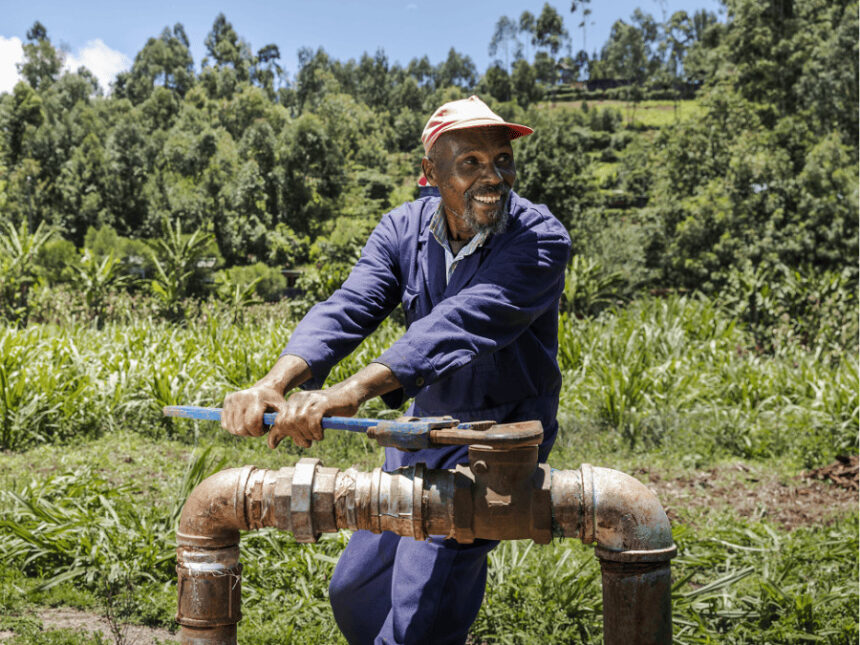
MA: Many of our projects are about providing clean drinking water, which unlocks the potential of communities – they’re not spending so much time fetching water, it’s beneficial to their health and it addresses gender inequalities. If there was a silver bullet, then it’s providing clean water and sanitation. There are so many benefits that go with the principles of clean water. I only wish we could do more of it.
And it’s not a philanthropic, charity programme, it’s more multi-faceted than that. We’re also discussing the price of sorghum, for example, with these farming communities at the same time. If it wasn’t related to our supply chain, then it would feel discretionary. We’re trying to make those communities more climate resilient and by doing so, we’re making our business more climate resilient because we’re adapting it to the impacts of climate change.
GDI: How deafening is the ticking of the clock for you from future target deadlines?
MA: Targets – particularly external targets – are very important, because they hold us to account and drive us in the right direction. We chunk up targets in years. They don’t feel that far out, because we have a target for fiscal 2024.
Targets are a bit of a simplistic lever to use, but they’re really effective when you factor them into KPIs [key performance indicators] and relate them to business performance and remuneration.
There are some targets that are easy to put a number on and others that aren’t, particularly with water. We can do these nice water projects, but unless we’re working with the local water authorities and with other users of water in that area, it probably won’t help the whole catchment be more resilient. We need collective actions with multiple stakeholders. This is slightly uncomfortable territory because we don’t actually know what our ROI [return on investment] is going to be.
If we help farmers that aren’t ours to use water more efficiently, then that’ll help us when we’re drawing water for our brewery downstream. Water is a shared risk.
Yes, KPIs are very important, but equally, we’ve got to plan more strategically to recognise there are areas that we can’t necessarily put a KPI or ROI on because they just can’t lend themselves to that – these are more systemic changes.
GDI: Do you sleep well?
MA: This collective approach is my biggest challenge at the moment. I go to quite a lot of global meetings – such as the UN Water Conference and COP – and I do get frustrated. I’m a bit impatient for change and that keeps me awake. I want the penny to drop for others like it has with us, in terms of an integrated approach and the need to collaborate.
You’ll see more collective action in water going on, but it’s just not fast enough and it’s not at the scale we need. But, otherwise, I do sleep okay. Thank you for asking!
This interview was published for Global Drinks Intel subscribers in August. For details on how to join them, click here.