

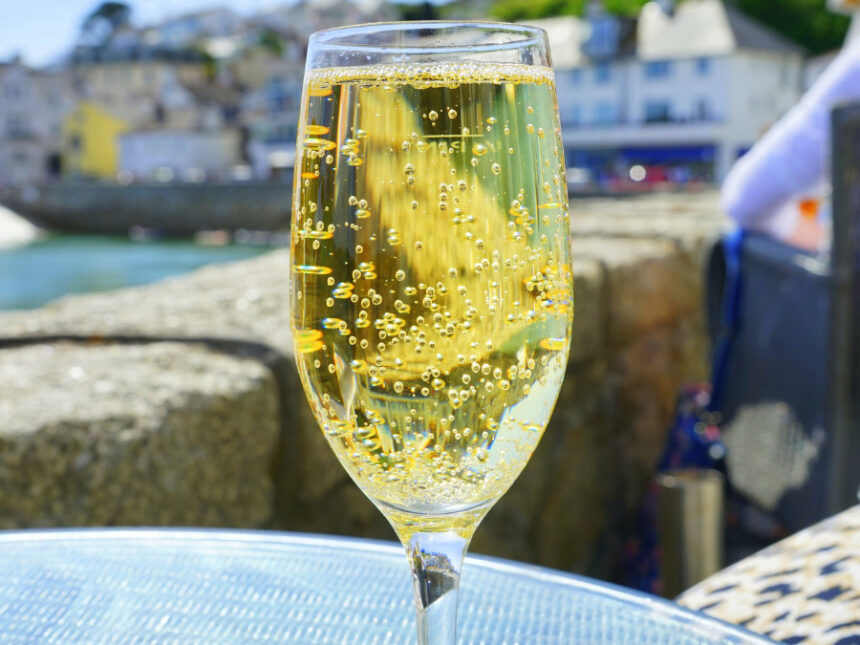
I first encountered English sparkling wine on a trip to London in 2017; a sample being poured at a stall at the city’s Borough Market.
Fresh from my Certified Sommelier exam, I freely admit I was unaware that wine of any kind was being made in England. Nothing about its storied climate – cool, grey, damp – was especially vitis vinifera-friendly from everything I’d learned. Perhaps it should have been a clue, however, that the week I was there it was warm, sunny, and temperate.
Having made several trips to the UK over the past few years, during which time the industry has expanded exponentially, I’ve become a disciple of the category. So much so that I’m placing my bets now: English sparkling wine is ripe for a ‘Judgment of Paris’-style standoff with Champagne.
Through a combination of climate change, favourable soils, available land and rising talent, England’s wine industry, and especially its sparkling wine segment, has started to gain serious traction among consumers. [England generally being in the spotlight of late with this year’s coronation of King Charles III also doesn’t hurt.] According to a 2022 report by trade association Wines of Great Britain, England lays claim to 195 wineries, with vineyard plantings up 70% over the last five years.
While there’s still time to be the person in your social circle who introduces everyone else to this growing, fascinating category, here’s a beginner’s guide to English sparkling wine.
The history
It’s not that wine production has been a recent development in England: Honeyed still wines from English soils were being produced since many, many monarchs ago. Warming temperatures and changing import tax laws, along with a general stirring in the 1980s and ’90s toward export-worthy wines in many international wine regions, have created an environment in which the country’s producers started making wine with the intent to be competitive beyond its shores.
Meanwhile, the warming climate has provided the impetus to lean more fully into the still cool-climate pedigree that saw the beginning of the sparkling wine industry in England.
Many sources point to Nyetimber, whose vineyards were planted by Stuart and Sandy Moss in 1988 to produce traditional-method sparkling wine, as being the genesis of contemporary English winemaking. Nyetimber went on to win major international competitions with some of its first bottlings, raising the profile of what the area could hope to achieve, and the growth has been exponential since. Indeed, several French Champagne houses have even snapped up land to get into the English sparkling game.
The regions
The majority of winemaking in England is centred around its southern-most counties, particularly in Kent, East and West Sussex, Hampshire and Surrey. It is worth noting that, as the crow flies, southern England is closer to Champagne than just about any other traditional method-focused sparkling wine region in Europe, with the exception of the cremants of Loire and Burgundy.
Several central and western counties in the southern part of England are also experiencing rapid growth. Cornwall boasts one of the oldest producers of English sparkling – Camel Valley – while wineries in Devon and Dorset are becoming dark-horse favourites among the category’s obsessives. Stephen Spurrier, the famed English provocateur of the 1976 Judgment of Paris, began his winery, Bride Valley, in Dorset, producing the first vintage in 2011.
The grapes and the soil
Prior to the rise of sparkling wine during the late 1980s and early 1990s, English winemakers primarily made still wines, favouring German grapes such as Müller-Thurgau and Reichensteiner. It was the Nyetimber plantings that introduced classic Champagne grapes to the region [in a move reminiscent of Trentodoc in the early 1900s], Stuart and Sandy Moss aptly recognising that not only the cool climate but also the chalky limestone soils of the southern counties presented ideal conditions for a Champagne-esque expression. Chardonnay, Pinot Noir and Pinot Meunier are now the most widely planted grapes in the country by a large margin. Bacchus, Seyval Blanc, Solaris, Reichensteiner, Rondo, Pinot Gris, and Müller-Thurgau round out the top ten.
The producers
In addition to Nyetimber and Camel Valley, other large or notable producers who have had a significant role in the development and recognition of the category include Gusbourne [which produced the official sparkling wine for Queen Elizabeth II’s Platinum Jubilee in 2022, and is probably the easiest to find in the US], Chapel Down, Harrow and Hope, Wiston Estate [which comes with a South African winemaking pedigree] and Breaky Bottom.
The modern way
In addition to the classic, traditional-method sparklers that helped bring attention to England’s wine industry, champions of the category also cite various iconoclasts who are using the rising moment to colour outside of the lines of classic Champagne-style wines. Pétillant Naturels, sparkling reds and traditional method expressions that use grapes other than the big three are starting to attract similar attention. Producers such as Westwell, Langham, Blackbook, Coates & Seely and Hundred Hills are among those considered ones to watch.
The where’s
As of the end of 2022, only 4% of English wine was being exported, but this is also on the rise, and the US is just behind Scandinavia in terms of where most of those wines go outside of the UK.
If travel to the country is on the cards, you don’t necessarily need to winery hop in order to enjoy these wines. In London, there are many restaurants featuring at least one English sparkling by the glass, and a handful by the bottle. To go a little deeper into the category, several restaurants and bars that feature more than one option include La Trompette, Oxeye, Sussex and The Wine Bar at Fortnum & Mason [also a good place to pick up a few bottles to take home, and London’s oldest department store]. Among several urban negociant wineries, London also sports one estate, Forty Hall Vineyard, which is accessible via public transport.
This article was initially published by The Alcohol Professor, a US-based online “homeroom” that covers beer, cocktails, spirits and wine along with travel tips, book reviews, bar reviews, recipes and videos.