

This article was initially published in the April issue of Global Drinks Intel magazine. For details on how to subscribe click here.
The fight to grab the consumer’s attention on retail shelves intensifies as American craft distillers proliferate and major producers expand their portfolios.
In 2006, the US was home to about 75 craft distillers. At the time, this was viewed as a huge number as a decade earlier this subgroup didn’t really exist. Most of the 75 focused their efforts on producing then-popular vodkas and gins, conveniently quicker and less expensive to make than brown spirits. In fact, during the 1990s, American whiskey sales had been so tepid that some distilleries were mothballed and their remaining stocks bulked off.
Yet, according to the American Distilling Institute, by last year the number of American craft distillers had exploded to 2,283, with most operating in the increasingly glamorous whiskey category or scrambling to do so, even if only finishing whiskies that had been distilled elsewhere. Moreover, seasoned producers often had multiple whiskey put-ups, from Bourbon to rye to single barrels to something called single malts.
But, craft is only a small part of overall whiskey/whisky sales in the US. The big brand owners, such as Brown-Forman and Heaven Hill Brands, remain the backbone of the category with multiple brands and SKUs, while imported whiskies from traditional areas such as Scotland, Ireland and Japan are now being joined by whiskies from England, France, India and practically any country that grows grain.
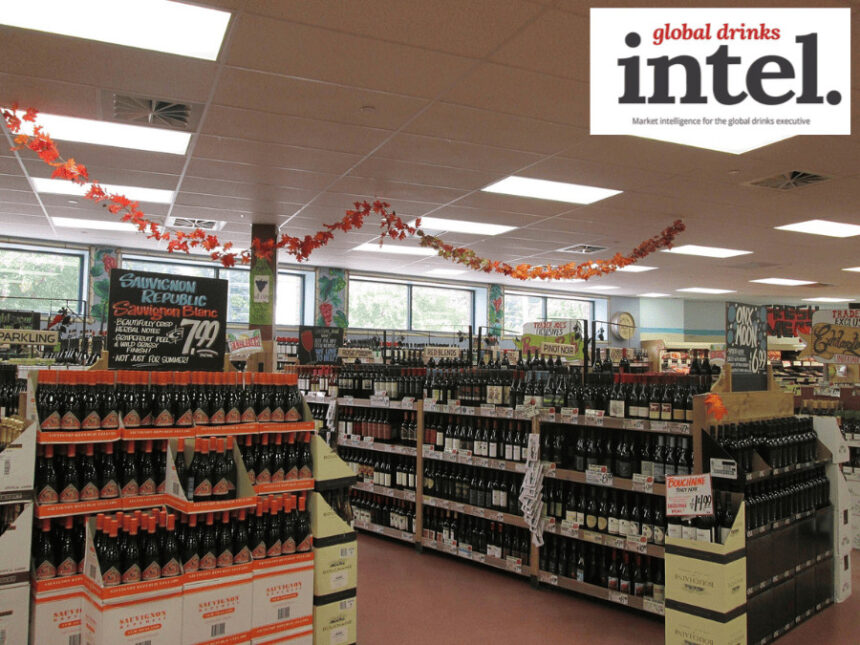
This all poses a question: Even if American consumers have gone whiskey/whisky mad, how much shelf space can bricks-and-mortar retailers devote to these thousands of whiskies for their increasingly venturesome customers to choose from?
For small producers, selling direct-to-consumer at the distillery, especially during their start-up period, is one way to get in front of consumers. Online marketing is another. But, as post-Covid buyers return to retail outlets to browse and get advice from sales staff, previously online-only distillers are feeling the pressure to find shelf space, hopefully at eye-level or next to higher-priced brands.
Lost Lantern, for example, is a US independent bottler patterned after those in Scotland and England that buy barrels of liquid from distillers and then blend or finish them. Initially selling online only, Lost Lantern now goes through a traditional distributor to the off-premise in California and plans to move into other states. “As the Lost Lantern brand matures,” says co-founder Adam Polonski, “we need to be in retail the way independent bottlers are in Scotland. We’ve also hired our first salesperson for California.”
Two sides to the whiskey boom
As the whiskey/whisky category has expanded in the US, so retailers of all sizes have scrambled to adjust. “Over the past five years, retailers have shifted and evolved in how they display whiskey,” says Heaven Hill’s VP for American whiskies, Susan Wahl. “There’s not just a whiskey aisle as there used to be. Now, stores have large sections separated like wine into categories. Some even have separate craft areas.”
Vodka extensions, especially flavoured ones, have been the first to yield space. While these expansions are welcomed, they have meant more competition for shelf space as new entrants increase and traditional players expand their portfolios. And, for the major producers and distributors, getting on a retail shelf is not enough.
“We’re only the seventh-largest distributor, so we fight tooth and nail for position in the bottle shop,” says Winebow’s VP for spirits, Monique Huston. “There’s the consumer perception, for example, that it’s important where a bottle is positioned. If something they look at seems too expensive, then they’ll look at what’s around it for an alternative.”
Michael Bilello, executive VP for strategic communications & marketing for trade group Wine & Spirits Wholesalers of America, agrees that product placement is crucial. “Shelf placement at retail and getting a prominent positioning on the back bar [in the on-premise] can be key to success for a new brand,” he says. “A supplier isn’t allowed to offer any incentive to a retailer or bar owner for preferential placement. In most retail settings, the retailer has a shelf philosophy that will largely dictate where your product will be merchandised.”
The methods by which brand owners seek to expand and improve shelf space fall within three approaches – improving the partnership with their distributor, introducing measures to entice consumer pull-through and working directly with retailers on the front lines.
Partnering in planning – and in the trenches
Distillers are like parents; all their offspring are equally beautiful and deserving of attention. Consequently, distributors usually push back – as do retailers – against taking a total portfolio. Luis Gonzalez is CEO of one of the most successful craft distillers, Colorado-based Old Elk Distillery, which in seven years has grown to annual sales of 100,000 six-bottle cases and a presence in all 50 states. “You need to harvest what the market and industry needs,” he says, “and then ask if your distributor thinks the same way. If so, how can you collaborate? If we’re launching something new, we talk with the distributors first and get their agreement.”
At the same time, Heaven Hill’s Wahl thinks the subcategorisation of whiskies favours profitable line extensions. “We ask how we can take advantage,” she says. “People are familiar with our Elijah Craig Bourbon, for example, so we now have an Elijah Craig rye.” Gonzalez believes line pricing of multiple offerings is a mistake. “Producers who have multiple placements at [retail multiple] Total Wine spread them out at different price points,” he observes. Winebow’s Huston concurs: “You have to ask the question, if you have something new coming, what is leaving? Is it your rye? Is it something funky like a flavoured whiskey?”
Ryan Maybee, co-founder of J Rieger & Co in Missouri, says toiling in the trenches with distributors is equally important. “We have professional sales representatives working directly with 12 different distributors in 27 states to set goals and determine how they need to cooperate,” he says.
Don’t wait to be asked for
When looking to get onto a retailer’s shelves, what can a brand owner do when told, “No one ever asks for you”? Although expensive, marketing activity certainly motivates consumers to try the ‘bar call’. Uncle Nearest is a Black-owned, women-managed whiskey producer founded in 2017, whose name honours the Black man who taught Jack Daniel how to make Tennessee whiskey. “When Uncle Nearest set out to grow, ” says chief business officer Kate Jerkens, “we invested heavily in promoting to the on-premise. We call it having a ‘mental capability’ – Seeing our bottle at a bar is very important to us. As well as contributing to depletions, it’s also great marketing for off-premise sales.
“If your sales consultants call on both on- and off-premise accounts, they can tell a retailer, ‘We’ve got the brand in ten bars within a mile of you’ – and vice versa.”
Advertising, endorsements, event sponsorship and affinity programmes all get brands noticed. Heaven Hill has promotions for its Evan Williams brand that honour ‘American Heroes’, while its Team Elijah Craig and charity-linked 19th Hole PGA campaigns aim to extend “the fan experience beyond the course”. Uncle Nearest recently completed an online promotion called the ‘Historic Black Colleges & University Old Fashioned Challenge’, donating US$1 for every Uncle Nearest Old Fashioned cocktail purchased in participating bars. “The key is to have a strong consumer-facing promotional programme that motivates them to support your brand,” says WSWA’s Billel.
Closing the sale
“Selling fine whiskey/whisky in retail stores is becoming more like selling fine wine,” says Wahl. “It’s becoming a ‘hand sell’,” and is therefore key to getting a good shelf position.
That starts with relationship-building through brand representatives and ambassadors. Education initiatives are key. “Where regulations permit it, we do a lot with sales consulting,” Huston says. “We strongly believe first and foremost in the value of education.”
Another way to build relationships is to provide operators with access to rare or special expressions. While bundling products can be legally difficult in some states, “you have to let the stores know that to get rare bottles, they also have to support less-expensive bottles in the portfolio”, says marketing consultant Eric Kim.
Providing single-barrel bottlings specifically for retailers is another relationship builder. “We thrive on single barrels,” Huston says. “There’s a lot more work in supporting single barrels, especially more paperwork, but we have a ton of single-barrel producers in our portfolio. It’s a category that’s exploded.”
Helping personnel with POS promotions, meanwhile, builds relationships with store staff. Valuable tools in catching the consumer’s attention include staff-pick tags on bottles, ‘shelf talkers’ with details about the product, and posts of point ratings. Using QR codes and fancy packaging are also good tactics. And, of course, providing liquid for consumer tastings and running bottle-signing sessions by distillers can achieve in-store attention.
Newer initiatives, especially those using social media, continue to evolve. Industry veteran Kris Comstock is launching a service called Stockwell Reserve Brands to collectivise the efforts of multiple craft distillers to provide critical mass in competing with larger producers. As a result, national distributors are continuing to discover successful regional brands.
To Gonzalez, it begins with having the right attitude. “There’s a phrase we use when planning how we should operate in getting into stores and onto shelves,” he says.
“Use sanity versus vanity.”
This article was initially published in the April issue of Global Drinks Intel magazine. For details on how to subscribe click here.