

This article was initially published in the March issue of Global Drinks Intel magazine. For details on how to subscribe click here.
Boasting the world’s most revered beer culture, Brussels is not known for its creative mixology or distilling prowess. But, innovative new mixologists and craft distillers are starting to make their mark.
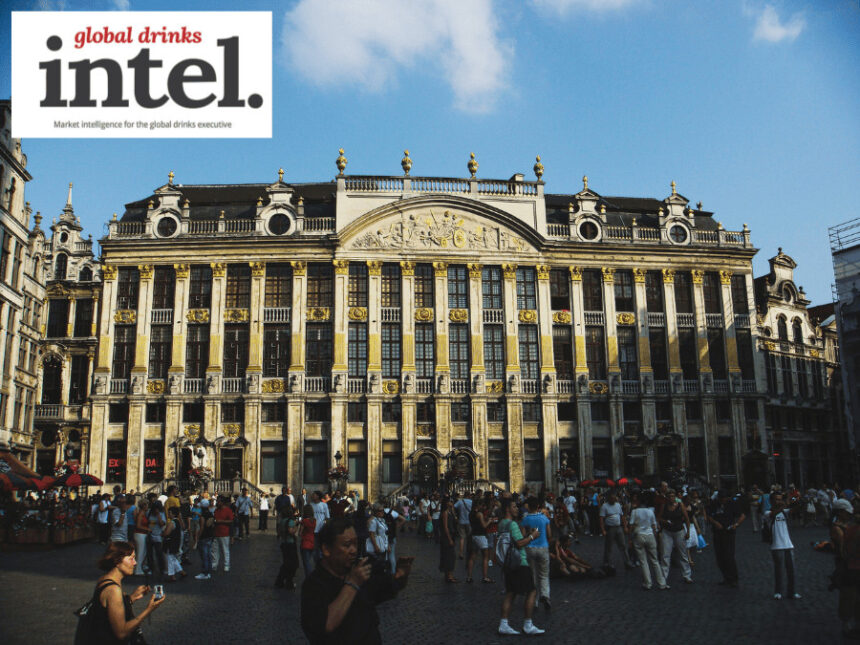
The capital of both Belgium and the European Union is many things to many different people. For lovers of good food and great dining, it’s a gastronomic city par excellence, at the centre of a culinary landscape that once boasted more Michelin stars per capita than any other country in the world, and still ranks within the top five. To fans of architecture and design, it boasts what is arguably the most beautiful square in Europe, the ornate, gilded Grand-Place.
For drinks aficionados, Brussels is the heart of what remains, even in the wake of the global craft brewing revolution, the world’s most diverse and revered beer culture, reinvigorated in the 21st Century by the opening of over a dozen new breweries.
What this city of 2.1m residents is not known for is being a hub of creative mixology, or a centre of distilling prowess. But that appears to be now changing.
The scene
At the dawn of this century, Brussels boasted dozens of great bars and cafes where you could find beers from all corners of the country. It was also home to just the one brewery, legendary lambic producer Cantillon, then – as now – located mere metres from the Gare du Midi.
Today, while the cafes continue to serve a culturally-diverse populace that ranges from affluent ‘Eurocrats’ to an immigrant community that makes up in excess of one-third of Brussels’ total population, they’ve been joined by brewery taprooms and, even more recently, a new generation of cocktail bars.
Beer specialty cafes abound throughout most neighbourhoods in the city, including establishments both older, like the Manneken Pis-adjacent Poechenellekelder, and newer, such as Moeder Lambic on Place Fontainas and the vegan-friendly Sister near the Grand-Place. Such is the importance that Belgians typically place on beer, though, that almost any bar or restaurant is likely to offer a selection of at least a half-dozen good-to-excellent domestic selections, and occasionally a few imports from neighbouring countries.
As they tend to require fairly large spaces, breweries, with the exception of the 123-year-old Cantillon, tend to be located more towards the outskirts of the city, with many, including En Stoemelings and Brasserie de la Senne, clustered along the banks of the canal that traverses the city’s north-west.
As befits their greater need for foot traffic and far smaller spatial requirements, most of Brussels’ cocktail bars are based in or near the city centre, with only a handful, including The Modern Alchemist in St-Gilles and Ethylo on the perimeter of Parc Josaphat, venturing further afield.
The trends
In contrast with days gone by, when locally-brewed beer offerings were few and far between, today the 15 or so operators with bricks-and-mortar breweries – as opposed to agencies that contract others to make their beer – find strong support among local cafe owners and operators. “A lot of the local bars now support the local breweries,” says Yvan De Baets, co-owner of Brasserie de la Senne, “It’s probably not the majority, but it’s massive compared to the situation in the recent past.”
Another recent change in the beer market has been a rise in consumer interest in draught beer, particularly within speciality beer, which is in contrast to the traditional Belgian preference for bottled beer. “In craft beer bars, there is a sort of competition to have a lot of draught [lines],” says De Baets, tempering his statement by noting that this has only led to a “small increase” in his brewery’s draught sales.
As a young and still-developing segment – barely six or seven years old, and much of that spent under Covid-19 restrictions – it’s difficult to talk about trends in Brussels’ cocktail scene. However, according to Tania Shamshur, who co-own Edgar’s Flavors with Mario Russello, even in such a youthful market, customers are tiring of extravagance.
“The major trend in the city is ‘less is more’,” she says. “[People want] simplicity in cocktails – no more massive garnishes and all the extras.”
Along the same lines, Karoline Vlk, who co-owns pioneering cocktail bar Life is Beautiful with Harouna Saou, cites “efficiency” alongside “seasonality and sustainability” as important movements within the local scene, although she also cautions that trends are very much a relative concept among Brussels’ mixologists.
“Everybody is really doing their own thing, making their own creations,” she says, “so I can’t really say that there are proper trends here.”
The local players
While one can’t ignore the influence in Brussels of the world’s largest brewing company, the Belgium-headquartered Anheuser-Busch InBev, inroads are being made by a new generation of much smaller breweries.
Arguably the highest profile Brussels brewers, aside from the venerable Cantillon, are Brasserie de la Senne and the Brussels Beer Project, both of which contracted their beer for a time before opening physical breweries (although it deserves noting that de la Senne has been brewing for considerably longer). Other notable, though much smaller, brewers include Brasserie de la Mule, Brasserie de l’Ermitage and La Jungle.
On the spirits side, Belgium’s other national drink is genever, sometimes spelled jenever, which has seemingly fallen out of favour with the latest generation of the country’s drinkers. So much so, in fact, that it can sometimes be difficult to find in Brussels bars.
As elsewhere, however, whatever slack was left by the decline of old-school spirits has been picked up by a growing cadre of craft distillers, including potato vodka producer De Cort, located about a half-hour outside of Brussels, Wallonia’s Biercée and Dada Chapel in Gent [both identified as favourites by Shamshur of Edgar’s Flavors], and Atelier Constant-Berger [highlighted by Sébastien Bourdain, who co-owns The Modern Alchemist with Benjamin Deniel and Christopher Ducat].
Curiously, none of the bar owners we spoke to displayed any particular enthusiasm for the handful of distilleries operating within Brussels.
The international players
It’s difficult not to notice AB InBev in Brussels, such is the predominance of signs advertising – and draught taps pouring – Stella Artois and Jupiler, the company’s two principal Belgian lager brands. After AB InBev, one notes the presence of Heineken-owned lager producer Alken-Maes and, in a peculiarity unique to Belgium, Duvel Moortgat, the flagship product of which is the 8.5% ABV Duvel.
The spirits equivalent of the AB InBev behemoth is, unsurprisingly, Diageo, according to Life is Beautiful’s Vlk. “Diageo is omnipresent,” she says, adding that Bacardi is also very active in the Brussels market, while last summer saw increased visibility for Campari’s Aperol and Pernod Ricard’s Lillet brands. Still, laments
the Modern Alchemist’s Bourdain, “there’s not a lot done (in terms of promotion and events) in Brussels, or even in Belgium.”
Challenges & opportunities
As voiced by bar owner after bar owner, the greatest challenge facing Brussels’ on-premise is the recovery from Covid restrictions.
“Before the pandemic,” says Bourdain, “we were thinking about opening a second bar, but Covid totally drained our bank accounts as the government barely helped us. Without any margin for error, we need to be more careful about expenses and [even] had to get rid of our only employee.”
Shamshur concurs: “We didn’t have much government help in Brussels during Covid, compared with other parts of Belgium – when you’re forced to close and still pay rent, you will feel it in your company’s bank account.”
Among the handful of concessions the Brussels hospitality industry did receive from the city was the ability to enlarge their streetside terraces, something Vlk says is being cut back now, but not to pre-Covid levels. The pandemic also prompted many bars to launch proprietary lines of bottled cocktails, another element that most if not all continue today.
As for what’s next, while Bourdain notes that, post-Covid, customers appear to be “ordering less and leaving earlier”, other owners believe that the youthfulness of the cocktail market allows for plenty of expansion potential.
“Brussels is a city where people are really into beers and wine,” says Shamshur. “I think in the future, Brussels will be recognised more as a city with a great cocktail scene [with] more and more bars providing quality drinks and great hospitality.”
This article was initially published in the March issue of Global Drinks Intel magazine. For details on how to subscribe click here.