

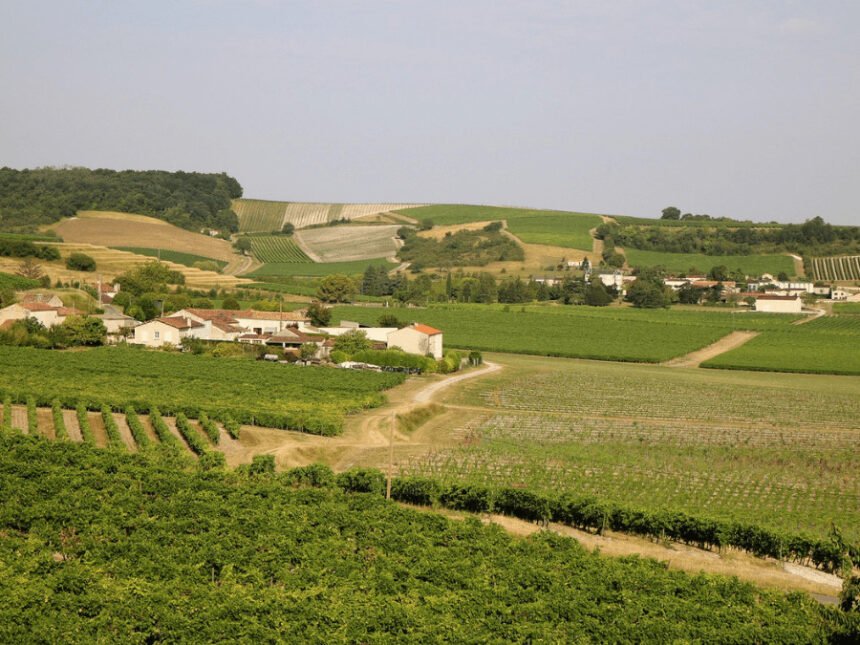
Traditionally, Cognac is a blended spirit, distilled from grapes grown across the eponymous region in southwest France. For centuries, rather than zeroing in on a particular site, producers have used a mix of grapes from different crus, or growing regions.
That’s starting to change.
Over the last couple of decades, smaller producers have begun releasing single-estate Cognacs, designed to showcase the terroir of distinctive vineyard properties. While this concept isn’t earthshaking in the world of wine, for Cognac, it’s almost revolutionary.
“From the beginning of the Cognac business, houses blended different batches from different years and different districts,” explains Eric Forget, cellar master at Hine, a small Cognac house founded in 1763. “This was done for only one reason – to produce and maintain consistency in taste.”
Although most Cognac stems from a single white grape variety, Ugni Blanc, fruit quality and character vary from region to region. “To make something stable in time, you have to play with these differences, as they do with Champagne,” says Forget. “They mix different years from different districts and different terroir to maintain the same character and quality.”
Today, producers including Hine, Francis Abécassis, Camus and a handful of others are forging a new tradition with terroir-driven, single-estate Cognacs.
The taste of terroir
Blending is a boon for Cognac producers, allowing them to make consistent, high-quality products every year, no matter what nature throws their way. So why mess with a good thing?
For Forget, it’s about showcasing Hine’s best vineyard – and having a little fun. In 2005, he created Hine’s first single-estate Cognac from the Bonneuil property, located in the prestigious Grand Champagne cru.
“We decided to release vintages from Bonneuil because the terroir of this estate is one of the best in Grand Champagne,” he says. “We selected 20 casks just for fun, but some people fell in love with the product.”
Following the success of the first release, Hine created Bonneuil offerings from the 2006, 2008, 2010 and 2012 vintages. Using fruit from a single vintage provides additional distinctions. “If you compare our Bonneuil vintages,” says Forget, “some are more fruity and some have a little more body, because the weather is different.”
Family-owned Camus, meanwhile, highlights a different cru in its Borderies Signature XO and VSOP expressions. Based in the town of Cognac, the house dates back to 1863 and launched its first single-estate Cognac in 2000.
“The Camus family has its roots in Borderies for five generations,” says sales director Daniel Tindal, adding that the house is the largest vineyard owner in the small, sought-after cru. This allowed Camus to create two products from its estate.
Standing tall among giants
With the ‘Big Four’ Cognac houses of Hennessy, Martell, Rémy Martin and Courvoisier representing the vast majority of the category’s sales, releasing single-estate products is more than a way to showcase terroir; it’s also a strategy for smaller, independent producers to find their own niche in the market. That’s what Francis Abécassis, who founded Domaines Francis Abécassis in the early 2000s, had in mind when he launched ABK6 Cognac in 2005.
As a newcomer to the region, he seized the opportunity to create a new business model based on single-estate products. This concept came naturally to Abécassis, who made wine with his family in southern France for decades before moving to Cognac. “In the world of Cognac, everything was fixed,” says Abécassis of his arrival just over 20 years ago. “Cognac is for old people – for rich people.”
Instead of buying eaux de vie – the distilled grape spirit that forms the basis of Cognac – from affiliated farmers and distillers as most houses do, Abécassis and his team handle everything, from farming to bottling.
“My goal was to create a house of Cognac, not by being a broker but by being a farmer,” says Abécassis, who now owns 370 hectares of vineyards in the region. “At the beginning, [the big Cognac houses] were wondering, ‘Who is this crazy guy?’”
Today, Domaines Francis Abécassis has three brands: ABK6 – specifically designed to appeal to a younger audience through non-traditional packaging and products – along with Leyrat and Réviseur. Among the company’s many single-estate offerings are the ABK6 VSOP Single Estate from Fins Bois, the Abecassis Grand Champagne XO and VSOP, and the Réviseur Cognacs from Petit Champagne.
“Depending on the soil and the place, you have different expressions,” he says, “It’s very similar to wine.”
When houses combine eaux de vie from different estates, he adds, site distinctions blur. “In the classic business model, they blend the Fins Bois with the Petit Champagne with the Grande Champagne with the Bons Bois with the Bois Ordinaires,” says Abécassis of the various crus. “Yes, the taste is the same every year and they do a really good blending job, but their taste is the taste of the brand. My taste is the taste of the terroir.”
For the time being, producing single-estate Cognac remains the domain of the smaller houses. None of the ‘Big Four’ currently offer a single-estate product. The main reason, according to Tindal at Camus, is because creating an estate product requires the producer to own a large amount of vineyard acreage within a single cru – and most houses do not. Instead, he says, “The majority of Cognac houses select and purchase wine spirits from winegrowers in different crus.”
The future of single-estate Cognac
Of the roughly 300 houses in the region, only a small number produce single-estate products. According to Abécassis, though, the growth of his brands shows that the concept is gathering steam.
“At the beginning, I wasn’t sure it would be a success because I didn’t have any brand name, I didn’t have any network,” says Abécassis, who is now one the region’s largest independent producers. It also didn’t help that single-estate Cognac was practically unknown at the time. “The concept was not so common, so it was difficult,” he says. “We are perhaps ten or 15 producers now.”
As the Cognac industry continues to evolve and modernise, that number is likely to keep growing in the years to come.
This article was initially published by The Alcohol Professor, a US-based online “homeroom” that covers beer, cocktails, spirits and wine along with travel tips, book reviews, bar reviews, recipes and videos.