


Against a nationwide trend of declining wine volumes (except for no-alcohol wine), total sparkling wine decreased by 7% in the first eight months of 2024 versus Jan-Aug 2023 in the US. As the holiday season approaches, what can we expect from the category this year?
The following is based on latest data from IWSR’s ‘US Navigator’ – the industry’s only trusted source of monthly volume data for total beverage alcohol in the US – across wine, spirits, beer, cider, RTDs and no-alcohol – by price tier, for all 50 states going back to 2019, based on highly accurate local tax office data.
Sparkling wine seasonality
Sparkling wine is notoriously seasonal, with around 20% of all consumption coming in December each year.
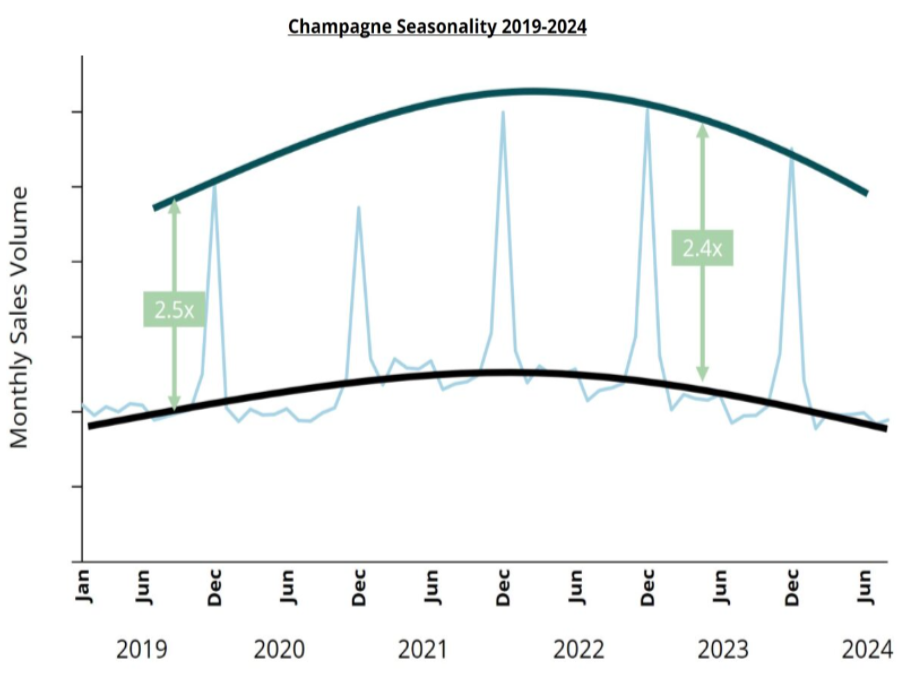
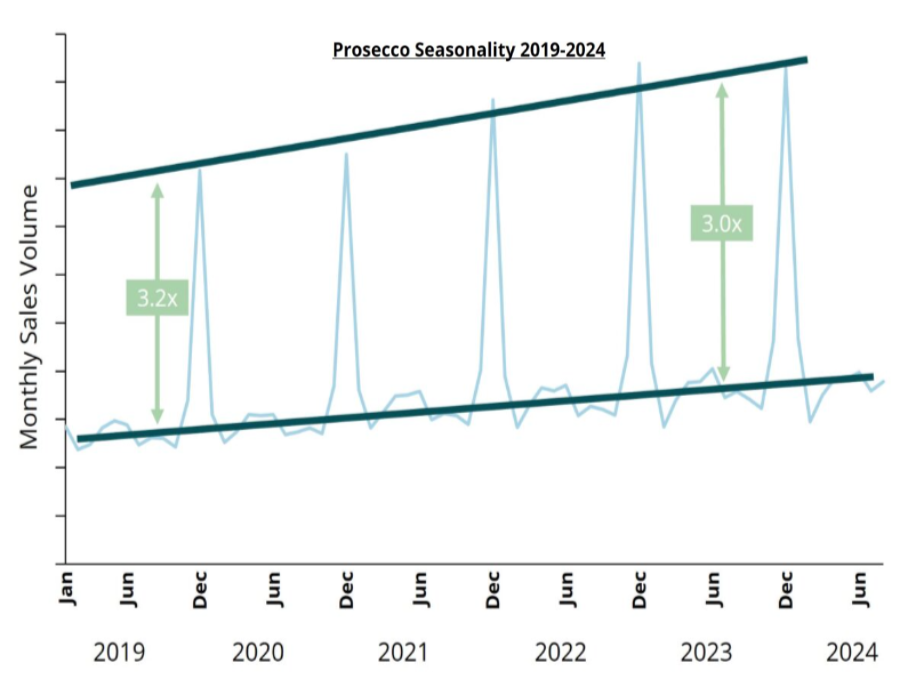
The sales spike in December represents about 2.5 times the baseline volume for champagne and over three times the baseline volume for prosecco. This is in line with expectations, as the lower average price point for the latter means that prosecco shows a greater rise over the holiday season than its more expensive sibling.
“Prosecco’s acceptance across a broader set of occasions has helped to boost its versatility, says Marten Lodewijks, president of IWSR’s US division. “Its affordability compared with champagne has also helped to propel the segment.”
Champagne vs Prosecco
What’s interesting is the underlying trend when looking at the seasonal data.
Champagne showed significant gains post-pandemic with a full year CAGR from 2019 to 2021 of 11% (vs. a slightly lower 10% for prosecco). The performance of the two categories then decoupled, with champagne declining 7% from 2021 to 2023 while prosecco continued to gain 5% over the same period.
This is largely to be expected as the inflationary environment in the US put pressure on consumers and de-premiumisation within sparkling wine more broadly – with prosecco winning out due to its lower average price.
Supporting the view that consumers are feeling the cost pressure is the fact that the annual December sales lift has been coming down slightly for both categories, with champagne decreasing from a 2.5x rise over the holidays in 2019 to 2.4x in 2023. Prosecco, meanwhile, went from 3.2x to 3.0x, suggesting that, in general, consumers are reducing their consumption of sparkling wine over the peak period.
“Champagne appears to be struggling with increasing switching to prosecco as consumers continue to feel the pinch of recent price increases,” adds Lodewijks. “Sparkling wine has historically always been a very fungible category, with even high-income consumers happy to switch to lower cost options in certain occasions.
“This trend seems stronger as consumers grapple with higher prices for virtually all goods.”
The outlook for December 2024
Sparkling wine performance so far this year (January to August) has been mixed.
- Prosecco is a bright spot for the total sparkling wine category. The sector has grown in all states YTD, but was not able to offset losses from other sparkling wine sub-categories, including champagne. California, Florida and Texas saw the largest volume increases in prosecco
- In champagne, states that are seeing the fastest declines in eight-month period compared to 2023 are Mississippi, Connecticut and New Jersey. The states with the largest absolute volume losses were California, Florida and New York
“The holiday spike for sparkling wine has historically been evident across many states,” notes Lodewijks, “This year, however, it’s likely that the slowdown in champagne will drag down any holiday boost for total sparkling wine.
“It’s more likely that we will see growth for prosecco, although the relative size of its holiday spike versus its baseline yearly volume is likely to be more subdued than that of previous years.”