

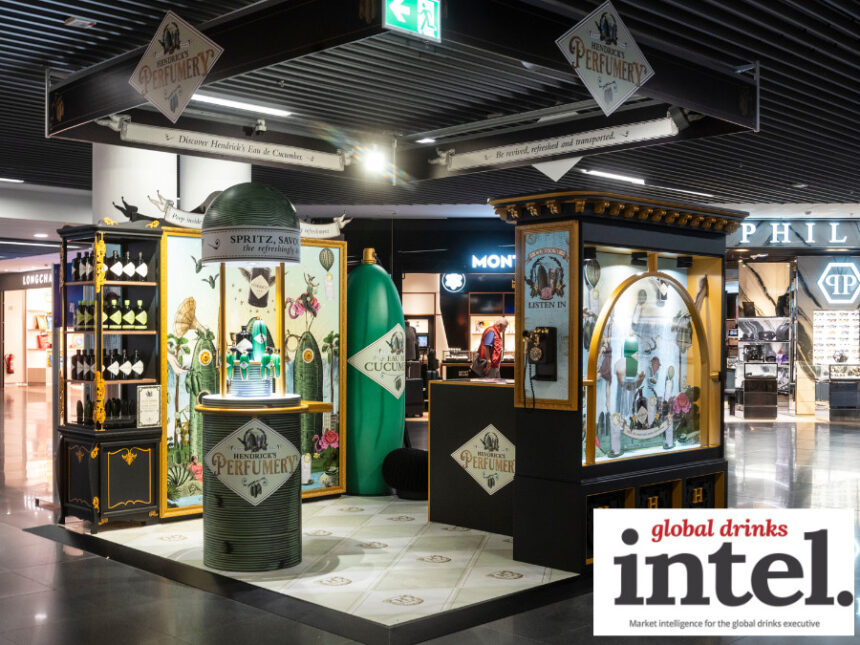
Since the last barrier to international travel post-pandemic was removed with the reopening of Chinese borders last year, there’s been a palpable upward shift in confidence levels around the global travel retail opportunity – particularly among gin brand owners.
And rightly so, given that research by IWSR Drinks Market Analysis shows the segment as having led the charge in terms of recovery. Although it’s not the biggest in the spirits category – scotch whisky and vodka are first and second, respectively – gin is, according to IWSR market research COO Emily Neill, “now one of the closest [categories] to pre-crisis volumes” at just 1.8% short of 2019 levels. “It has benefited from being geared towards the summer tourist traveller, especially Europeans,” she adds.
Gin’s 2022 volume rise was a staggering 112%, compared with scotch whisky’s +77% and vodka’s +68%, so it’s little wonder that brands are feeling buoyant. Much of this is down to the easing of travel restrictions in Asia, points out Jason Kidd, founder of Outcast Brands, which owns Blood Monkey Gin. “The opening up of China has led to new confidence across the wider global duty-free landscape as part of the last continent to fully reopen since the pandemic,” he says. “[This] has been evidenced in market data from the large duty-free retailers and airports, as well as in participation in major trade shows, such as TFWA Singapore and Cannes.”
Online touchpoints and digital activations offer new opportunities
Part of that buoyancy has been generated by consumers’ new-found willingness to engage with digital campaigns – a continuation of lockdown-induced necessity – which have become a focus for many gin brands in their GTR activities.
One such brand is Martin Miller’s Gin, whose owner, Spain’s Zamora Co, last year launched a digital activation called ‘Message in a Bottle’, where consumers interacted with the bottle through an augmented reality label to learn more about the brand’s history and participate in prize raffles.
“[Travellers are] much more willing to experiment with new products and experiences when they are on a trip,” according to Martin Miller’s GTR on-premise chain manager, Rubén Canabal. “They are also more interested in looking for and trying local products from traditional categories of that country, for example, gin in the UK, which makes them more open to these activations.”
Leila Stansfield, GTR MD for Bacardi – which owns Bombay Sapphire, the channel’s biggest gin brand – concurs. “The pandemic accelerated the take-up of digital in the travel retail space,” she says. “Digital is now firmly embedded as an integral focus in our omnichannel strategy; it’s a huge engagement enabler to unlock significant growth in footfall and conversion.”
According to Stansfield, 85% of travellers are exposed to online touchpoints while they travel and “that’s a powerful opportunity to reach, engage, inspire and convert them to shoppers”. She adds: “Considering only around 50% of travellers become shoppers, digital solutions allow us to target the remaining 50% with meaningful connections at key moments on their journey – pre, during and post-travel.”
Because of this, Bacardi’s GTR division continues to increase its investment in dedicated omnichannel campaigns that combine in-store activity with digital storytelling. Examples, says Stansfield, include using artificial reality to demonstrate the features and cocktail options of a new expression, virtual reality distillery tours so travellers can see where their products are made, and tailored social media targeting to inspire consumers to look out for in-airport exclusives before they travel.
“By the time travellers reach airport stores, they are digitally primed to enjoy the innovation in-store,” says Stansfield. “It’s great to see our omnichannel partnerships with airports and retailers pay dividends, with increased pre-ordering, click-and-collect and in-store sales.”
In June last year, Bacardi launched Bombay Sapphire Premier Cru Tuscan Juniper – a super-premium, small-batch iteration – exclusively to GTR. Bacardi GTR head of marketing Ignacio Vázquez says the ambition with the extension is to “build on Bombay Sapphire’s position as the top-selling premium gin in the channel”. Bombay Sapphire is No.10 on IWSR’s Top 50 Spirits Brands in GTR rankings for 2022 — up from 14th position a year earlier.
“We know that travellers are in constant search for exclusive products and experiences and that there’s a rising number of gin connoisseurs in the market for premium gins who want a sophisticated taste profile,” says Vázquez. “With its unique Italian flavours, Bombay Sapphire Premier Cru Tuscan Juniper brings gin lovers the opportunity to savour and appreciate the nuances of its pure and multi-layered taste profile.”
Travel retail remains a key showcase for premium products
This more traditional approach of leveraging the GTR channel to showcase premium products remains a stalwart for brand owners, with their activations often centring around getting liquid to lips, as this is an ideal environment in which to do so.
As Antoine Robert, export manager at Distilleries et Domaines de Provence says: “The audience is more captive, as travellers generally have time to spare and have more confidence in the products sold in duty-free stores than in other distribution channels. They’re also more likely to taste alcoholic drinks, as they don’t have to drive. It’s even more true in gin, as gin lovers generally like to try new gins frequently.”
The company has its Gin XII and Absente brands in GTR, with its most successful activation to date being a dedicated bar at Nice Airport. “There are so many gin brands that it’s not easy to stand out from the crowd when you don’t belong to a big group, even with an exceptional gin,” says Robert. “Quite a few gins, but fewer craft brands, manage to be distributed in duty free, so it’s very important for us to have Gin XII listed in most of the French airports and some of the main hubs in Europe, the Middle East and Asia.”
Blood Monkey’s Kidd agrees that travel retail provides fruitful ground for activations, as the audience usually has time to spare. “Travellers are often looking for unique experiences and products during their journey,” he says. “The anticipation of exploring new destinations, seeing old friends and trying new things makes them more receptive to engaging with brands and participating in various activities; gifting also plays an active role here.”
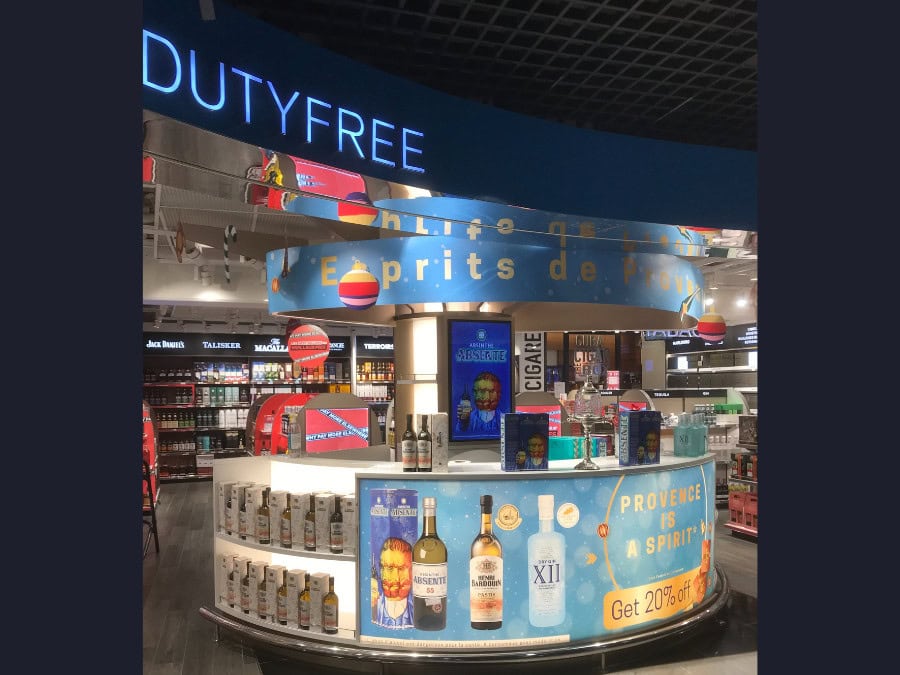
From scratch cards to a ‘Gin Perfumery’ and a ‘Sensory Potion’