
Single malt scotch whisky remains a pillar of the overall whiskey/whisky category in the global travel retail channel, but the latest ShelfTrak analysis suggests that all is not well for the sector.
Global travel retail is seen as a key market for single malt scotch whisky brands, with premiumisation and exclusivity driving both demand and assortment. However, the latest ShelfTrak analysis suggests that the category may be suffering from over-assortment, SKU proliferation and inefficient space allocation.
While channel operators continue to stock extensive whiskey/whisky ranges, there is growing evidence that an overly complex category structure may be diluting impact and reducing the effectiveness of core brand messaging.
Challenge of SKU proliferation
According to ShelfTrak’s latest review, the sheer number of malt whisky SKUs in travel retail is staggering. Across key GTR hubs, the category encompasses 985 unique brand iterations, spread across 54 brand owners and 125 distinct brands. Some locations – particularly in Asia – have excessively broad ranges, with the top three stores stocking more than 230 single malt SKUs each:
- Hong Kong Duty Zero: 269 SKUs
- Taipei Everrich: 238 SKUs
- Singapore T3 Lotte: 233 SKUs
This level of range complexity can dilute visibility for core brands, making it harder for shoppers to navigate the category. Furthermore, the significant SKU count raises concerns about an over-reliance on limited editions and exclusive expressions at the expense of strong, recognisable brand stalwarts.
In contrast, some stores in the Americas, such as Vancouver and Chicago, stock as few as 20-to-26 malt whisky SKUs. This highlights a stark contrast in retail strategies, where these markets focus on curation, while others risk overwhelming consumers with choice.
Space allocation
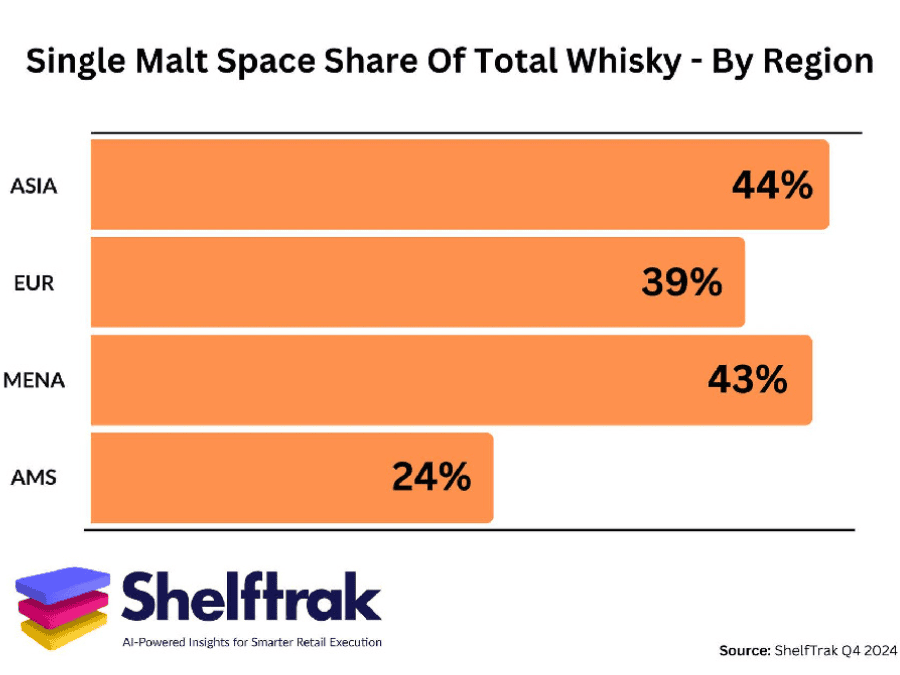
The allocation of space within the whiskey/whisky category further underscores differences in retail execution and strategy. Across GTR, Scottish single malts command 38% of total whiskey/whisky shelf space, slightly ahead of blended scotch. However, there are stark regional differences:
- Asia: 44% of whiskey/whisky space given to single malts
- Middle East & Africa: 43%
- Europe: 39%
- Americas: just 24%
At the retail operator level, the differences are even greater. China Duty Free Group dedicates 63% of whiskey/whisky space to malts, while Duty Free Americas (23%) and Nuance (24%) allocate far less. This suggests certain retailers have very different strategies and views on the strength of the single malt segment, while others may be overly invested, possibly at the expense of other key categories.
Brand dominance and space control
The data also highlights the competitive landscape within the space. The largest players – William Grant & Sons (14.9%), Pernod Ricard (13.9%) and Diageo (13.7%) – command a significant share of malt whisky facings. However, within individual retailers, some brands dominate:
- Glenfiddich leads with an 8.2% share of single malt facings, followed by The Glenlivet (7.9%) and The Macallan (7.4%)
- Some brands, such as Bowmore (3.7%) and Talisker (3.6%), have a much smaller footprint despite strong reputations with consumers
This imbalance in distribution presents an opportunity for challenger brands to negotiate better positioning in stores where the market leaders dominate.
The premiumisation dilemma
Price positioning remains a key factor in the single malt category, with GTR often used as a channel to promote high-value and duty-free exclusives.
However, the broad range of SKUs often leads to inconsistencies in pricing, with some key brands experiencing wide price disparities across markets. For example:
- The same whisky SKU can vary in price across Asia, Europe and the Americas
- Premiumisation has driven average price points higher, but there is evidence of price fatigue among consumers in some locations
This raises the question: is the category truly driving incremental value, or is it simply inflating retail complexity without delivering real sales growth?
The path forward
The findings from ShelfTrak’s data point to three clear opportunities for optimising the single malt scotch category in GTR:
- SKU rationalisation – Retailers must assess whether extensive ranges are delivering value or adding confusion. A streamlined core range, supplemented by strategic exclusives, may improve category efficiency
- Smarter space allocation – Disparities in shelf share suggest a need for more balanced space strategies that align with actual demand and growth potential
- Price harmonisation – Addressing pricing inconsistencies will be crucial in maintaining consumer confidence and ensuring long-term brand equity
This article is available to Global Drinks Intel members only.
Click below for details on how to join the Global Drinks Intel community.
Already a member?
Log in here to read the article in full.
If you work for any of the following corporate subscribers to Global Drinks Intel, head here to activate your access.
- AB InBev
- Bacardi
- Campari Group
- Diageo
- Moët Hennessy
- Pernod Ricard
- Proximo Spirits
- Suntory Global Spirits
- William Grant & Sons