

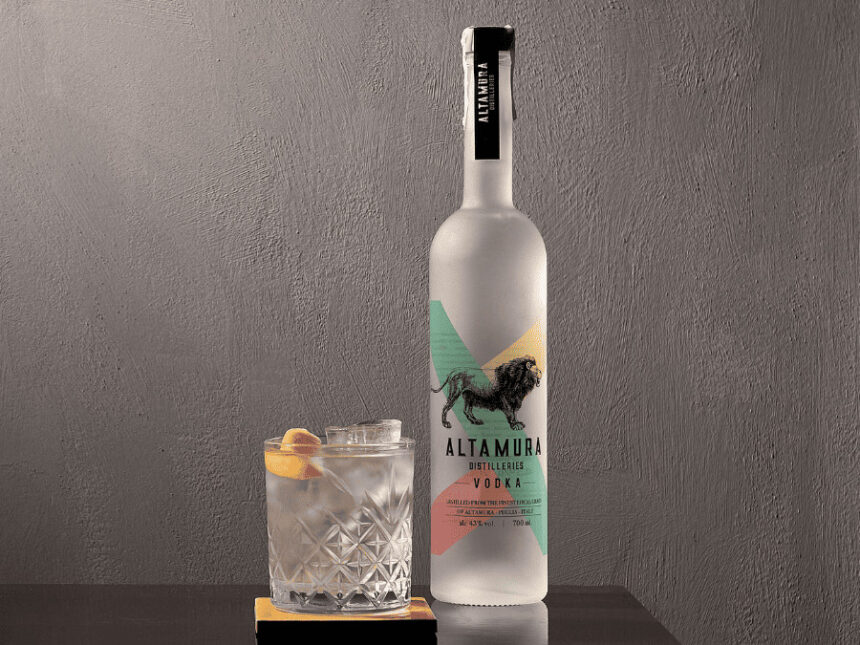
In February last year, Altamura Distilleries launched its namesake vodka in home market Italy. Distilled from wheat grown in and around the city of the same name in the southeast of the country, Altamura vodka retails for around EUR30 [US$32] per bottle, with volumes since launch at just over 50,000 units. Co-founder & MD Frank Grillo tells Global Drinks Intel what he has learned from the last 18 months.

GDI: Why have you chosen one of the most competitive spirits categories for your first product?
FG: I knew nothing about distilling – I’m a career marketer. I always wanted to live in Italy – my family’s Italian American – and in the middle of COVID, we decided to move to Puglia, mostly because of the weather, the beach, the food. I love to cook and came across a recipe for Pane di Altamura, which is the only bread in the world protected by a PDO – it has to use only durum wheat grown in the city or in five surrounding towns and has to be baked in Altamura. I got really curious about the wheat and found nobody was distilling it.
Culturally, wheat distilling is a cold weather thing; there’s Scotch, for example, and there’s vodka from Poland, Russia and Ukraine. Durum wheat only grows in hot weather places and we discovered it makes a really flavourful vodka. When we started experimenting, we found that a lot of the terroir comes through in the distilling. Our idea was to distil in a way that expressed the bread in a liquid format, it doesn’t spend time in wood and it doesn’t have added botanicals.
Initially, this was a lifestyle project for me. I really wasn’t thinking beyond this being a cool thing to do, But, it’s gone a lot further since we launched.
GDI: How do you look to get the provenance cue across to the consumer?
FG: It isn’t a problem in Italy, where Pane di Altamura is fairly well known. The most common comment we got from Italian consumers is: How did we miss it?
We do have to explain the story when we leave Italy, but ‘Brand Italy’ is fairly powerful – think of Prosciutto di Parma, Parmigiano Reggiano, and Barolo wine. We fit into the Italian story of being very geographically based, so it’s not as hard to tell the story as it appears. It takes a little longer than just ‘we’re made from rye’, but it makes sense when you think about us as an Italian product.
GDI: Which brand are you looking to take the place of on the shelf or back bar?
FG: We’re super-premium, so we compete head-to-head with Grey Goose and Belvedere. They’re both great products that I have enormous respect for. But, we’re a very different style. They’re both very pure, neutral-flavoured alcohol products, while Altamura has more of an umami taste.
We want to play in mixology., so we’ve built the vodka to be in a EUR20 [US$21] Martini. We bring a different perspective to that level in vodka.
GDI: Where was your biggest challenge in setting up Altamura Distilleries?
FG: As an American, it was opening a business in Italy. Living there’s amazing – setting up a business there is a slow torture! It’s a very different business environment and we weren’t familiar with a lot of the business practices. On top of that, opening a distillery in a part of Italy that doesn’t really think about high-ABV distilling was daunting, particularly getting the permits to distil and the licences to sell. It didn’t help that neither of us are native Italian speakers!
Once you get past that, the distribution regulations in this industry are insane. If you’re a start-up distillery with aspirations, figuring out the myriad of distribution methodologies and regimes by country is so daunting. We distribute now in Italy, India, the UK and the US and each of them has a completely different regime for how distribution works.
If you pick one market, you can probably become good at it. But if you try to expand, it’s a hard business.
GDI: What advice would you give to someone 12-18 months behind you?
FG: The biggest thing we failed at was we thought too linearly and didn’t anticipate what was about to happen. We were so focused on launching the brand that once we’d done that, we realised we needed somebody to help us sell this. The lack of forethought – how do you sell this stuff? How do you get it delivered? Where do you store it? What happens when you ship it out? – certainly cost us time. We couldn’t see all the things we needed to worry about.
We’ve caught up, but we wasted six months after launch because we hadn’t used the time to think through all the things we didn’t know. We got people in to help us, but we could have done that a lot sooner. If you only focus on the product, you wind up with a lot of vodka in a warehouse and that’s not what you want.
GDI: What’s your exit strategy?
FG: I never like disparaging products I respect, but we have replaced Belvedere and Grey Goose as some house pours. We have the ability to go further but it’s really hard to do that on your own.
We have to show we’re able to be a global brand, but I think we belong in some other brand portfolio that wants to have something in that super-premium category. Grey Goose and Belvedere have pretty much owned that category for 20 years and I think we can play there.
GDI: What’s the plan in the meantime?
FG: We aspire to express the wheat in other formats – I think it would make an amazing wheated bourbon! We’ve also had a lot of asks for gin – Italians love gin. Right now, the vodka has such a strong pull in the market, so we’re just focusing on that.
Subscribe to Global Drinks Intel in October for 50% off the usual annual cost