- Conflict in the Middle East is having a negative impact on aged spirits sales in global travel retail, although growth in other regions is helping to partially offset the losses
- India is a key battleground in GTR, thanks to increased travel by well-heeled Indian consumers, alongside advances in airport infrastructure and retail
- Key trends for aged spirits in the channel include premiumisation, but also localisation – the appetite for home-grown products – which extends beyond India to the likes of China and Thailand
- Rival categories are challenging the traditional dominance of scotch and cognac: other whisk(e)y origins, aged agave-based spirits and dark rum are all making inroads
- Despite economic pressures, there is limited evidence of trading down, although travellers are becoming “more considered” in their purchasing decisions.
Geopolitics has a lot to answer for. Amid difficult global trading conditions for beverage alcohol, the global travel retail (GTR) channel represents a much-needed growth opportunity, particularly at premium-and-above price points, and particularly for the aged spirits that have long dominated the marketplace. But the on-off war between the US–Israel and Iran has, at least temporarily, slammed on the brakes.
“Travel retail has experienced a significant slowdown in recent months as a result of the ongoing conflict in the Middle East, which has had a considerable impact on passenger flows and, consequently, on sales across the channel,” reports La Martiniquaise-Bardinet (LMB) international marketing manager Constance Descamps.
At times like this, GTR’s geographical diversity is a boon. “Despite these challenging conditions,” Descamps adds, “we continue to see positive momentum through a key strategic partner in Europe.”
Radico Khaitan’s president of international business, Sanjeev Banga, echoes Descamps’ view. “Initially, the impact was more severe,” he says. “Now, gradually, the travel situation is improving. We are seeing airlines returning to their regular flight schedules and, hopefully, from September onwards, passenger traffic should also inch towards normalcy.”
All eyes on India
Losses in the Middle East have been partly offset by increased travel to Asia Pacific, particularly among the highly influential Indian passenger base during the May-to-June school holiday season. “This not only boosted GTR sales at Indian airports, but also at Asia Pacific’s airports,” explains Banga. “Indians love their whisk(e)y, so the sales of brown spirits did well.”
As in domestic destinations, India remains the bright hope of travel retail. Brown-Forman’s director of GTR operations, Oscar Camargo, isn’t alone in identifying the country as a “significant” growth opportunity. “As the world’s largest whisk(e)y-consuming market, it’s highly relevant to our super-premium spirits portfolio,” he says. “We expect its importance in GTR to grow as passenger numbers increase and the country’s aviation landscape develops.”
Bacardí’s GTR marketing director, Darragh Ryan, has identified another positive development in the market. “The recent increase in the duty-free allowance for Indian travellers, alongside continued airport and airline investment, is giving brands more opportunity to showcase premium and super-premium expressions,” he says.
Local partnerships are key in a market that remains highly complex and regulated. Proximo’s head of GTR, Roy Summers, credits the partnership between Irish whiskey Bushmills and Monika Alcobev for the brand’s presence at major hubs including Delhi, Mumbai and Hyderabad. He adds that, in a traditionally scotch-dominated market, “our aim is not simply to challenge established preferences, but to offer travellers a compelling alternative”.
Global localisation
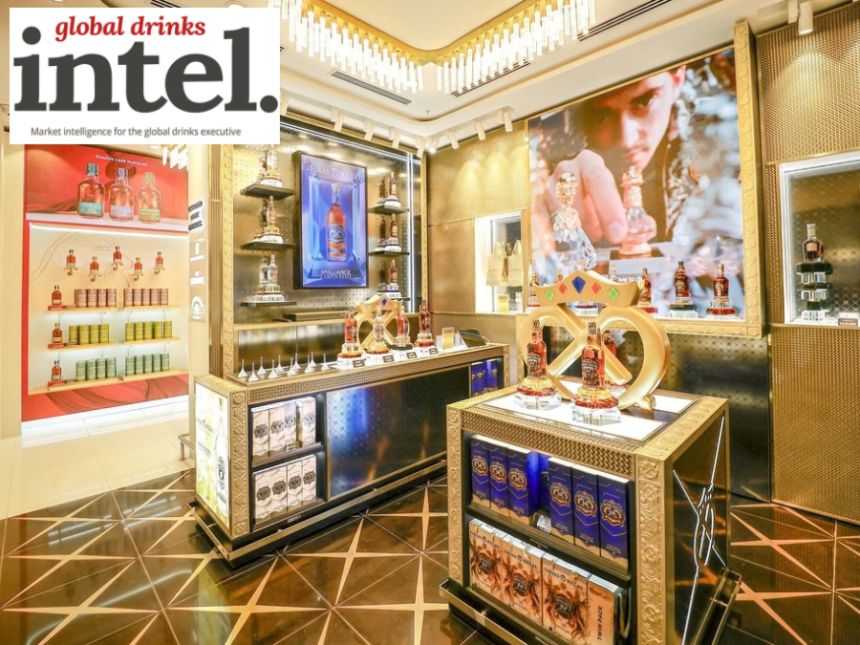
Two trends, in particular, have become highly significant in India: premiumisation and localisation. For a multinational operator like Pernod Ricard, both can be explored – the former through initiatives such as the company’s Chivas Regal Boutique in Mumbai International Airport, and channel exclusives including Royal Salute 25-year-old Delhi Edition and Chivas Extra Tequila Cask Selection.
As for the latter, Pernod Ricard GTR’s director of prestige brands & champagne, Andrew Bardsley, highlights good growth for Seagram’s whiskies, notably Royal Stag, and innovations such as the company’s first premium Indian single malt, Longitude 77.
Localisation is also a factor elsewhere, including in China, where the guochao (pride in Chinese culture) trend prompted Pernod to launch a channel-exclusive expression of its The Chuan Pure Malt, produced at the Emei Mountain distillery in Sichuan province.
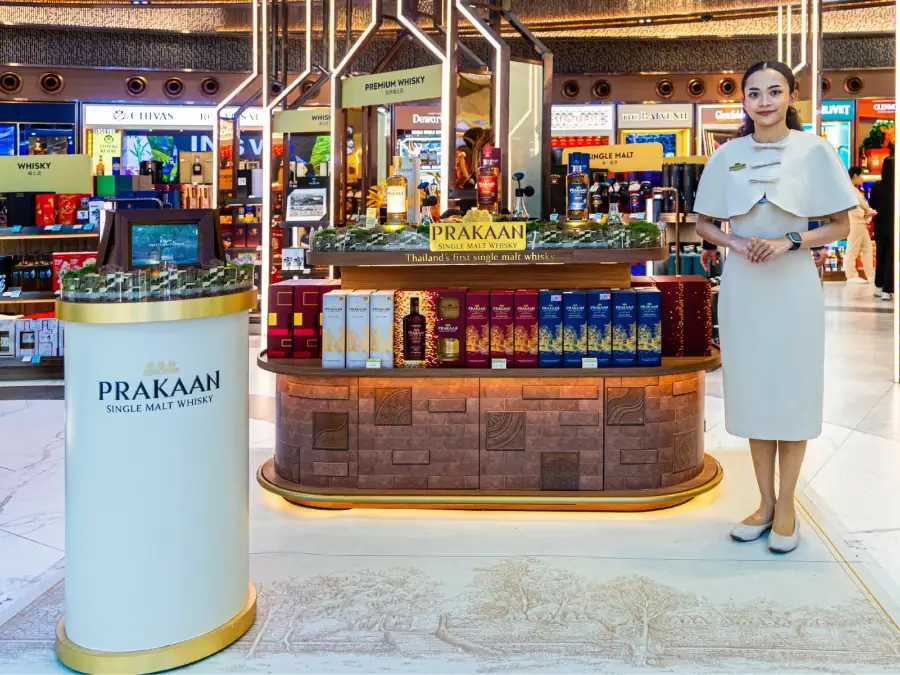
In Thailand, International Beverage’s head of GTR, Edith Ng, believes the channel’s consumers increasingly want products with “cultural relevance”, prompting the company, via a partnership with King Power at Bangkok Airport (below), to invest in its Thai spirits brands, including Prakaan Single Malt Whisky and Phraya Rum. “With the addition of special activations around occasions such as Songkran [Thai New Year], these brands are achieving double-digit growth in the channel,” she says.
If local whiskies are muscling in on scotch’s traditional territory, how about other aged spirits? Heaven Hill Brands’ MD of global travel, Salvador Blanco, cites recent domestic market data as indicating positive momentum for “several whisky origins beyond scotch”.
He adds: “Importantly for us at Heaven Hill, American whiskey is growing at a faster rate than scotch. We expect travel retail to follow, because travellers increasingly expect to find the same category diversity at airports and other travel retail locations.”
Boundaries fade
Bacardí’s Ryan believes consumers are becoming increasingly ‘category agnostic’. “A whisk(e)y drinker may just as easily pick up a bottle of aged tequila or rum,” he claims. “That openness to discovery is reshaping the browsing experience.” Ryan sees an “exciting shift” for aged tequila in particular.
At Proximo, Summers expresses similar bullishness, arguing: “The categories are not necessarily replacing one another. Instead, the high-end spirits repertoire is broadening.”
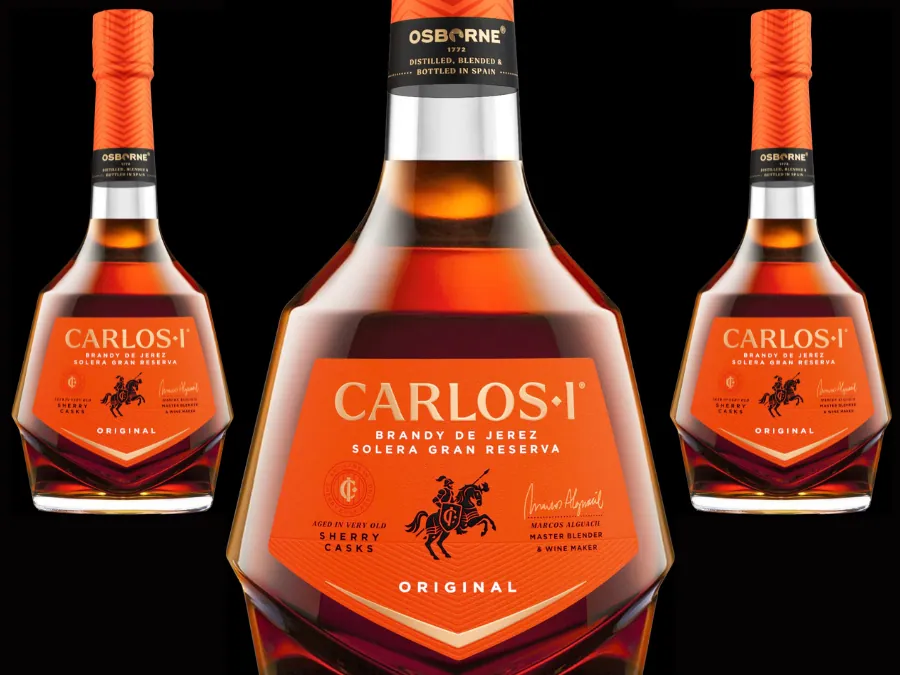
That could be music to the ears of a product like Osborne Group’s Carlos I Brandy de Jerez (below). Conditions can be challenging in Osborne’s European heartland, where its traditional consumers are ageing, so the company is targeting Asia, with airport listings in India, and has plans for the Far East despite cognac’s traditional dominance there. “This means the category requires greater investment and brand-building,” says Osborne GTR manager Cathy Aumiaux.
Where does this leave one of the traditional bulwarks of aged spirits – scotch? William Grant & Sons’ MD of GTR, Rufus Parkinson, maintains that scotch is “an incredibly resilient category”, pointing to single malt’s “unique place” in premium travel retail.
“What’s changing is that consumers are becoming more knowledgeable and more adventurous,” he says. “They’re looking beyond age statements alone and want to understand provenance, craftsmanship and the story behind a whisky.”
Empowered buyers
This consumer shift transcends categories: businesses as diverse as LMB, Brown-Forman and Edrington acknowledge the evolution of the higher-end GTR shopper, while voicing confidence in the future.
LMB’s Descamps believes international travel has become more accessible to a broader consumer base, while Brown-Forman’s Camargo sees a polarisation evident in the appetite for standard, and also prestige-plus, products – leaving ultra-premium and prestige price tiers more vulnerable.
Edrington’s marketing director for GTR, Alessandro Felicani, argues that travellers are becoming “more considered” in their shopping habits, reinforcing the importance of brand consultants in the channel. “Many purchase decisions are influenced in-store, so highly trained sales staff are essential when it comes to guiding travellers through the range and helping them understand the differences between expressions,” he adds.
Challenges for aged spirits in GTR remain, then, but there are also opportunities. “While inflation and economic uncertainty have made consumers more thoughtful about their purchases, we haven’t seen a significant shift away from premium spirits in travel retail,” says Osborne’s Aumiaux.
“Instead of trading down, travellers are becoming more discerning. They’re willing to spend when they perceive real value through exceptional quality, authenticity and a memorable brand experience.”
Members-only intel
Keep reading this members-only article – and every one like it
- ✓All paywalled news and interviews
- ✓Category and market data
- ✓Monthly GDI magazine
- ✓Full archive + daily newsletter
Secure checkout · Cancel any time · Company invoices available
Already a member? Log in
See all plans, incl. 10-reader and corporate
Check if your company already pays for you Your company may already give you free access.
Corporate subscribers: AB InBev, Bacardi, Campari Group, Diageo, Moët Hennessy, Pernod Ricard, Proximo Spirits, Suntory Spirits Group, William Grant and Sons.
Activate company accessNot ready yet? Get the headlines free in our daily newsletter.
Sign up free