

This article was initially published in the December/January issue of Global Drinks Intel magazine. For details on how to subscribe, click here.
As Tequila sales soar, producers are struggling to meet demand — can alternative agave and ‘agave-adjacent’ spirits like sotol bridge the gap? Richard Woodard reports.
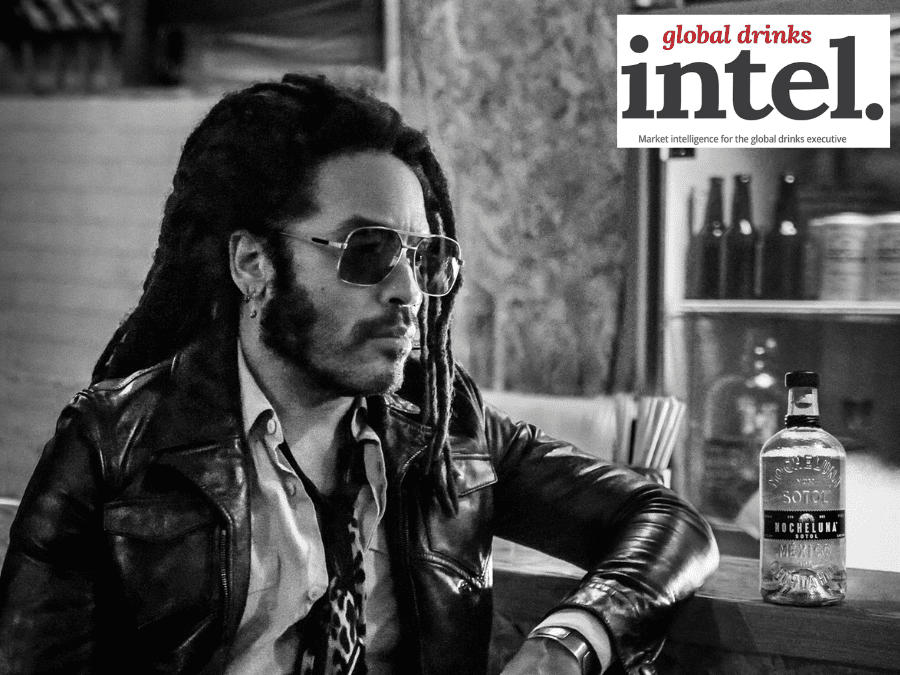
Another month, another celebrity spirits launch with its roots in Mexican culture. But the latest tie-in between famous face (Lenny Kravitz), multinational (Pernod Ricard) and local operator (Casa Lumbre) is just a little different. Because the product in question, Nocheluna, isn’t yet another high-end Tequila or even mezcal, but a sotol.
A what?
Sotol isn’t an agave spirit, but the distinction is largely academic. Produced from the dasylirion plant — aka sotol or ‘desert spoon’ — which grows in Mexico’s Chihuahua Desert, it undergoes a broadly similar production process to other agave spirits. Nocheluna’s flavour profile (as described by Pernod Ricard) has echoes of mezcal — dried stone fruit, caramel, firewood — and its ultra-premium pricing at US$80 a bottle shares a similar ambition to high-end Tequila. Essentially, the same winning formula (Mexican provenance, celebrity association, luxury positioning) has been applied to a new, and almost completely unknown, spirit type.
“Nocheluna aims to become the ultra-premium reference of the category,” says Pernod Ricard. “It will be launched globally over the coming months, starting with the US market.” No surprise there, and no surprise either if Nocheluna quickly becomes heavily reliant — in line with other agave/agave-adjacent spirits — on the US for most of its sales.
‘Soaraway success’ putting pressure on agave supplies
The reason for Nocheluna’s existence, and for the multiple investments in other agave spirits in recent years, is the soaraway success of Tequila. Or, we should say, the soaraway success of Tequila in the US because, for all the early promise of markets including the UK, Spain and Australia, this remains a largely stateside success story.
Last year, according to IWSR Drinks Market Analysis figures, global agave spirits volumes rose by 18%, constituting a strong recovery following COVID-affected 2020, and giving Tequila a 2.5% share of global spirits volumes (in 2016, the figure was 1.8%). The IWSR is now forecasting Tequila to grow at a compound annual growth rate (CAGR) of 7% between 2021 and 2026.
That’s a positive prognosis, but one that comes with challenges. It takes several years for Blue Weber agave plants to reach maturity, and a great deal of the consumption growth is occurring within the Añejo and Extra Añejo segments, which require the longest maturation periods. Agave is in short supply as a result, and it’s expensive.
“Agave prices have remained close to record levels for the past three years, at MXN26-28 (US$1.34-$1.44) per kilogram,” says IWSR research director Jose Luis Hermoso. “Prices will only start moderating when there are signs that Tequila is cooling down in the key US market.”
This analysis is echoed by brand owners. “Greater demand for our Tequila brands, driven by the continued growth in the US and a faster-than-expected rebound in Mexico, has required a greater supply of agave,” says Mia Simpson Culp, MD of Tequilas at Brown-Forman, which owns the Herradura and El Jimador brands. “Agave costs are below their peak, though easing at a slower pace than expected due to the higher demand within the category.”
Spiralling costs open door to ‘agave-adjacent’ spirits
This is exacerbated by the broader scenario of spiralling costs and inflation. While Tequila is cushioned against these pressures by strong demand for higher-margin products, this combination of circumstances could open the door for rival agave, or ‘agave-adjacent’ categories.
These include not only sotol, but also mezcal, raicilla and bacanora — all authentic Mexican spirits with their own heritage. They might also include agave spirits of non-Mexican origin, because the country doesn’t have a monopoly on growing the spiky succulent. Countries such as Australia, South Africa, India and the US are already producing their own agave spirits and, while they cannot use the protected Tequila name, they can trade on consumers’ growing knowledge of agave products.
“We’re finding that bartenders and consumers are curious about other types of distillates similar to their favourites, and we expect to see a rise in interest for raicilla, bacanora, sotol; other agave distillates made outside of Mexico, and non-agave spirits from Mexico,” says Campari Group marketing director Julka Villa. The company has already invested in Montelobos Mezcal and Ancho Reyes liqueurs, and has hinted at more deals to come.
Such moves embed Mexican spirits ever more deeply in the drinking culture of the US and elsewhere, but they could also pose an eventual threat to Tequila’s supremacy. “An industrialisation of alternative agave plants to produce spirit of a recognised quality could erode the dominance of Tequila in the agave spirit space in the longer term,” says Brandy Rand, chief strategy officer at the IWSR. “After all, only 20 years ago, consumers worldwide would turn to Scotch or Bourbon when thinking about whisky, but now the choice has expanded widely.”
Investment to secure top spot for Tequila in Mexican spirits space
It has even expanded to Mexico, with Abasolo, the Mexican corn whisky produced by Casa Lumbre, in which Pernod Ricard acquired a stake in 2021. For the moment, however, Tequila is the star attraction within Mexican spirits and is set to remain so.
For all Campari’s interest in alt-agave, the company has invested heavily in boosting production of Espolòn, the fast-growing brand that is now the No.5 premium Tequila in the US. Meanwhile, Culp emphasises that Brown-Forman’s agave activities remain tightly focused on Herradura and El Jimador.
Something similar could be said about Pernod Ricard, though the company has in the recent past made deals in mezcal (Del Maguey, Ojo de Tigre), as well as sotol. Only a few days after announcing its investment in Nocheluna, the group unveiled its acquisition of Código 1530, a high-end Tequila and mezcal. The brand sits in the category’s sweet spot, with a roster of ultra-premium and prestige expressions, and is already widely available across the US, with a limited international presence. It’s a much-needed agave boost for a company that has, until now, relied on its Olmeca, Altos and Avión brands for Tequila sales.
With the benefit of Pernod Ricard’s strong distribution network, the global footprint of Código 1530 is sure to expand in the years to come, while continuing to exploit the American thirst for luxury Tequila. It’s an indication that, however strong the potential of alternative agave spirits, the Tequila bandwagon shows little sign of slowing down just yet.
This article was initially published in the December/January issue of Global Drinks Intel magazine. For details on how to subscribe, click here.