

This article was initially published in the October issue of Global Drinks Intel magazine. For details on how to subscribe, click here.
After a tough couple of years, gin is back with a bang in Europe’s Global Travel Retail and shows no sign of losing its appeal for the region’s travellers, reports Joe Bates.
The gin category rebounded very strongly in the European GTR channel last year, after the disastrous impact of the pandemic in 2020. Last year, according to IWSR Drinks Market Analysis, sales in the channel reached about 600,000 nine-litre cases, an increase of 79% over 2020, when volumes plunged by 70%.
Europe remains the most important market for gin in GTR by a significant margin. In the Americas, the category's second-largest in GTR, volumes in 2021 only totalled around 77,000 cases, says IWSR.
Anecdotal evidence from leading brand owners suggests gin’s recovery has continued into 2022, despite the war in Ukraine denting Russian travellers’ contribution. Instead, a strong recovery in international air travel has been the prime driver of gin’s resurgence in European GTR.
Suppliers also report a robust performance from the cruise and ferry channel, but the jury is out on whether the return of UK-EU duty-free sales after Brexit has played a decisive role in shaping gin’s reviving fortunes.
Importantly, there are no signs yet of ‘gin fatigue’, a trend that is becoming apparent in leading domestic markets, such as the UK and Spain. In fact, IWSR predicts that gin in European GTR will grow at a CAGR of 13% between 2021 and 2026.
Have the UK and Spain peaked?
“It’s probably right to say the gin category in the main European markets (the UK and Spain) has reached its zenith in terms of growth rates," says Simon Roffe, director of business development at Welsh Whisky Co, the producer of Penderyn Whisky and Brecon Botanicals Gin. "But, the category is still attractive, which is evident in the continued boom in brand launches and extensions.
“Growth coming from markets where gin is just awakening, the brand extensions in terms of flavours, higher-strength gins and, indeed, formats (RTDs, etc.) mean the category still has much to offer,” he continues. “But, it’s become super-competitive and only brands that can find a point of difference or have endless investment ability will be sustainable on a larger commercial scale in the long run.”
Roffe argues that Brecon Botanicals Gin, described by the company as a “big traditional juniper [gin] laced with coriander and revealing hints of spicy cinnamon”, is distinctive for being a “Penderyn brand”. “There's also the purity of the water supply from the Brecon Beacons National Park [in Wales] and being positioned at a sensible price point that gives Brecon a real edge,” he adds.
This year, Brecon Botanicals, which is listed with Dufry in the UK, has enjoyed a five-fold increase in year-to-date sales. “We've also benefited from wider distribution ... and have gained listings in European duty-free on board airlines and in diplomatic channels.”
Border trade boost
The brand is not alone in enjoying strong European results. “Silent Pool has seen 307% growth so far in the first half of the year,” reveals Adam Dobson, global sales director at UK craft distiller and namesake brand owner Silent Pool Distillers. “The UK is one of the largest contributors, with border trade and ferries contributing further exponential growth for the brand.”
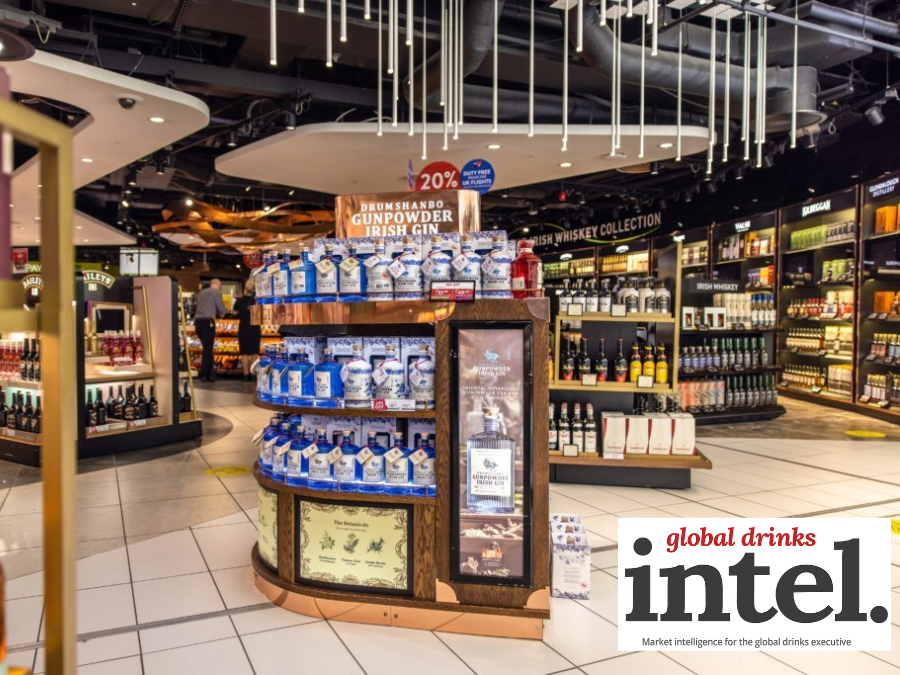
Barry Geoghegan is the founder of specialist GTR drinks distributor Duty Free Global, whose wide gin portfolio includes Silent Pool as well as Drumshanbo Gunpowder Irish Gin, Ginato Gin from Italy, Ukiyo Japanese Gin and McCormick Distilling's Broker’s London Dry Gin. He also takes an upbeat view of the category’s prospects, in particular, singling out the stellar performance of Drumshanbo, a craft gin made by The Shed Distillery in County Leitrim, Ireland.
“The brand is still growing in its home market and seeding into new markets as travel recovers and grows at pace,” he says. “It has recently been listed in Dufry in the UK and is showing great traction. The team at The Shed Distillery is constantly innovating — it is introducing its Sardinian Citrus variant into GTR and, with more flavours to be launched at the end of the year, is looking at achieving strong growth in the channel.”
Brexit brings mixed results
Also reporting strong European results this year is Ian Macleod Distillers-owned Edinburgh Gin. The company’s GTR director, William Ovens, says: “Edinburgh Gin has seen significant growth across European duty-free, which has been driven by the return of significant passenger numbers, Brexit duty-free pricing, the increased [UK] duty-free allowance and the launch of new products. Demand has been so high that it's exceeded our forecasts.”
Ovens reports that the UK and Spain are driving Edinburgh Gin’s European GTR business. “We have increased listings with Dufry in Europe — we now have listings for six SKUs, including our GTR-exclusive Strawberry & Pink Peppercorn, which is doing really well both in the UK and Europe.
In an indication of how important the sales channel has become for Edinburgh Gin, the brand partnered with airline lounge provider Premium Plaza Group earlier this year to open a bar in its first Plaza Premium Lounge at Edinburgh Airport. The centrepiece of the 760sqm lounge is the Edinburgh Gin Bar, which offers the widest range of the brand’s gins in any off-premise setting, including Strawberry & Pink Peppercorn and Watermelon & Lime, both of which are GTR-exclusives. The Art Deco-style bar also features other spirits from Ian Macleod Distillers’ portfolio, including Glengoyne, Tamdhu and Smokehead malts, the blended King Robert II Whisky and Langs Rum.
Ovens believes that duty-free pricing and the larger four-litre inbound UK personal allowance, a result of Brexit, have provided the brand with an additional boost this year. “We've seen a positive uplift in sales as well as spend per head, driven by increasing incoming allowances and lower duty-free pricing,” he confirms.
In contrast, Silent Pool’s Dobson believes the Brexit effect has yet to kick in. “Neither Brexit nor the subsequent increase in allowances has had a major effect on the brand’s trajectory," he says. "It’s the general influx of departures, wider brand awareness and our gifting that has become important to our success this year. We're still cementing our wider distribution, so I don’t believe we are yet seeing the benefit of incoming passengers taking advantage of increased allowances.”
Cruise and ferry sales strong
One thing gin brand owners do agree on is the strong performance of the cruise and ferry sector in Europe this year. “We're excited to have landed key distribution in the GTR channel," Lynsey Eades, international sales & GTR director at the Cotswolds Distillery, the producer of Cotswolds Dry Gin, tells Global Drinks Intel. "Working with Harding Retail, we've secured listings on P&O Cruise Duty Free and will be bringing Cotswolds on board through our activations on three ships, telling guests about our story, provenance and sampling our award-winning dry gin.
“Distribution with Condor Ferries and Brittany Ferries will further extend our brand presence in the [English] Channel as we look to follow our target audience for whom travel is a key part of their lifestyle, newly reinvigorated post-pandemic,” she adds. “The cruise and ferry sector presents a significant opportunity for us and we'll be looking to build this into 2023, working with the operators to bring theatre on board.”
Similarly, Guillaume Villerabel, commercial export director at Maison Villevert, the producer of French grape-based super-premium gin G’Vine, is equally optimistic about the potential of the maritime sector. “For premium brands like ours, the opportunity in cruise and ferry is that we can really connect with consumers, not through a simple tasting in a 1cl cup, but going into the details of the brand heritage, production processes and production specificities.
“We participated in the Viking Whisky Festival for the introduction of Talbert [French whisky] and the brand sold out before the end of the cruise,” he adds. “We're also discussing with a major operator to organise masterclasses on French spirits for the guests, together with cocktail workshops on board.”
Cruise lines are even partnering with distillers to produce exclusive gins at sea. Devon-based craft distillery Salcombe Distilling Co, for example, now distills, labels and bottles the maritime-inspired Marabelle Gin [the botanical mix features sea kelp] on board P&O Cruises’ Iona cruise ship. Angus Lugsdin, the co-founder of Salcombe Distilling, believes the cruise and ferry sector in Europe has “great potential”.
“There’s a captive audience that's able to browse in an unpressured environment, and they’re often able to try the product on board,” he explains, although warns brands entering GTR to be aware of the high costs associated with the channel. “They should view it as part marketing/brand awareness exercise and part commercial retail opportunity,” he says.
Further underlining the growing importance of the maritime sector in the region, Baltic ferry operator Viking Line staged two gin fairs for passengers this year. Around 20 exhibitors attended the fairs, including international brands such as Bombay Sapphire, Hendrick’s, Edinburgh Gin, The Botanist, Roku and Sipsmith, as well as regional brands including Kyrö from Finland as well as Sweden’s Bränneri, Hellström, Hernö and Crafter’s.
Following the worst of the pandemic, gin’s performance in European GTR has been impressive. Encouragingly, regional travellers don’t appear to have grown tired of the category, though it would be short-sighted not to recognise the short-term headwinds challenging all spirits sectors in the sales channel. The cost-of-living crisis will push gin's retail prices higher, which may impact sales of super-premium lines and, of course, any resurgence of COVID-19 during the winter period could hit passenger traffic levels.
Nonetheless, gin is in a far better place in European travel retail than it has been at any time over the past two years.
This article was initially published in the October issue of Global Drinks Intel magazine. For details on how to subscribe, click here.