

This article has been available to Global Drinks Intel subscribers since July. For details on how to join them, please click here.
As the on-premise channel continues along the road to recovery, and consumers remain committed to cocktails at home, the premium soft drinks & mixers segment has been broadening its reach.
“Simplicity,” as Leonardo da Vinci once said, “is the ultimate sophistication.” It’s an adage that, outside of the very highest echelons of bartending, rings true for cocktails.
In many bars, the ongoing combination of a recruitment drought and soaring operational costs means that when it comes to developing a cocktail menu, simplicity is critical. For the at-home drinker, meanwhile, the fewer the ingredients – and the simpler the process – the better. These needs have prompted a swathe of traditional mixer brands to branch out into the area of cocktails.
The move by premium soft drinks & mixers into the cocktail space seems like a match made in flavour heaven. It’s also a timely one: In its 2023 Market Report, compiled in partnership with research agency CGA, Fentimans notes that on-premise drinks sales in the UK last year totalled GBP30.7bn [US$39.4bn]. While that’s a substantial increase on 2021’s GBP13.5bn, sales are still behind the GBP31.1bn recorded in pre-pandemic 2019.
Meanwhile, Fever-Tree, again citing CGA, says that from 2014 to 2022, sales of mixers in the UK soared by 92%. An additional insight from last year, according to Nielsen: cocktail mixers represent a bigger sales segment than both tonic water and ginger beer.
The time to innovate is now.
Who’s drinking?
Fentimans’ report makes for interesting reading. Based on data from CGA BrandTrack, for example, the largest age group for premium soft drinks and mixers is 35- to 54-year-olds, with the segment’s consumers skewing 66% to women. Almost two-thirds [63%] don’t have children and just under half [46%] live in suburban areas.
What’s perhaps most surprising is that while 41% of mixer consumers said they eat out weekly, only 18% drink out of the home with the same frequency. If the premium mixer drinker were summed up in a persona, then, they’d be a middle-aged, child-free woman, most likely sipping in a suburban home.
Clearly, this is not a trend that’s skewing towards Gen Z.
Betting on cocktails
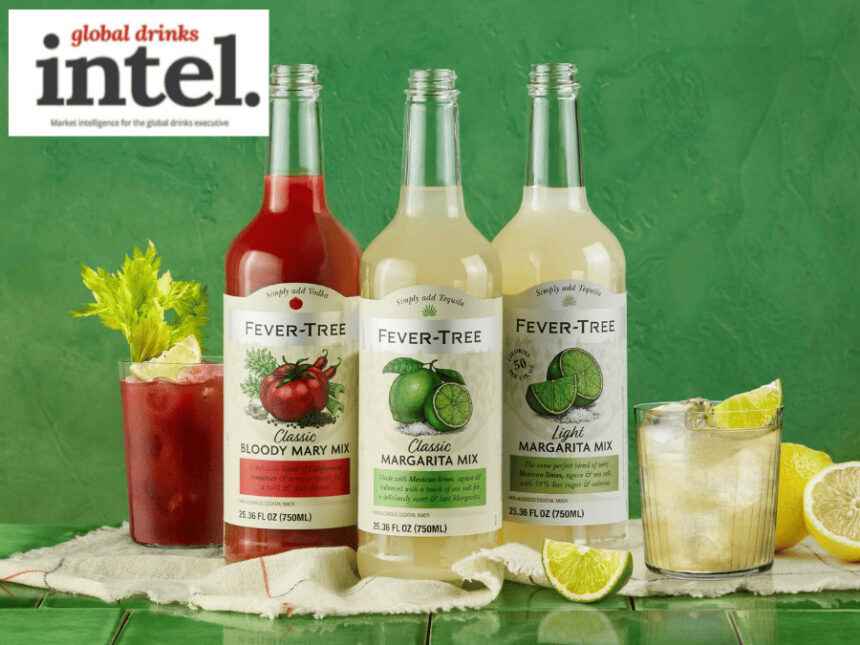
Earlier this year, Fever-Tree stated its cocktail-led intentions strongly: In the UK, the company released Margarita, Espresso, Passionfruit Martini and Mojito mixers, while Fever-Tree Classic Bloody Mary and Classic [along with a Light extension] Margarita hit the US. Targeted at both the on-premise and at-home drinkers, the brand said the US launch came as the cocktail mixer segment grew 27% in the country over the last three years.
The simplicity win? Typically time-consuming serves could now be created with just two ingredients, making life easier for bartenders, both professional and home-taught.
Brand director Emma White says the cocktails-at-home trend played a big part in the moves. “We also know they’re hoping to recreate the bar experience while in the comfort of their own home with friends and family, or even by themselves, without the noise and crowd of an actual bar,” she adds.
For Fever-Tree North America CEO Charles Gibb, the brand’s cocktail mixers are only “scratching the surface” of potential growth. “Like with carbonated mixers,” he says, “the non-carbonated category is primed for tremendous growth and represents a bigger market opportunity than tonic water alone. It’s the perfect time for Fever-Tree to enter the market.”
The low-alcohol opportunity
By 2030, according to market research agency Qualiaket, global sales of bottled cocktails are expected to hit US$26bn – with lower alcohol content a key consumer driver. Mixer brand owners would do well to take a long, hard look at premix cocktails – this seems like a fortunate meeting of trends, with momentum building on momentum.
Related to this is the health & wellness trend, where mixers should make more of their natural ingredient claims, with a strong emphasis on real fruit. This is enforced further when claims around low calories come into play.
The view from the other side
While soft drinks and mixers up the cocktail ante, liqueur producers should feel threatened. But, do they?
“This phenomenon does not concern us very much,” says Nicola Dal Toso, CEO of Volare liqueur owner Rossi d’Asiago. “We have different target audiences. We believe that these new products introduced into the market by tonic brands are mainly aimed at the off-trade channel, designed for end consumers approaching the homemade cocktail creation.”
Dal Toso also feels that the breadth of flavour offerings isn’t sufficient to meet bartender needs. Volare, with its 38-strong range, doesn’t operate in the same space. While he agrees there is “certainly a market niche for these new products,” he is unsure the trend will last.
“We believe the homemade cocktail-making trend, for obvious reasons, peaked during the pandemic period,” he says. “With the reopening, social habits and needs have changed and this trend is decreasing. Everyone wants to go out and have fun with friends while enjoying a delicious cocktail at a cool venue.
“In this sector, there are plenty of competitors,” Dal Toso continues. “We’re trying to differentiate ourselves through our approach in the first place, making liqueurs with top-quality ingredients [that are] able to show all the passion we put into our brands.”
For Volare, bartender outreach includes masterclasses, events and social media activity, as well as point-of-sale materials. “Thanks to our wide range of flavours, we offer bartenders the opportunity to experiment with new taste experiences, allowing them to express their expertise at their best.”
A note of caution
Mixers moving into cocktails, then, feels like a smart move for consumers and high-volume bars. But it’s by no means a done deal. Back in 2019, The Coca-Cola Co launched the four-strong Signature Mixers range from its namesake brand. Developed specifically to be mixed with brown spirits, there was much fanfare at the time, only for the group to withdraw the line just over a year ago.
Whether the pandemic downturn was the reason for Signature Mixers’ demise is unclear. But, the cocktail opportunity for mixers going forward is certainly one to watch.
This article has been available to Global Drinks Intel subscribers since July. For details on how to join them, please click here.