- The super-premium-plus spirits scene in Asia is increasingly diverse in terms of geography, expanding beyond China to Japan, Korea, Taiwan, Malaysia and Thailand
- Consumers across the region are exploring categories beyond cognac, including high-end whisk(e)y of all origins, agave and locally-made versions of Western spirit styles
- Short-term challenges have led companies to adapt their local strategies, prioritising accessible products and a deeper relationship with key customers
- Here, consumer engagement is crucial, involving luxury loyalty programmes and money-can’t-buy exclusive events for VIP collectors
- The conviction is, whatever the short-term challenges, Asia’s luxury landscape is evolving rather than shrinking, with plenty of potential for future growth
In Asia, the high-end spirits market is navigating the troubled waters of 2026 bloodied but unbowed, with brand owners still confident in super-premium’s resilience and potential.
If Asia is a vast region that defies facile generalisations, the continent’s luxury spirits market is now similarly diverse and complex. And, while the challenges in the current global environment of geopolitical conflict and macroeconomic fragility are obvious, the inherent opportunities for brand owners persist.
At Pernod Ricard – arguably the strongest luxury spirits player in the region – executive VP of global markets Gilles Bogaert is wary of treating what the company defines as “prestige spirits” in monolithic terms.
“It’s more meaningful to consider its distinct sub-segments,” he explains. “At one end, more accessible expressions – starting at approximately EUR100 SRP (US$118) – that appeal to affluent middle-class consumers and are broadly distributed across markets and channels; and, at the other, rare and collectable offerings reserved for ultra-high-net-worth individuals (HNWI) through highly curated, exclusive networks.”
Pernod’s business in the region remains “strongly anchored” in China, where Bogaert is optimistic about the recovery of the cognac category, with a major focus also on Japan, South Korea, Taiwan and Singapore. That said, he also sees further opportunities elsewhere: “At the same time, we’re broadening our geographic footprint by accelerating in high-potential Asian markets with growing affluent and HNWI populations – Hong Kong, Macau, Malaysia and Thailand.”
According to Brown-Forman’s Asia Pacific MD, Eveline Albarracin, ‘Developed Asia’ – defined as Japan, Korea and China/Taiwan – comprises key territories with large-scale potential for super-premium-plus whisky. “We see the most profound opportunities for luxury spirits in India and emerging South-East Asian hubs, where a rapidly expanding affluent class is increasingly prioritising high-end, international brands,” she says.
“India, in particular, is projected to be a primary growth engine as it moves toward becoming the world’s largest spirits market by volume. Prestige spirits is the overarching opportunity, with a value of about US$3bn in Asia, so the opportunity is massive.”
As cognac stumbles, others rise
Accompanying this growing geographic diversity is an ever-larger basket of spirits categories with aspirations to attract the luxury consumer. While cognac has driven much of international spirits’ super-premium-plus performance across the region over the past decade, Bogaert says this is changing now, with Pernod Ricard’s diverse higher-end portfolio enabling the group to “capture new growth opportunities in a challenged cognac environment”.
Whisk(e)y is key here: according to Bogaert, prestige whisk(e)y accounts for more than 70% of prestige international spirits in Japan, with imported high-end whisk(e)y’s performance (+22% in 2024, IWSR data) outstripping that of prestige Japanese whisky (+6%). Similarly, he highlights Taiwan, where whisk(e)y has a dominant 85% share of the prestige end of the market, pointing to the performance of blended scotch Royal Salute, which, between 2019 and 2024, gained 17 percentage points of market share (IWSR).
But there’s more. “Tequila is the fastest-growing prestige spirits category globally (+28% CAGR 2019–24, IWSR), with early signs of traction in Japan, Thailand and Vietnam,” says Bogaert. “With strong brands such as Código and Avión, we’re well-positioned to capture this emerging trend in the region.”
This expansion of Asia’s higher-end spirits market is a welcome development for brand owners. At Suntory Global Spirits, the commercial excellence VP for Asia Pacific, Bruce Song, ticks off a long list of focus categories for the company: bourbon, Japanese, scotch, Irish and Canadian whiskies, including Jim Beam, Maker’s Mark, Yamazaki, Hibiki, Laphroaig, Bowmore, plus Roku Gin.
“Rising affluence, evolving consumer preferences and growing appreciation for craftsmanship and storytelling continue to drive premiumisation across Asia, creating strong opportunities for luxury brands,” he says.
“Younger LDA consumers are more exploratory and less anchored to the traditional Western spirits categories, with preferences that evolve quickly and are shaped by digital discovery and social influence. While this reduces category and brand loyalty, it also creates opportunity.”
That opportunity creates openings beyond the largest multinationals and the companies with a long-standing focus on the region.
Heaven Hill International MD Bryan Fallon says: “Heaven Hill’s brands are well positioned to appeal to consumers in the middle-class category due to … the variation of price points in popular categories like tequila and whisky, with names like Evan Williams, Elijah Craig and Tequila Ocho.
“We see great opportunity for our brands as more people enter the economic subset.”
The emergence of locally-crafted Western-style spirits
However, Asia’s potential is not confined merely to Western imports and the long-established Japanese whisky category.
“One of the most important trends, long term, is probably the emergence of a larger number of locally crafted Western-style spirits,” says Cyril Camus, president of Camus Wines & Spirits and a long-time participant in, and observer of, the prestige spirits market in Asia.
“Gin and whisky distilleries are being built in large numbers throughout the region, and meeting with local success. At a time of uncertainty regarding free trade and the recurrence of short but brutal tariff spats, the local production of international-class spirits for consumption locally seems to make sense.”
This conviction is at the root of Camus’ Guqi whisky distillery (below) in China, and of similar projects undertaken by Diageo and Pernod Ricard in the country.

‘Middle-of-the-road’ luxury shrinks
As these comments suggest, for all the long-term upward trajectory of super-premium-plus spirits in Asia, the short-term picture is less than rosy.
“Luxury spirits are certainly facing a lot of headwinds in Asia,” Camus explains. “From the restrictions on consumption at official functions in China to increased tariffs, struggling economies, disruption to business and leisure travel, and a different approach to alcohol consumption from Gen Z, as well as evolving consumption patterns in the 60-plus years old segment, premium spirits – and especially brown spirits – are confronted with a need for rapid change and adaptation.”
On top of all this, he adds: “Middle-of-the-road luxury is a shrinking category, creating additional challenges for mainstream brands looking for profitability at the premium end, or luxury brands looking for scale at that same premium level.”
This has led brand owners to adapt their regional strategies. Pernod Ricard’s Bogaert reports a degree of downtrading, requiring agility in pricing. “In certain cases,” he says, “we’ve introduced more accessible expressions to broaden recruitment under established brand franchises – as illustrated by the recent launch of Royal Salute Blended Grain in Taiwan and across South-East Asia,” he says.
For Suntory Global Spirits, these more uncertain trading conditions have led to “more considered consumer spending” among luxury spirits, notes Song. But, he adds: “We continue to see relative resilience in parts of Asia, with sustained demand for premium, experience-led consumption.
“In this environment, we’re focused on driving value through elevated experiences – making luxury more accessible through curated serves, such as the Hibiki highball, and immersive brand activations that support sustainable growth.”
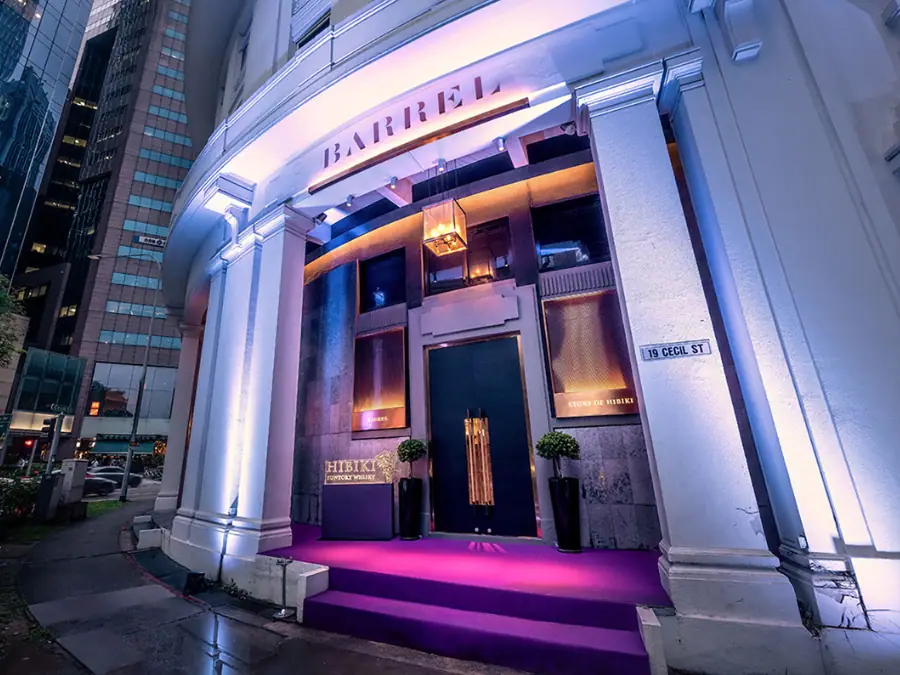
In this, SGS relies on what it calls its gemba philosophy, defined by Song as “staying close to the consumer through elevated on-trade experiences, premium serves and a strong presence across key luxury touchpoints”.
This encompasses concepts such as the ‘Barrel Story’of Hibiki’ dining experience in Singapore (below) and House of Suntory Shop-in-Shops.
The evolving consumer relationship
If there is a dominant thread connecting super-premium-plus spirits across Asia today, it is this need to engage directly with prestige consumers.
Bogaert sees this as an evolution of the consumer relationship, from merely transactional to something much deeper. He highlights Pernod Ricard’s ‘Le Cercle’ loyalty programme for its most faithful collector customers, involving private advisors, exclusive experiences and rare access – for instance, the launch of cask programme ‘The Vault’ at last October’s Singapore Formula 1 Grand Prix. There are also retail pop-ups blending art and entertainment, exclusive previews and tastings.
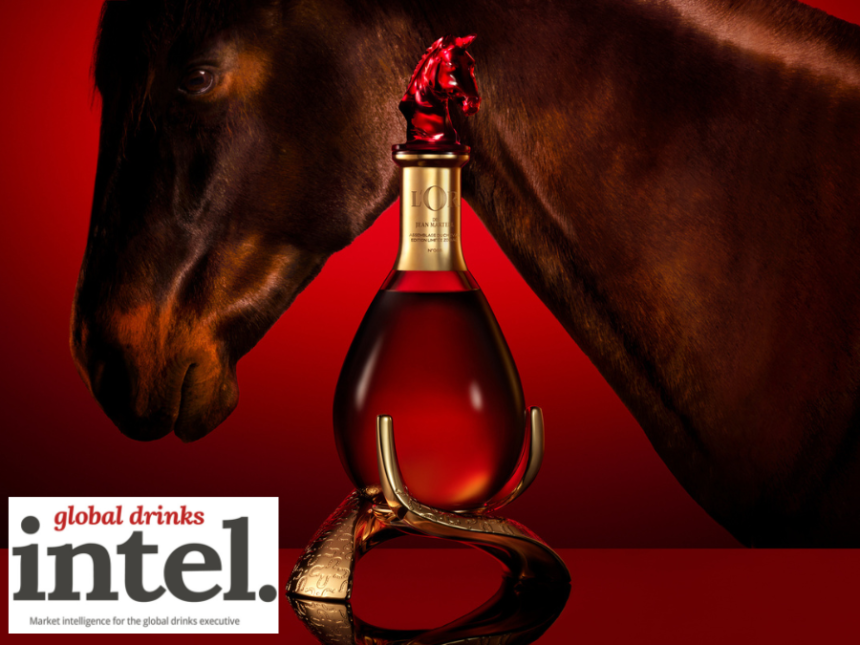
“In a crowded market, the modern luxury consumer seeks more than just a product,” Bogaert explains. “Rather than a global ‘one-size-fits-all’ campaign, we focus on moments that matter for our consumers. Leveraging major cultural celebrations allows us to remain part of the consumer’s heritage and traditions, as we do with Martell (main image) during Chinese New Year every year, with a strong focus on Cordon Bleu this year.
“We’ve shifted our focus from short-term, fragmented tactical actions toward a unified strategic framework. We now ensure that every initiative contributes to a sustainable increase in brand desirability and long-term value creation.”
Meanwhile, Brown-Forman’s Albarracin reports that the company is expanding its luxury footprint in Asia by introducing three to four additional premium labels to key markets, such as India, over the next few years, including The Glendronach and El Jimador.
“While cyclical headwinds like inflation exist, we’re witnessing a deeper, structural, permanent evolution across what is a fascinatingly complex region,” she explains.
“Contrary to the global narrative of drinking less, IWSR data show Asian Gen Z is actually discovering new ways to enjoy alcohol through ‘nuanced choice’ – favouring high-quality spirits in social, highly aesthetic settings. We believe once consumers migrate to these authentic, super-premium brands, they rarely trade down permanently.”