

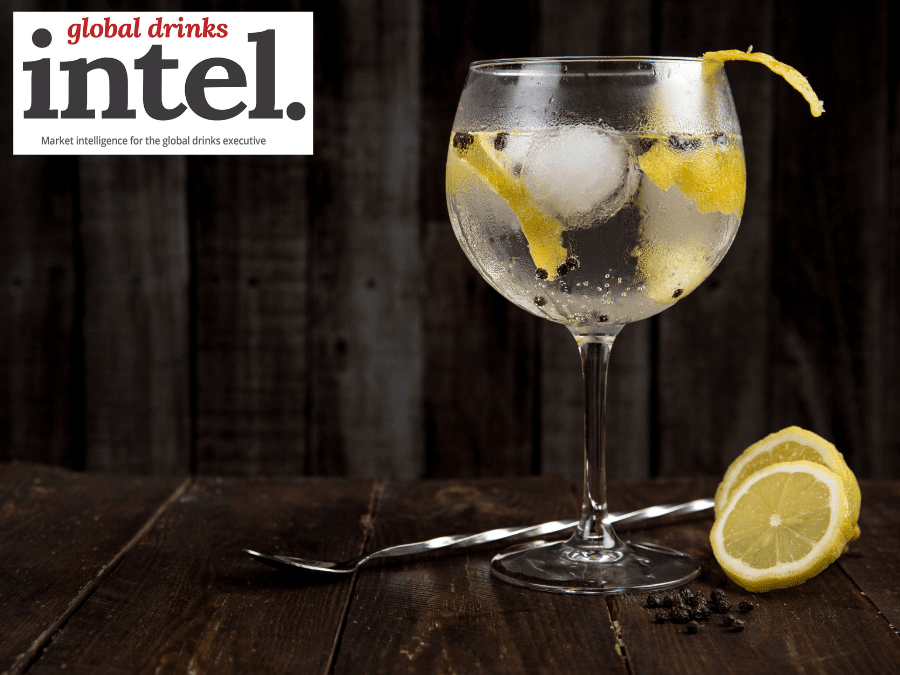
As the ‘ginaissance’ peaks in the segment’s key markets, brand owners are thirstily eyeing new consumers, particularly across the Americas, Asia and Africa. Richard Woodard reports.
Where next for gin? As the segment’s key markets mature – especially the UK and Spain – and the range of gin-centred beverages and consumption occasions grows ever larger, it’s a question that’s about more than mere geography.
Rumours of gin’s demise, perhaps as a result of the COVID-19 pandemic, have once again proven to be exaggerated, with brand owners looking to a number of markets across the Americas, Asia and Africa, and flavoured gins continuing to bring new news to consumers who have not tired – yet – of the juniper-based spirit.
“In Europe, the gin boom is over the peak, but still slightly growing – though, not as much as before,” says Godelief van Erve, global marketing director of De Kuyper Royal Distillers, owner of the Rutte brand. “In Asian markets, gin is growing, especially in countries such as India and China. Not only is gin consumption rising in these markets, but so are locally-crafted products.”
That’s music to the ears of Sanjeev Banga, president of international business at India-based distiller Radico Khaitan, owner of Jaisalmer Indian Craft Gin. “Yes, the ‘ginaissance’ started in Europe and the rest of the world is following it,” he says, “maybe not at the same pace in some markets. The US seems a bit slow, but we expect it to catch up very fast.
“India is seeing remarkable growth in gin consumption, especially in a category that was non-existent until three years ago. The Middle East, Far East and Australia are also witnessing a growing demand for gin. As more people have started travelling, Global Travel Retail is also returning to pre-COVID levels.”
The US is clearly a huge potential market for gin – Cotswolds Distillery CEO Jeremy Parsons describes it as “a big opportunity for the category”, but there are still plenty of openings across Europe for brands with the right credentials and at favourable price points.
“Europe continues to perform very well,” observes Brockmans CEO Guy Lawrence, quoting IWSR Drinks Market Analysis data showing that super-premium gin grew by 33% in Europe during 2021. “We see strong growth in big markets such as Germany, Spain, Italy and also Austria, Switzerland, Belgium and France.
“The US continues to do well, and is a high-potential market, as does Canada. Asia (super-premium gin (SPG) +21% in 2021, IWSR) is clearly behind the European curve from a volume perspective, but these are also good markets. Americas SPG is now the same size as Europe SPG, and growing at 26% a year, according to the IWSR.”
Premium-plus and flavours offer opportunities in UK and Spain
There are even opportunities in the traditional gin hotspots of the UK and Spain, where growth is “slowing”, according to Robert Eastham, global sales & marketing director of Zamora Co-owned Martin Miller’s. He points out that, globally speaking, ‘premium-plus’ is the second fastest-growing segment, behind flavoured gin.
Flavoured gin can divide opinion in the industry – to purists, anything that takes juniper away from centre stage lacks authenticity – but there’s no doubting its role in reinventing the category and driving it on to even more growth. Martin Miller’s takes what Eastham calls a “premium” approach to flavours with its Winterful and Summerful limited-edition seasonal releases, which aim to remind consumers of the scents and flavours of autumn/winter and spring/summer, respectively.
At La Martiniquaise, Gibson’s has grown steadily since its repackaging. The brand is now ranked in the top ten across Europe and leads in France, with 39% market share. Flavoured gin, in the form of Gibson’s Pink, infused with strawberry and rose petal, has been a key part of that success, leading the French pink gin segment with a market share of 42% (IRI).
Now, Gibson’s is exploring the fashionable trend for all things citrus, with Gibson’s Blood Orange, a premium gin containing juniper, coriander, angelica and fresh, bitter blood oranges. According to international brand manager Chanhy Bastos, Gibson’s Blood Orange is poised to launch in a number of markets, including the Netherlands, Portugal, Turkey, Africa, the Middle East and Latin America, with Mexico a key market. “Where the brand was almost exclusively distributed in Europe a few years ago, it now extends to more than 50 countries,” Bastos says.
“Citrus is still a strong theme because people associate with it easily, especially as it’s often used as a garnish,” says Jim Long, owner & MD of UK-based botanicals supplier StarSpice Ingredients. The proven success of citrus is a particular draw for established brands, he adds, highlighting extensions such as Hayman’s Exotic Citrus, which uses ingredients including kumquat, Persian lime, pomelo and mandarin.
Capitalising on no- & low-
Another area of expansion for gin is the burgeoning no- & low-alcohol segment – both in the form of 0% ABV versions of marquee brands, such as Tanqueray and Gordon’s, and in the new breed of intensely botanical gins that claim to deliver a great G&T with 90% less alcohol. “Gin can also optimise the growth of lower-alcohol moments, and our Gin Essence was developed to offer consumers a lower-alcohol G&T without the compromise on flavour,” says Parsons. Cotswolds Dry Gin Essence is bottled at 46% ABV, but is designed to use only 5ml of spirit per serve because of its concentrated formula.
Others, though, are less convinced of the potential of the no- & low- opportunity for gin. Eastham agrees that it makes sense for volume gin brands to launch no-alcohol versions, before adding: “We might see some growth under this premise, but we don’t see this as the next big thing in the gin category. Our focus is on what we know best, which is premium gin for gin lovers.”
Gin is now broad enough to embrace a wide diversity of approaches and strategies. Liviko’s Crafter’s Gin brand continues to expand its range, adding to its London Dry Gin (launched in 2015) and colour-shifting Aromatic Flower Gin (2017) with the arrival this year of Crafter’s Wild Forest Gin. The extension is described by export marketing specialist Gloria Hallaste as “a homage to the mythical Nordic wilderness” with botanicals including juniper berries, spruce thorns, pine shoots, late summer heather flowers and blueberry shoots.
“Innovation remains very important, for sure,” says Brockmans’ Lawrence, by way of contrast. “However, as a one-SKU business at Brockmans Gin, we see continued success from just focusing on our core proposition. Well-made, delicious-tasting gin marketed correctly will always do well. Super-premium gin continues to show promise in line with the premiumisation trends we see across categories around the world.”
This article was initially published in July/August’s issue of Global Drinks Intel magazine. For details on how to subscribe, click here.