

This article has been available to Global Drinks Intel subscribers since June. For details on how to join them, please click here.
As the saying goes, Rome wasn’t built in a day. On closer inspection, that rings true for every corner of the Italian capital – including its on-premise. From trendy locales to password-protected speakeasies, the city is bursting with creativity.
Italy has long been one of the most popular tourist destinations globally, and the country’s capital city shaped the world in a way unlike any other. Today, Rome is famed not only for its rich history and cultural significance, but also for its food and beverage offerings that attract residents and tourists in their droves.
The scene
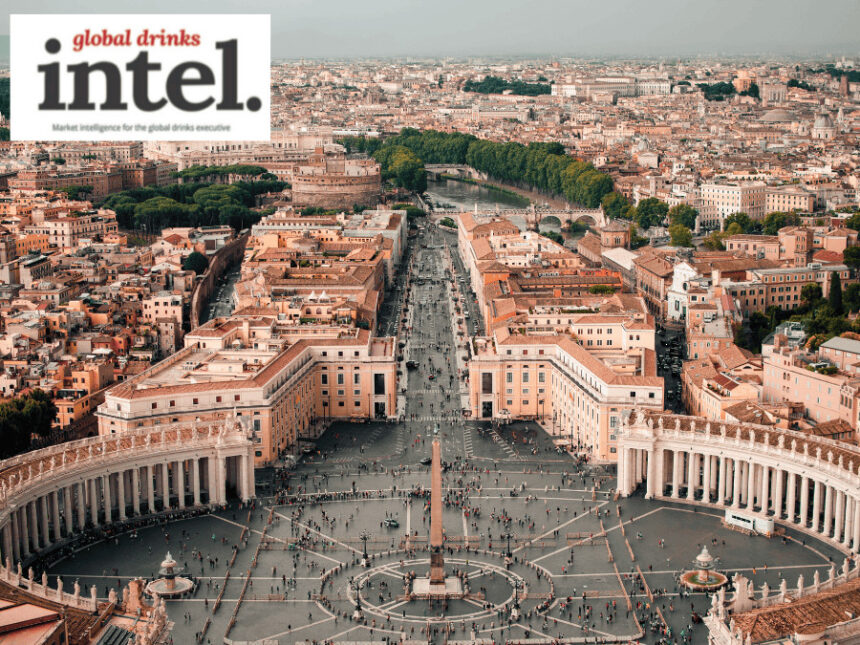
With a population of a little over 4.3m, the metropolitan city of Rome is the most populous in Italy. On top of that, the city welcomes around 10m tourists each year – in 2022, the total arrivals in Rome’s hotels and residences were 9.9m, an increase of 245% on 2021 – and a recovery of +74% on 2019 – according to the Lazio Bilateral Tourism Authority. With the Colosseum and St Peter’s Basilica [in the independent Vatican City State at the heart of the capital] regularly featuring on the list of the world’s ten most visited landmarks, it’s little wonder the city is such a draw.
Rome offers a myriad of on-premise options, with over 8,000 restaurants and more than 9,000 bars. From the neighbourhoods of Trastevere to Prati, every crevice of the city has something to discover.
Take Drink Art Gallery, for example. Nestled in the Ponte area, the cocktail bar features works of art and vintage objects that help recreate the atmosphere of clubs in the US from the 1930s, with German and Belgian beers, numerous distillates and fine wines to enjoy.
Continuing the 1930s theme, over in Campo de’ Fiori you’ll find the Jerry Thomas Speakeasy which pays homage to the legendary namesake US bartender. Serving a range of classic and contemporary cocktails, everything inside the bar is 1920s- and 1930s-inspired – including the drinks. The speakeasy takes meticulous preparation of its infusions, bitters and spirits aged in wood and glass. Opened by a team of bartenders in 2010, the small club in the heart of the city became known as the first Italian ‘secret bar’ – entry is via password and only 30 to 40 people are admitted each night. Named as one of the 50 World’s Best Bars for five years in a row, bartenders here are masters of their craft.
Francesco Delfino, a trainer at the Jerry Thomas Academy, says: “In a classic cocktail bar such as Jerry Thomas, the Martini is trending once again.” Other classic serves, such as the Americano and Vermouth & Soda, are also popular at the speakeasy, but consumers are becoming more adventurous with their choices. “People are not afraid to try new drinks with different techniques, for instance, clarification, redistilled or milk/fat-washed,” says Delfino. “They’re more open to it now than they were even a few years ago.”
Key trends
If you order a drink from a Roman bar in the late afternoon until early evening, you will often be asked if you would like an aperitivo. The drink-and-snack occasion is meant to stimulate the appetite to prepare for the upcoming meal. It’s a popular tradition in Rome to gather with friends or colleagues at a bar or restaurant for an aperitivo before dinner.
“The most popular drink always remains the Aperol Spritz, especially during aperitivo,” says bartender and head of relations & sponsors at TEDxSapienzaU Ilaria Cataldi. Typically, an aperitivo includes a glass of wine, beer or a Spritz [comprising Aperol or Campari with Prosecco and soda water], accompanied by small plates of olives, cheese, cold cuts or bruschetta. One popular recent trend, however, is the Aperitivo Analcolico – a non-alcoholic version made from bitters, citrus and herbs.
In Rome, Crodino is a popular carbonated aperitif drink that’s often served as a non-alcoholic alternative. The beverage, originating in the 1960s, is now owned by Campari Group, which suggests serving in a lowball glass over ice with an orange slice to bring out the distinctively bitter flavour derived from a blend of herbs and spices that include rhubarb, gentian, nutmeg, cloves and coriander.
International players
While Italian brands such as Martini, Campari and Aperol are staples in Rome, multinational brand owners, including Bacardi, Diageo and Pernod Ricard, have always had a strong presence. This has been especially evident of late due to the gin boom, says Cataldi, as it is mostly imported.
Research from CGA by NIQ shows that over a quarter of Italian on-premise consumers drink gin – significantly more than those who imbibe whisky/whiskey, vodka, rum, brandy or Cognac – and more than a third order with ‘very high’ frequency, or even every time they go out.
With the rise of gin has come a renewed interest in mixers. “For soft drinks,” says Cataldi, “we use Schweppes, but in this market segment, there have been several changes. International producers tend to offer new things, especially in flavoured tonics. Several competitors to Schweppes are coming into Rome, such as Fever-Tree, as well as other manufacturers who are positioning themselves in the more premium area.”
Having an edge is crucial for brands, while Cataldi notes that for younger LDA consumers, premium and quality reign supreme as they look to drink “in a more sophisticated manner”.
Local players
Some of the best juniper in the world grows wild across Italy, so it’s little surprise that the rise of gin has been accompanied by the arrival of local brands. Today there are around 300 Italian gins, including Rome-based Santuario and Distilleria degli Umori as well as Del Professore – the vermouth and gin brand was acquired by Campari Group last year.
The demand for quality is prevalent throughout the supply chain and is increasingly being tied into mixology in Rome. At Terrazza delle 5 Lune, a rooftop bar tucked away behind Piazza Navona, Delfino offers high-quality spirits in a creative format by mixing traditional and modern elements. “The typical consumer is a traditionalist, so to get people to experiment more, it’s easier if you add a few elements of novelty,” he says.
The bar offers classic cocktail serves, such as a Spritz or Negroni, for consumers to experiment with “because the ending – Spritz – alludes to the name of the cocktail and, for example, Prosecco remains the common element, so the consumer becomes more comfortable trying something creative, rather than a completely new cocktail invented by us”, explains Delfino.
Challenges and opportunities
Like everywhere else, Rome’s on-premise was hit hard by Covid-19. The Italian Federation for Retail & Catering Businesses [FIPE] believes the channel was “among those [industries] hit hardest by the pandemic and restrictive measures”, with 80% of Italian families reducing their consumption in bars and restaurants in April 2021 compared with before the pandemic.
There’s been a remarkable recovery since then, with the sector’s sales climbing by EUR1.2bn [US$1.3bn] in 2022, according to the FIPE. This year is crunch time – 2023 is when the trade association predicts the city’s on-premise will “return to the turnover levels of the summer of 2019”.
Many Roman bars and restaurants already offer a range of no- & low-alcohol options, but with consumers embracing the health & wellness trend, it’s likely that demand for premium no/low options will rise. This offers an entanglement for producers, which Cataldi sees as both a challenge and an opportunity.
“There’s still a lot of work to be done,” she says. “No- & low-alcohol alternatives are more of a cultural change that people need to get used to. If bars propose particular cocktails as non-alcoholic that look as aesthetically pleasing as their alcoholic counterparts, consumers will adapt more easily, as there won’t be any prejudice towards people who are simply drinking a mix of fruit juices.”
With this in mind, Cataldi created a signature non-alcoholic cocktail for Terrazza delle 5 Lune called Daisy B, with grapefruit, lemon and rose syrup. “Although the ‘mocktail’ page in drinks menus has long been seen as an add-on, lately more people want something without alcohol,” she says. “For establishments, it’s only fair to broaden one’s cocktail list to meet the needs of those who maybe, just to avoid drinking alcohol, go for the classic Coca-Cola or lemon soda.”
Although Rome has a reputation steeped in tradition, this step-change proves that the city’s bar scene is steadily moving in a more modern direction.
This article has been available to Global Drinks Intel subscribers since June. For details on how to join them, please click here.