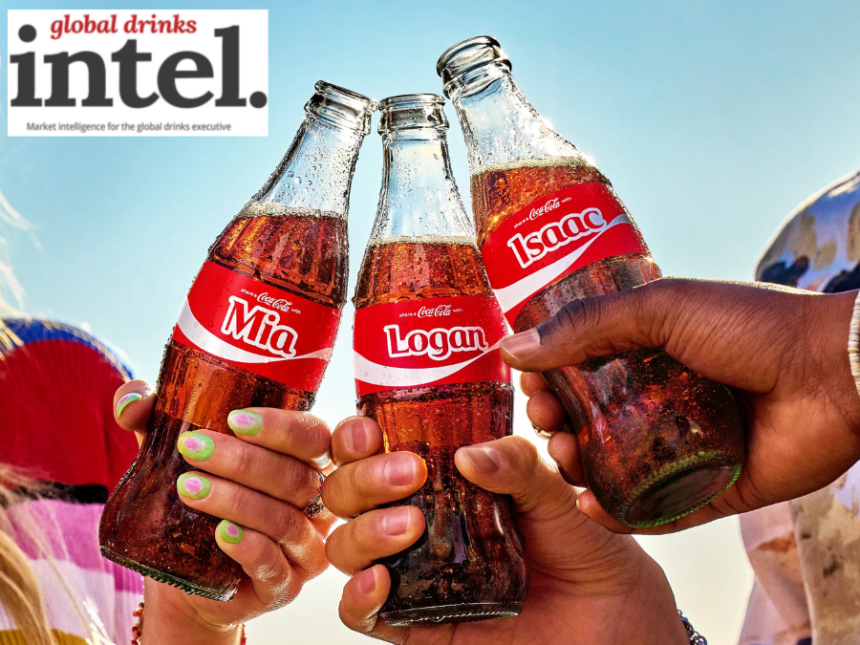
Coca-Cola’s ‘Share a Coke’ marketing platform returned last month – and it’s easy to see why. The response to the first activation in 2011 was phenomenal, boosting young consumers’ engagement and driving sales skyward.
As you’d expect, the new campaign’s launch ad is slick. But it also highlights something important that’s now lacking in many global campaigns: unique insight.
As was the case 14 years ago, ‘Share a Coke’ involves the brand swapping out its logo for personalised names on-pack in its signature typeface. This time around, however, it’s targeting a new generation – information overloaded Gen Z consumers thirsty for authentic connection in an increasingly digital world.
To bring this to life, we see young people struggling to fit in the demands of modern life – studies, work and socialising – across online and physical spaces, before Coca-Cola helps to bring them together with personalised bottles and cans, a QR code-powered digital hub and a ‘Memory Maker’ feature.
So far, so good. Only, for me at least, there’s a bit of a ‘but’.
But what makes this different to what other soft drinks brands are doing?
Take Fanta’s new ‘Wanta’ global brand platform, which launched a year ago.
In its launch ad, we see how Fanta helps young adults juggle studies, work, socialising across online and physical spaces by quenching their thirst for authentic connection and enabling them to ‘Do more of what they Wanta’.
Both brands sit in The Coca-Cola Co’s portfolio, so it’s fair to assume that their brand teams drink from the same target demographic insights fountain.
The end results, however, lack differentiation – something that often occurs when worldwide brand strategies are built on an insight that has at its core a commonality to unite a global audience.
Both are strong examples of classic, insights-driven marketing. The two executions are just about different enough, but how much better would they be if each had been built on a more distinct and clearly ownable, brand-specific insight?
Often, a lack of distinct insight means some global brands struggle to be truly innovative – a preference to shoot for the larger – and easier-to-score – targets instead is a common indicator.
Take PepsiCo, which in March acquired prebiotic soda brand Poppi in a jaw-dropping US$2bn deal. Could a brand owner of PepsiCo’s scale, reach and resources have spotted the health soda trend sooner and grown something itself from infancy? I guess now we’ll never know.
Another global soft drink brand shooting for a bigger bullseye is 7Up. In September last year, the brand unveiled its new ‘Level Up With 7Up’ platform, which is all about positioning the soft drink as a mixer to elevate social occasions.
The insight here seems to be that mixers are big business. As this is true, there is indeed a certain logic to what they are doing. But by not marketing 7Up as a drink in its own right, are they diluting the product (no pun intended) and selling it short?
Big opportunities can look great because they are just that: big. But that doesn’t necessarily mean they are always the right opportunity for a brand to automatically pursue.
One last strategy that caught my eye recently is Minute Maid Zero Sugar’s ‘Sells Itself’, the better-for-you beverage option’s first global brand platform.
Again owned by The Coca-Cola Co, Minute Maid’s approach zags where Coke and Fanta zig. Its ads show actor Jon Hamm (whose Mad Men character Don Draper created ads for Coke) preparing to hawk the product only to discover that his doing so is redundant – because Minute Maid Zero Sugar sells itself.
The campaign is entertaining and slick. And it’s likely to have been informed by the same insights about what Gen Z wants. It, however, wears its insights lightly – avoiding the clichéd replaying of the woes of today’s hectic lifestyles that have led others to look and feel alike.
In marketing circles, the power and importance of having a unique creative asset is taken as read. But that’s only half the story.
So let’s hear it for the power and importance of the unique insights every marketer needs, to help them produce the full story.