

This article has been available to Global Drinks Intel subscribers since June. For details on how to join them, please click here.
The makers of a synthetic alcohol substitute believe its lack of buzz-killing side effects could change the beverage alcohol industry beyond recognition.
Something rarely discussed among those who work in beverage alcohol is the simple fact that consuming too much of the stuff is bad for your health. The descending ladder of negative outcomes might start with a hangover after a big night out, but more intense consumption brings with it a greater risk of falling prey to over 200 diseases, from cancer to cirrhosis. Indeed, the World Health Organization labels alcohol as a “toxic, psychoactive and dependence-producing substance” and has taken the position that “no level of alcohol consumption is safe for health”.
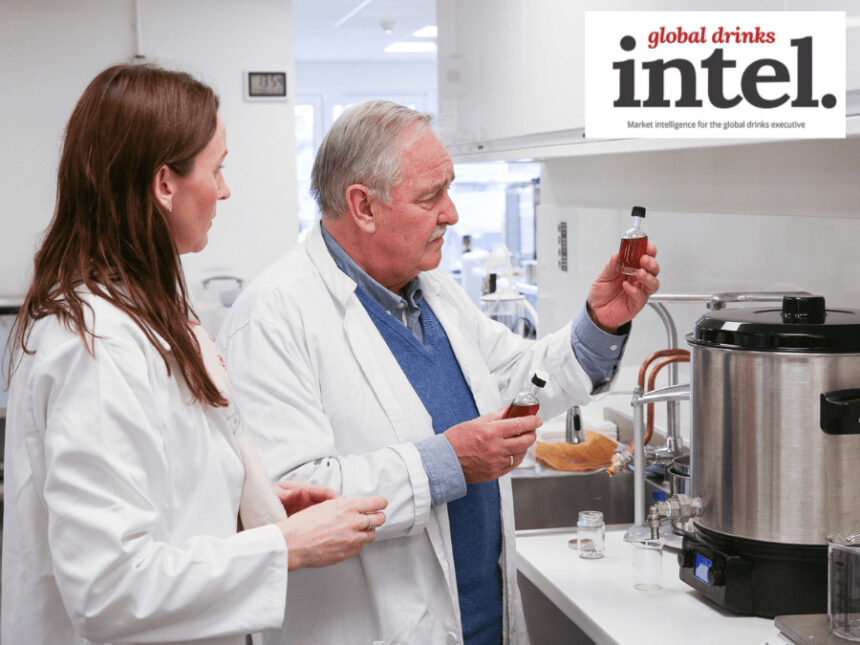
The harmful effects of alcohol have been a significant driver of the no- & low-alcohol segment, which in 2022 surpassed US$11bn in value across ten key markets, according to IWSR Drinks Market Analysis. These effects also inspired UK-based firm GABA Labs, a team of neuroscientists led by professor of neuropsychopharmacology David Nutt, to develop a synthetic alcohol compound called Alcarelle. Nutt claims the compound mimics the positive effects that alcohol has on the brain, but avoids the harmful ones that come with drinking to excess.
Alcarelle targets the gamma-aminobutyric acid [GABA – hence the company’s name] system in the brain – a chemical messenger that reduces anxiety, stress and fear – and produces a calming, mood-altering effect. GABA Labs is raising funds to have Alcarelle approved by the US Food & Drug Administration, a costly – and lengthy – process expected to take until 2028.
If successful, GABA Labs will sell Alcarelle to third-party drinks companies to add to their own products. “We don’t want to compete with the drinks industry,” says co-founder & MD David Orren.
Botanical spirit Sentia Red’s ‘warm and joyous’ effect
In the meantime, GABA Labs has joined the growing number of companies whose beverages promise to replicate the effects of alcohol using plant extracts. In 2021, it launched Sentia Red, a 0% ABV floral, bittersweet aperitif-style spirit made with a long list of botanical ingredients the company claims enhance the brain’s GABA system, including magnolia bark, rose, hawthorn, liquorice, blackberry and gentian.

While the beverage contains no alcohol, GABA Labs recommends that consumers shouldn’t drive after drinking Sentia Red, while pregnant women and those on medication should also give it a miss.
“It’s not the exact equivalent of the effects of alcohol,” says Orren, “but it gives you a very healthy, warm and joyous state. You feel good; you are completely controlled and utterly conscious.”
Priced at GBP29.50 [US$36.70] for a 50cl bottle and sold mainly online, Sentia Red has proven popular – sales in ‘Dry’ January this year increased 20 times over 2022. Some high-end bars and UK department stores stock the product, and the company has received distribution offers for Sentia in Canada, Germany and South Africa. Orren is also confident of a US launch in the coming months, while a second expression, the spicy Sentia Black, launched earlier this year.
Orren is keen to point out that, despite its success, Sentia Red is only a vehicle to get Alcarelle into the market. “I want the drinks industry to make its own generation of drinks,” he says. “If we can make better drinks than the industry, then there’s a problem. We need to step back and be the ingredient supplier providing the opportunity to add that functional effect, but without the damage to health.”
Alternative-alcohol category could be ‘seismic’
GABA Labs is not the only company active in this area – several start-ups in the US, such as Kin Euphorics [backed by US model Bella Hadid], Psychedelic Water and Ghia, have also created alcohol-free spirits that claim to create a relaxed buzz.
Orren welcomes the competition. “I don’t think anyone else is doing the scientific work that we’re doing to triangulate and identify the most effective use of botanicals, but there are people playing with botanicals and we welcome that,” he says. “Some of them have done some good work.”
GABA Labs doesn’t yet have enough evidence to legally make health claims about Sentia or Alcarelle, but Orren is convinced the creation of an alternative-alcohol category could be a seismic development, not only in beverage alcohol but also in wider society.
“It’s potentially transformative, just like electric cars are,” he says. “It might take a little time to happen, but once the imagination kicks in and there’s knowledge and conversation about [alcohol alternatives], the demand will just make it happen.
This article has been available to Global Drinks Intel subscribers since May. For details on how to join them, please click here.