

This article was initially published in the November issue of Global Drinks Intel magazine. For details on how to subscribe, click here.
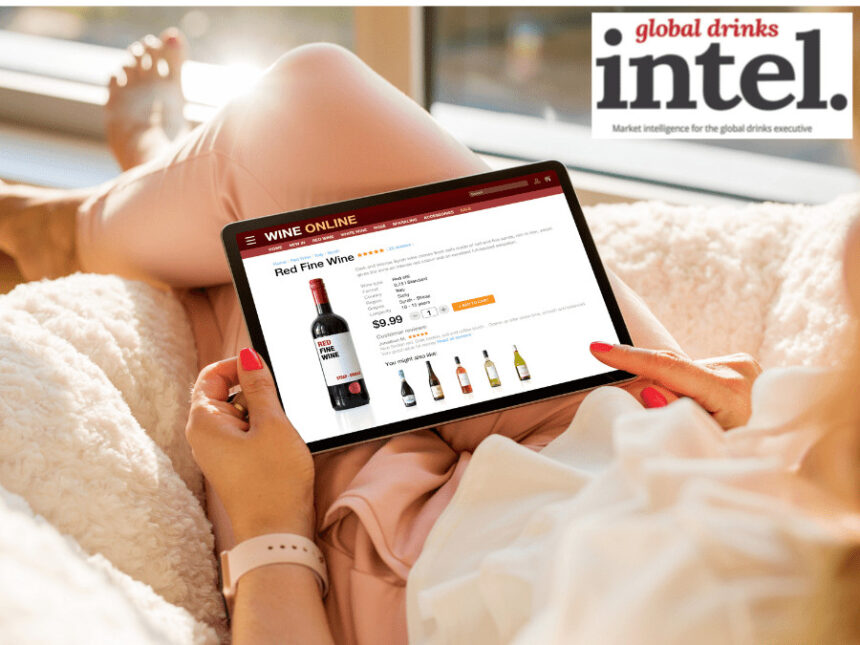
After booming during the worst of the pandemic, online beverage alcohol sales have dropped off slightly. Roger Morris examines whether e-commerce will deliver in the long term.
During the first two years of the Covid-19 pandemic, online retail sales of beverage alcohol in the US grew so quickly that, given the channel’s small size and fragmented nature, it was difficult to determine precisely how large the growth was.
It is also a diverse channel, populated by pure online retailers with no bricks & mortar presence, grocery stores and supermarkets where such sales are permitted, direct-to-consumer (D2C) sales by wine and spirits producers, and a quickly emerging sector – traditional wine and spirits shops, many of which never sold online before the pandemic.
Now, almost three years after the onset of the pandemic, the question are stacking up. How ‘sticky’ is the channel? Will consumers go back to shopping primarily in person, or will they continue to order aggressively online, whatever their favourite source? And, will the ordered wine or spirits be shipped to the consumer, hand-delivered or collected from the wine shop or cellar door?
Online channel doubled in size from 2019 to 2021
To the great relief of online retailers, the channel is beginning to look quite sticky, though not yet quite like superglue.
A recent report by Rabobank, a leading global food and agribusiness bank, found the online channel for alcohol had more than doubled in size from US$2.6bn in 2019 to more than $6bn in 2021 – although it still represents only about 4% of total off-premise alcohol sales. Rather than retreating post-pandemic as some had predicted, Rabobank predicts a modest 3.4% increase for online this year.
“Through the first three quarters, our estimates have been holding pretty well, although there was a decrease in first-quarter sales,” says Bourcard Nesin, a RaboResearch beverage analyst and author of the ‘Alcohol E-Commerce Playbook’ report. Nesin notes that sales have been catching up in recent months and his 3.4% estimate is in line with IWSR Drinks Market Analysis, which estimates US growth of 1.3% in 2022 [and average annual growth of 10.9% from 2021 to 2026].
While consumer demand is crucial, there are other fundamental growth factors. “What you need to understand,” Nesin tells Global Drinks Intel, “is it’s not just about consumer demand. During the pandemic, many grocers and wine shops that had not previously sold wine and spirits online invested in the infrastructure to do so.” Now, it’s in their interest to continue to drive – or lure – consumers online to fulfil their investment’s potential.
Similarly, when wineries had to close their tasting rooms during lockdowns and struggled to staff them when they reopened to the public, they invested time and money into D2C presence with upgrades, added content, trained personnel and expanded wine clubs.
Neither were big alcohol brand owners standing idly by. According to Rabobank’s report, the average size of these companies’ e-commerce teams has grown since 2019 by 117%. So, even though online retail sales remain a relatively small channel for alcohol, both established and new players believe it is full of promise, perhaps representing their greatest growth engine.
Food and beverage outlets set a fast pace
While the rest of the online alcohol sector was doubling sales, food stores’ online alcohol sales increased by 238% year on year in 2020, then by another 9% in 2021. This growth is being driven both by small grocery stores just discovering online business and by large food chains accelerating their gradual expansion into online sales. For example, Nisen says that before the pandemic, Walmart, the international hypermarket chain, had only 200 of its US stores delivering alcohol. That number has risen today to more than 1,500.
Another sales accelerator came from consumers upgrading their purchases, especially during the first year of the pandemic, although the trend continues today. During 2020, the Distilled Spirits Council of the US (Discus) reported sales of super-premium brands represented 40% of revenue growth. Discus’s then-chief economist, David Ozgo, credited this trading-up to consumers “not travelling, going on vacations or dining out as often”.
For 2022, Nisen expects the grocery store segment to increase by about 15%.
Marketplaces expand & diversify
Both Instacart and Drizly were established in 2012 as marketplaces or e-commerce platforms that didn’t actually produce alcohol or hold inventories, but rather worked with those who did to market and deliver those products through websites and specialised apps. Not surprisingly, their businesses, along with smaller marketplaces such as Vivino, have exploded over the past few years. Instacart, for example, upped its delivery business during the pandemic from 7,000 partners to 17,000.
City Hive is another company that has facilitated the growth of online beverage sales. “We started City Hive in 2016 as a tech platform for independent businesses,” says co-founder & CEO Roi Kliper, who explains his background is in tech and not beverages. “After one month, we had 25 wine and spirits accounts.” Today, City Hive services more than 3,000 wine and spirits retailers in 40 states and claims to have the largest network of independent stores. “We’re an enabler,” Kliper says, explaining City Hive’s clients can’t always compete on price with retailers with thousands of SKUs. “We believe whoever owns customer relations owns the business, and that’s where we fit in.”
Rabobank predicts this segment will grow by about 15% in 2022.
Speciality retailers expand beyond the rare and the old
For years, David Parker and his Benchmark Wines were e-commerce outliers, founded in 2002 to sell rare and older wines online. Now, with an inventory of more than 60,000 bottles at any given time, Parker has seen the number of online retailers grow around him. Some deal in current vintages or special offers, some own inventory, while others take orders on behalf of producers. “We’ve seen a lot of changes,” he says. “The rise of nationwide [online] retailers had started before the pandemic, and they continue to be strong, although we’ve seen some dropouts.”
These national players have been joined in force by small, single-store retailers — the so-called ‘mom & pop shops’. “We did a little business before the pandemic,” says Margaret Bruce Leigh, wine director for Ace Beverage in Washington DC, which has been in business since the repeal of Prohibition in 1934. “Then, things exploded, and we pivoted to put everything online. It continues to be a big part of our business, mainly with local deliveries, except for speciality whisky shipments.”
Whether big or small, online-only or with a storefront, it is more difficult in the US for retailers to sell nationwide than it is for D2C wine and spirits producers. “Currently, only 15 states allow out-of-state retailers to ship wine into their states,” says Tom Wark, executive director of the National Association of Wine Retailers, the organisation leading the charge to change these prohibitions.
Rabobank expects this channel to drop in sales by 6% after a period of hyper-growth, but a rebound is expected in 2023 as adjustments are made and new technologies come online.
D2C online temporarily cools off
Rabobank also predicts a 5% decline in 2022 for D2C sales, which it organisationally splits between online-only wine clubs with no in-person venues (which netted sales of $846m in 2021) such as Naked Wines and Winc, and traditional winery-based sales ($791m), which depends heavily on tasting room interactions.
That may be changing. In its annual D2C survey released in June, Silicon Valley Bank found that online activities hosted by wineries while their tasting rooms were closed may be paying off in other ways than immediate sales.
In the report, Rob McMillan, who heads the bank’s wine division, wrote: “Prior to 2020, attracting new [wine] club members was always a key function for the tasting room. The industry has since discovered how to gain memberships via digital marketing now, with an average 17% of new members joining via digital channels in 2020 and 2021.”
Overall, Rabobank says total online sales have now grown to represent about a quarter of the $7.2bn D2C wine sales.
What lies ahead?
Despite signs that the US and global economies will remain in their current funk, or likely worsen, Rabobank’s Nesin sees continued growth in online alcohol sales for some time ahead. “Wealthy people tend to do well in a recession,” he says, “and online shoppers tend to be much wealthier – and with higher education – than average.” Online retailers are working hard to capture younger people, he adds, even though their current spend levels may be minimal. “Win them now, and they’ll be loyal for the next 20 years.”
Benchmark’s Parker also sees a bright industry future coming from younger consumers. “Millennials have always been curious, more so than Gen X,” he says. “They’re into trying new things – different wines from different regions.”
City Hive’s Kliper, meanwhile, believes the future lies with the ‘hyperlocal’ personal approach to online sales, and they are all optimistic about spirits. Long consigned to high-end and rare products, spirits are expected to gain a larger portion of future online alcohol sales.
Nesin remains optimistic: “E-commerce will be the No.1 driver of industry growth over the next decade and a critical component of brand-building, awareness and trial, both online and in-store.”
This article was initially published in the November issue of Global Drinks Intel magazine. For details on how to subscribe, click here.