
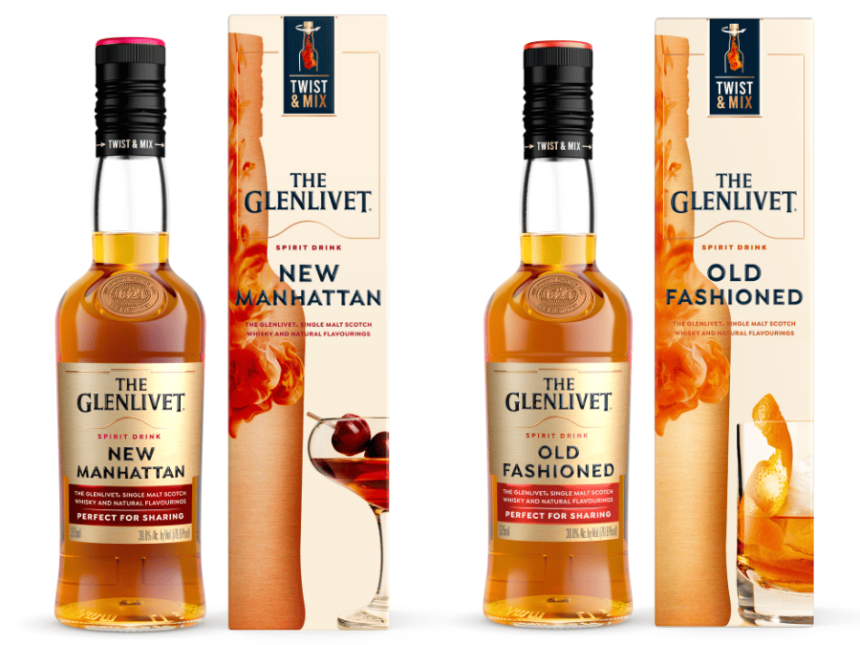
Two months ago, Pernod Ricard’s Chivas Brothers division released Twist & Mix, a premix concept for single malt The Glenlivet. Global Drinks Intel caught up with the group’s global head of Scotch whisky portfolio innovation, Yogesh Gandhi, to learn more about the growing importance of finding something new for consumers in spirits.

Global Drinks Intel: How long have you been with Pernod Ricard and what are your roles and responsibilities?
Yogesh Gandhi: I’ll hit 11 years in December. I’m a bit of an innovation lifer. Where I am now has more interesting innovation than Procter & Gamble, where I used to work – that was tooth whitening and skin care.
There are a lot of different parts to my role. The most important is orchestrating innovation. In Pernod Ricard – and in Chivas Brothers – we have internal innovation within the brand companies, but we also have innovation happening in our regions. That’s a load of different stakeholders that need to be managed. I need to make sure whatever innovation is happening is laddering up into our overall business and brand objectives.
The other side of my job is about working with the teams to identify innovation. That’s about talking to the brand teams, understanding the needs and opportunities, and then matching that with consumer trends or unmet consumer needs. We’re continually doing research, so we have a good sense of what it is that the consumer wants and what trends are coming through, and then we match those together.
A few years ago, for example, we were seeing the beginning of more conscious consumption. In Spain, which is traditionally a strong market for Ballantine’s, the brand had been slowing as a result of this trend. That led us to build Ballantine’s Light [with an ABV of 20%]. That’s the link between business opportunity, business need and consumer trend.
Speak to anyone in innovation, and you’ll get 50 different processes – there are a lot of templates. Within the process, there’s a lot of artistry, experimentation and failure. Sometimes we have to kill projects because they don’t work. There’s also a lot of perseverance. Twist & Mix took the best part of three-and-a-half years!
The process isn’t perfect, but there is structure. In many ways, it’s chaos within structure.
GDI: Where do you experience the most resistance to innovation?
YG: Three or four years ago, it was very traditional – leather sofas, fireplaces, that sort of stuff. But what I’ve seen is this real desire to take Scotch in new directions and into new places.
One of our oldest innovations is Chivas XV, a 15-year-old blended Scotch. The insight there was, when you look at American and Irish whisky/whiskey, the eyes on the wider category had really grown, but the perception of Scotch was still very traditional – ‘for my father’. With Chivas XV, we looked at a higher-energy moment. We changed the liquid profile completely, it’s a much smoother whisky. There was no resistance to that.
The marketing directors we have now have the foresight to see this as the direction we need to go in. That may be contrary to what you thought my answer would have been, but we’re starting to push stuff. There’ll be a lot more over the coming months and years that double-down on that point.
GDI: Are there any toys on the Chivas Brothers shelf that you’re not allowed to play with?
YG: We’ve been trying to break innovation in many ways. Traditionally, it’s always been age and cask finish. That’s pretty much it. We’re starting to play with some really interesting cask finishes, for example, and there’s a lot coming. You would never have seen that previously.
One of the key things we’re doing now is working cross-collaboratively with other Pernod Ricard groups such as The Absolut Co and Mumm, Perrier-Jouet & Martel on how we use packaging to deliver experience. That’s where the consumer’s going. We all live in an experience economy now. There are a lot of toys on the shelf that are packaging-led, such as the paper bottle from The Absolut Co. We’re looking at how we extend that beyond Absolut.
GDI: Why did you apply the Twist & Mix concept to The Glenlivet? You could have used it on Ballantine’s or Chivas.
YG: The DNA of The Glenlivet has always been about original thinking and breaking tradition. Do you remember ‘The Capsule Collection’, which we launched in 2019? That surprised all of us!
Single malts have traditionally sat separate from cocktails. What we’ve seen is you can use single malts in a great way with cocktails, where you’re still getting the flavour while making it more approachable to more consumers.
We didn’t want to get a traditional RTD for The Glenlivet but having this technology, which allows us to elevate the liquid, felt like a good fit.
GDI: What are your expectations for Twist & Mix?
YG: We’re very much in a test, learn and optimise mode. The experiential part is so big, so I’m hoping consumers will have it in their hands very soon and start to share it on social media.
On the surface, it seems like making an Old Fashioned or a Manhattan would be really simple, but it took us a long time to get those perfect. We don’t want to rush into doing Whisky Sours, for example, until we know we can deliver something great.
Over the next few years, more markets and more flavours will definitely be on the cards.
GDI: How big a growth driver is innovation? Have the knocks on your door become more frequent in recent years?
YG: The simple answer is yes – a lot more.
Six or seven years ago, for example, the Chivas portfolio was much narrower – we had 12-, 18- and 25-year-olds. Now, we’ve got a whole range, including Chivas Extra, which has gone into lots of different versions, Chivas XV and Altus.
Innovation is now seen as the big driver. When you look at American and Irish, there are so many different flavours and options. We need to get into delivering newness for Scotch.
We’ve done a hell of a lot over the last six or seven years to break that traditional perception of Scotch, to make it more accessible. Ballantine’s Light is one, then there’s the Ballantine’s gaming stuff recently with Borderlands and we launched a blended whisky with The Last of Us game called Moth & Wolf. That was all about using innovation as a way to attract new consumers into whisky and make them feel like it’s not such a precious thing.
GDI: How much of a hindrance are the definition regulations around Scotch to innovation?
YG: The rules are there for a good reason, to maintain the category’s integrity. They do limit us to a certain extent.
In the first instance, we won’t think about the rules. We’ll think about how we get the best proposition for the consumer. Then we have informal conversations with the Scotch Whisky Association – we have a great relationship with them – to understand what they think to make sure we sit on the fence. We want something great for the consumer, but we still want to sit within the world of the SWA.
GDI: What innovation have you seen in other spirits categories that you wish you could do in Scotch but can’t?
YG: I saw Skrewball peanut butter whiskey [which Pernod Ricard bought a stake in seven months ago] and thought that’s an amazing concept. Would we ever do that on Chivas or The Glenlivet? Probably not, but we’ve started doing stuff like that on Ballantine’s flavour range – that’s a good way to make your brand more accessible.
I also saw the use of a widget in an Espresso Martini RTD that gives the serve a head. Could a whisky with a head be an interesting thing? I don’t know, but it works in that category. Maybe it would work in our category.
We’re definitely looking at packaging and technology to add new benefits for consumers. There’s so much more you can do.
Why infinite whiskey/whisky onto finite US shelves won’t go – Market Intel