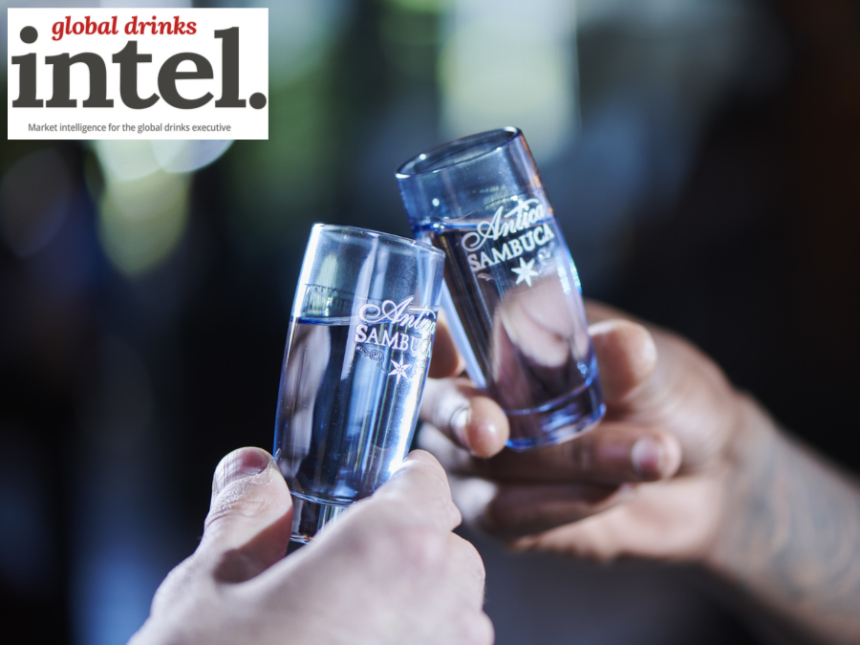
- Long pigeonholed as either a shot or a digestif, sambuca has struggled to remain relevant amid emerging preferences for lower-ABV, lighter and ‘healthier’ serves
- Brand owners believe the category needs to embrace new serves like long drinks and cocktails, as well as innovative consumption occasions in the on-premise
- While some attempts are being made to make sambuca more exciting, smaller brand owners feel there needs to be a category-wide push to revive its prospects
The words used to describe the market for sambuca are fairly uninspiring – ‘mature’, ‘traditional’, even ‘dormant’. In its Italian home market, the liqueur is struggling to break free of the digestif moment, while abroad it is yet to shake off the shackles of shot-fuelled nights out – and heady mornings.
“Ten to 15 years ago, sambuca had a big revamp thanks to flavour [innovation],” says Pallini SpA CEO Micaela Pallini. “But now, it’s more static.” Despite describing the market as “dormant”, Pallini emphasises that the category is “still big”.
“Like many people, my early memories of sambuca were tied to the shot occasion and not necessarily in a positive way,” adds the founder of JBC Distillery in Australia, James Columbine. “For a long time, that experience shaped my perception of the category and meant it wasn’t something I actively sought out or explored further.”
Sambuca sticks out awkwardly amid beverage alcohol trends for lower-ABV and ‘healthier’ serves too. European law requires liqueurs labelled as sambuca to have a minimum ABV of 38% and a minimum sugar content of 350g per litre.
On top of that, while traditionally consumed for its medicinal properties, anise as a flavour is divisive. Perlino, the Villa Cardea, Dilmoor and Milla Maestrini brand owner acquired by La Martiniquaise-Bardinet in 2015, says sambuca’s “distinctive flavour can make it harder to recruit new drinkers”.
A combination of the above has led to what Perlino sees as the category’s main challenge: “Declining relevance among younger consumers, who are increasingly drawn to tequila, aperitifs and no/low-alcohol options.”
A new serve for sambuca
To broaden sambuca’s reach and accessibility, there is unanimous feeling that the category would benefit from branching out beyond digestifs and shots.
When it comes to sambuca’s party association, Pallini says: “I don’t think it’s very beneficial, especially now”. In Italy, she notes that the health & wellness trend, coupled with the increasing cost of living, mean consumers are currently less likely to opt for a dessert, and thus a digestif. Meanwhile, the country’s stricter drink-driving laws have also curtailed the after-dinner consumption occasion.
Pallini suggests serving sambuca with ice, before dinner, or even with food. While sambuca pairs well with things like coffee, cream liqueurs and chocolate, she feels “it’s not an easy mixer”.
Might it be the next spritz liqueur? “No, definitely not!”
For Columbine, the most obvious opportunity is in “simple long drinks”. Contrary to Pallini, he thinks sambuca works well with mixers like “soda water, tonic, lemonade and even ginger beer, where the dilution softens the intensity of the anise while still allowing the flavour to come through”.
“If someone’s only memory of sambuca is a late-night shot from 20 years ago, simply handing them another neat shot is unlikely to change their view,” adds Columbine, whose AUD45 (US$31.80) Wild & Aromatic Sambuca uses local botanicals, such as aniseed myrtle and strawberry gum, for an Aussie twist. “Presenting it in a different context creates an opportunity for [consumers] to experience the category in a new way,” he says.
“From a cocktail perspective, I’d be interested in seeing more bartenders use sambuca as a modifier rather than the hero ingredient. Similar to the way absinthe is often used in small amounts to add complexity and aroma, sambuca can bring an interesting layer of sweetness and herbal character when used thoughtfully.”
At Rossi d’Asiago Distillery, CEO Nicola Dal Toso believes the best approach is not to ditch shots but to straddle sambuca’s role as both a party drink and “a premium Italian spirit”.
“The shot occasion has played an important role in building awareness of sambuca around the world and remains a key driver of visibility, trial and consumer engagement,” says Dal Toso. “Today’s consumers are increasingly focused on quality, moderation and meaningful social experiences. In that context, the shot occasion is about sharing moments, celebrating with friends and enjoying a distinctive product with a strong identity.
“The goal is not to move away from shots, but to ensure sambuca is appreciated for everything it has to offer.”
Room for international growth
While the bulk of sambuca’s volumes are still consumed domestically, producers say the liqueur still has significant untapped potential internationally.
“The category may never become a mass-volume spirit like vodka or whisk(e)y, but it can certainly become a larger and more valuable category,” says Dal Toso.
The US holds most export sales (19% in volume terms), followed closely by Germany (18%) and the UK (16%), according to IWSR. Of the top five export markets, three (Canada, the UK and the US) saw volumes decline between 2020 and 2025, while Germany remained flat. Only the Netherlands, which imports 6% of global volumes, grew, rising 2%.
Perlino marketing manager Elena Branda suggests sambuca is seeing a challenge of recruitment as its consumer base ages. “The UK’s relative stability is particularly interesting,” she says. “The market has a long-established sambuca culture in bars, clubs and the late-night trade, which has helped maintain a loyal consumer base.
“However, the fact that volumes were flat rather than growing suggests that even in one of the category’s strongest markets, recruitment of new drinkers remains a challenge. Overall, the data suggests that sambuca is not facing a crisis of relevance among existing consumers, but rather an enrolment challenge: maintaining devotion is not enough when younger consumers are entering the spirits market with very different preferences and drinking occasions.”
Asked about export markets for Rossi D’Asiago’s Antica Sambuca, Dal Toso says: “We see mixed performance across markets, with some experiencing declines or stagnation while others have remained broadly stable.
“This reflects both category dynamics, broader shifts in the spirits landscape and consumer trends. In many of these markets, the consumer’s attention has moved toward fast-growing categories such as tequila, agave spirits and RTDs.”
Despite this, he says “strong, well-positioned brands with clear identity, consistent quality and strong distribution can remain resilient and even grow share within their segment”.
For Pallini, the global travel retail channel holds potential – particularly at sea. “On a cruise line,” she says, “people tend to indulge themselves. They don’t have to drive. They have time.”
A paucity of brands
While sambuca is certainly an established category, Pallini says it could do with an international push from “bigger players to try and help us innovate the category”. She explains: “The problem with the sambuca market is there are just two or three brands, and then there’s a lot of [lesser-known] names.”
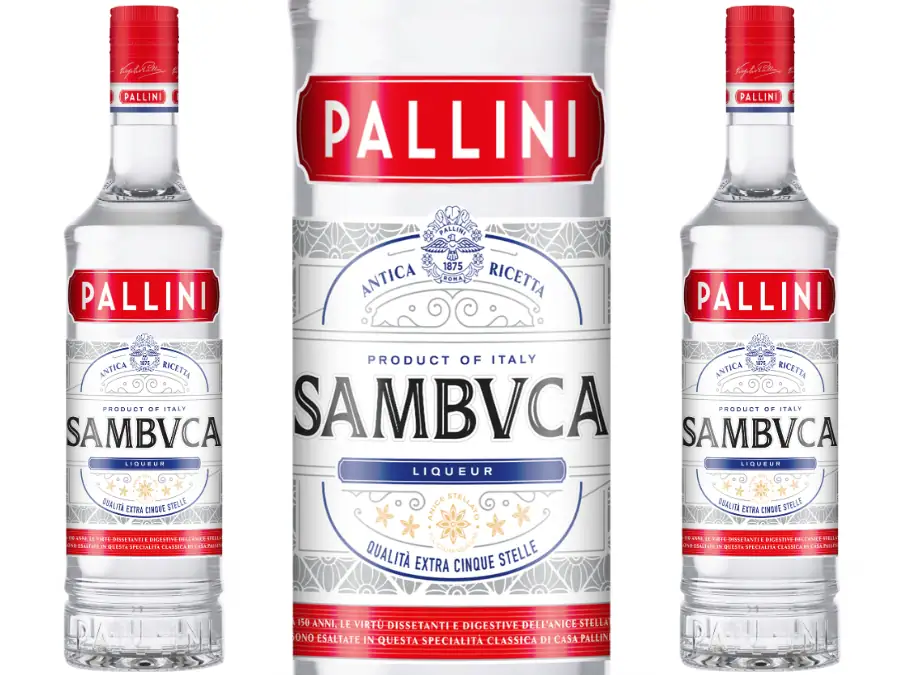
As part of its 150th anniversary celebrations this year, Pallini revamped its Sambuca 313 brand, renaming it Pallini Sambuca (above), updating the bottle shape and introducing a new label featuring “Art Nouveau motifs”. Part of the rationale behind the name change was to simplify the concept – The number ‘313’ referred somewhat randomly to the distance in steps from the Pallini Distillery to the Pantheon in Rome. Perhaps more significantly, the new name allows the company to lean into the recent success of Pallini Limoncello.
“We’re looking to support the brand strongly, maybe – depending on the market – by putting it next to our limoncello,” says Pallini. “[Sambuca is] a category that needs a bit of love, a revamp, and it still could deliver some interesting sales, because a lot of customers like the flavour.”
With a little innovation and attention, sambuca could yet break out of its malaise. Whether the anise liqueur can compete with the rising stars of limoncello or RTDs, however, is less certain.