
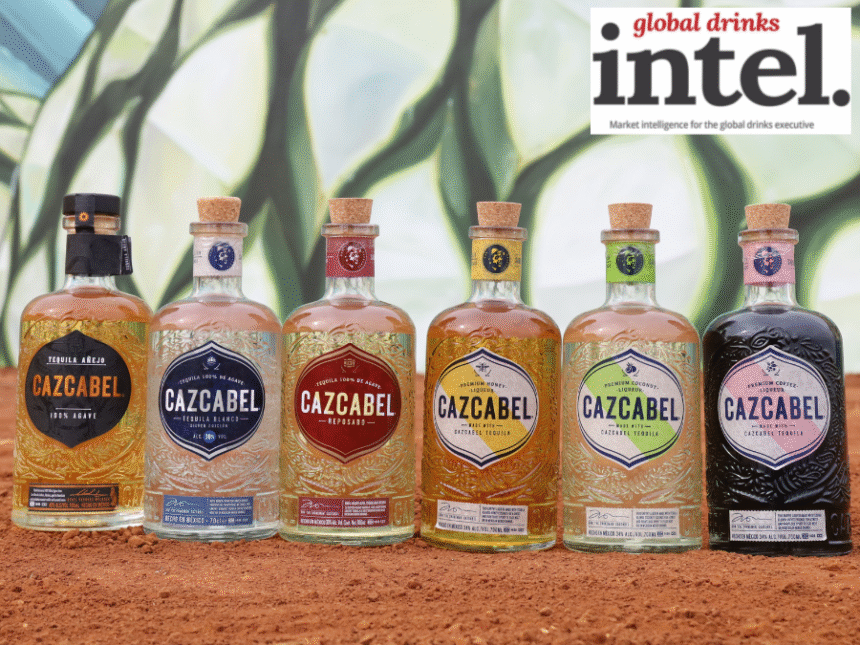
Guy Lawrence’s career in beverage alcohol dates back to 1988, since when he’s held roles of increasing seniority at companies including Bacardi, Russian Standard, Mast-Jägermeister and Brockmans Gin. At the start of last year, he set up specialist drinks advisory firm Craft Spirit Capital and is currently working with tequila brand Cazcabel as a non-executive board advisor.

Be early – But not too early
Innovation is essential, but timing is everything. Lawrence’s first lesson came early in his career at Guinness, when he helped launch Smithwick’s Alcohol-Free Bitter. The product was sound, but the market wasn’t ready. “It was an unmitigated disaster,” he recalls. “At the time, in the late 1980s, no God-fearing bitter drinker wanted to drink an alcohol-free bitter.”
Contrast that with his next project – Guinness Draught in cans, which introduced the innovative widget. “It worked very, very well,” Lawrence says. “The business went on to do GBP50m [US$66m] in retail sales within two to three years.”
“We all want to create products that are differentiated, but if they’re too differentiated, they’re not relevant. If they’re not relevant, they’ve got no market. Now, what can happen is you can differentiate yourself into a position that you think the market is going to move to, and that’s where the skill lies. If that market then opens up, you end up having the lion’s share of that particular opportunity.”
Build a high-performance culture
“It’s all about the team,” Lawrence insists. During his tenure at Bacardí and later as CEO of Mast-Jägermeister’s UK unit, he focused on developing people and culture.
“You can’t achieve any spectacular success without a great team,” Lawrence says. That meant empowering staff, encouraging constructive feedback and investing in development – even hiring a coach to instil a high-performance culture. Both Bacardí UK and Mast-Jägermeister UK became ‘Sunday Times Top 100 Companies to Work For’ under his leadership.
Now, as a board member & advisor, Lawrence sees the same principles at play: “Whether you’re working with five or 100 [employees], it’s the same – be collaborative, open-minded and relentlessly focused on ROI.”
Success can happen quickly
While many entrepreneurs expect a long grind, Lawrence emphasises that rapid growth is not only possible – it’s something to be prepared for.
He shares an example from his time at vodka brand Russian Standard, which doubled its sales in two years. “We went from 350,000 to 750,000 cases,” he says. “That kind of explosion was a result of great route-to-market, focused distributors, the right pricing and some smart luck.”
But, luck favours the prepared. “You need to have done your whole opportunity assessment,” Lawrence says. “Understand the consumer, the trade and your financials. Then, you work it – very hard.”
Nail down your route-to-market
Perhaps the costliest mistake new drinks brands make is expanding too fast – particularly internationally. “It’s very tempting, when you get that call from a French distributor,” Lawrence warns. “But, if you haven’t built out your home market first, you’re diverting funds and attention too early.”
He stresses that route-to-market should be focused and sequential. “You need velocity; it needs to be multichannel,” he says. That means establishing on-premise credibility, then building out retail and e-commerce once the brand has real traction.
And beware the US trap: “To launch in the States properly, you need serious money and capabilities. You can burn through cash quickly.” In short, dominate your home turf before trying to conquer the world.
Don’t lose money
It sounds obvious, but in an industry known for glitzy campaigns and high burn rates, profitability is often neglected. Lawrence quotes the late Charlie Munger, who was vice chairman of Berkshire Hathaway: “Rule No.1: Don’t lose money. Rule No.2: Don’t forget rule No.1.”
He’s a strong proponent of what he calls ‘bootstrapping’: “I don’t believe in over-investing,” Lawrence says. “You learn more that way. Ask yourself, ‘Where’s the best place to spend this GBP10,000? How do I get the best return?’”
From using AI to reducing headcount to hiring fractional executives, Lawrence recommends getting scrappy early on. “If your brand has the DNA to be big, you’ll see that without burning millions. Then – and only then – raise to scale.”
He adds a final caveat: “Chasing growth in a declining category is a trap. I’ve seen businesses double down when consumer sentiment had already moved on. Don’t throw good money after bad.”
If Lawrence has one overarching message, it’s this: Success isn’t solely about having a great product; it’s about having the right plan, people and principles to back it up.