

The city that never sleeps has awakened from its pandemic-induced slumber and its on-premise is thriving. Bridget McElroy reports
Though the Covid-19 pandemic quite literally placed a curfew on the city that never sleeps, New York City (NYC) has recently begun to remind the world just why it earned its nickname in the first place. As restrictions loosen, NYC’s seemingly immeasurable drinks culture is once again gaining momentum.
The scene
NYC is made up of five boroughs: Manhattan, Brooklyn, Queens, the Bronx and Staten Island, all of which abound with thousands of restaurants, bars, speakeasies, clubs, pubs and other venues. In 2016 (the most recent year for which standardised data sets are available), nightlife generated $35.1bn in total economic output in New York. In 2019, before the pandemic sent shockwaves through NYC’s restaurant industry, it had 23,650 establishments.
Manhattan is the most densely populated county in the whole US, so it comes as no surprise that of the five boroughs, Manhattan boasts the largest number of these nightlife establishments. A person cannot even step outside in Manhattan, let alone walk down the block, without eyeing at least one.
The bar subsector includes drinking establishments that primarily serve alcoholic beverages, of which there are upwards of 2,000. With more than 6,000 active on-premise liquor licenses across the borough as of 2018, it is clear that a significant portion of consumption occurs not only at drinking establishments, but also at those designated as food services.
Every neighbourhood, from the Upper East Side through to Midtown, has its fair share of institutions with something unique on offer. However, the most popular areas in which to imbibe are downtown. The West Village, with its cobblestoned streets and neighbourhood feel, is packed with fashionable restaurants and swanky bars. Radiating out from there with similar atmospheres are the Meatpacking District, Chelsea, SoHo and Tribeca. The Lower East Side and East Village are also heavily trafficked by late-night revellers, though the scene is a touch grittier there.
Key trends
While the Covid-19 pandemic dealt a devastating blow to the industry, it did not have major negative effects on drinking habits. If anything, New Yorkers may have been indulging more over the past year, with beer, wine and spirits sales all up through December. Not only that, but consumers have been trading up into more premium brands, especially when purchasing wine.

When countered by the fact that nobody was drinking out during lockdown, it is not clear whether New Yorkers were actually drinking more, or just drinking more at home. Regardless, the longlasting curfews and restrictions fuelled an eagerness within New Yorkers to rejoin the city’s vibrant on-premise scene. Some bartenders even say that the social deprivation of the last year has ushered in a new, more aggressive generation of mass drinking to compensate for ‘lost’ time.
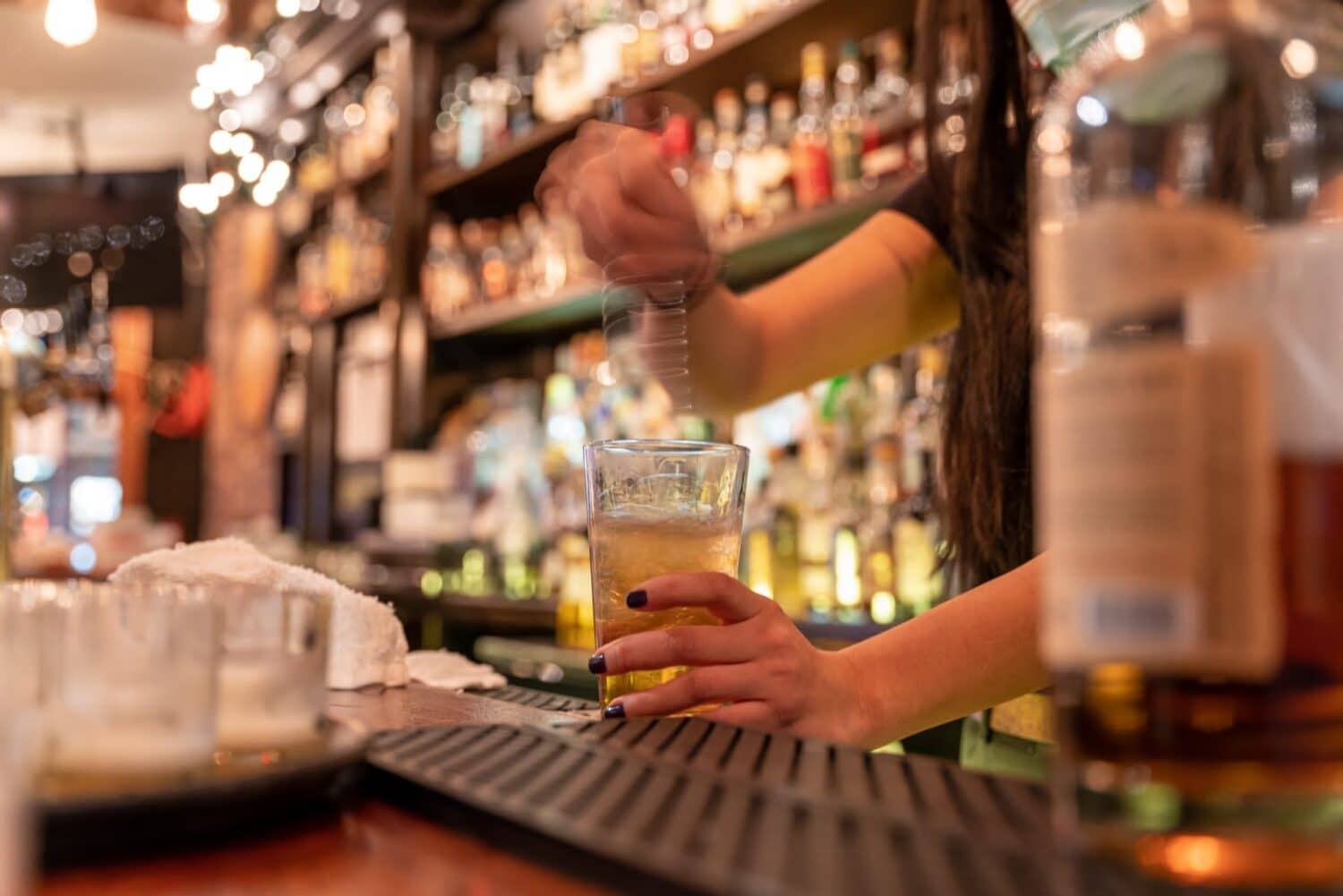
When bar seating was reinstated in early May, the influx of patrons was immediate. Although NYC altered its liquor laws early in the pandemic to allow to-go and delivery drinks (this ended on 24 June), and the city’s top bartenders led an explosion of virtual mixology sessions, takeaway drinks and self-mixed cocktails did not scratch the itch. “People were just dying to be able to just sit at a bar and order a drink,” says Edwin Morales, bartender at The Copper Still in Chelsea, where business has boomed since reopening in June last year.

Seasonality affects drink inclinations but overall, vodka and tequila reign supreme in the spirits category, with Tito’s and Casamigos at the top of their respective lists. While the simple vodka seltzer will always be in high demand, right now, mezcal and tequila consumption is soaring. The spicy margarita is perhaps the most trending drink in Manhattan, and an exceeding number of cocktail bars and restaurants offer at least one rendition.
Most bars are also stocked with a variation of a hard seltzer, whether it be White Claw, Truly, High Noon or one of the many other brands that have dipped their toe into the spiked seltzer movement. Though these seltzers were more popular pre-pandemic, they maintain relevance, often ordered as a beer substitute during the day or much later at night.
International players
The international influence on New York is palpable — 40% of its population is foreign born, and New Yorkers speak 800-plus languages. This cosmopolitan identity manifests itself in both alcohol preferences and prices. Pre-pandemic, 40% of New Yorkers and 51% of non-residents spent more than $30 on drinks alone during a typical night out. New York is infamously expensive and when paired with the fact that the on-premise clientele favours large international brands (especially domestic labels with an international reach) over small regional ones, drinks prices make sense. Patrón, Jameson, Stolichnaya, Grey Goose, Bacardi, Hendrick’s and Tanqueray are all ubiquitous.
That’s not to say New Yorkers don’t appreciate the niche, too. Ireland’s The Boatyard Distillery just started distributing its Double Gin in NYC, and Matthew Hunter, the former head mixologist at the esteemed Eleven Madison Park, has dubbed it his favourite gin right now. It’s bottled at 46% ABV, and according to Hunter, is perfect for a summertime gin-and-tonic or martini.
Local players
In considering local players, one must look to Brooklyn. Home to most of the city’s local producers, the borough lays claim to around 20 independent craft breweries, each with an annual production of 6m barrels of beer or less. Craft beer, specifically IPAs, is gaining momentum and the younger population is likely to choose a craft brew over a mainstay like Guinness or a Bud Light.
Brooklyn also boasts ownership of 10 of the New York metropolitan area’s 12 distilleries. Despite being the birthplace of the first commercial distillery in North America in 1640, Staten Island has no distilleries today. The other two, Port Morris Distillery and Long Island Spirits are in the Bronx and on Long Island respectively. All 12 produce small-batch products for a mostly local or regional market. Even Kings County Distillery, NYC’s oldest and largest whiskey distillery, can only ship to 40 states, and not internationally.
Although New York state is one of America’s oldest and largest wine-producing states, very little wine comes from the city itself. A few wineries, tasting rooms and a plethora of extensive wine lists exist, but NYC’s only vineyard is in Brooklyn at the Navy Yard. Not only is Rooftop Reds New York’s only vineyard, but it is also the world’s first commercially viable urban rooftop vineyard, producing 20 to 25 cases a year.
Challenges and opportunities
Like most cities, all bars and restaurants in New York were forced to close in March 2020 save for delivery. Phase one of reopening did not begin until June 2020. Even then, the city’s governor Andrew Cuomo frequently updated indoor dining ordinances and reduced capacity limits, making the process tedious and frustrating.
Many mixologists, like Hunter, took to the web to host virtual classes during lockdown. Others, like Jack Schramm, who was head bartender at experimental bar Existing Conditions in Greenwich Village before it closed permanently, got more creative. Schramm teamed up with Milk Bar confectioner Jena Derman to launch Solid Wiggles, a company that ships boozy (and not-so boozy) jello cakes across the country. However, most lower-profile service workers had nothing to do except “sit around and collect unemployment”.
As of 17 October, bars and restaurants are authorised by the NYC Council to add a temporary recovery charge of up to 10% to a bill. Before that, New York implemented a citywide program to expand outdoor seating options, thus encouraging social distancing while helping establishments rebound. This movement introduced an exciting al fresco culture to New York, the likes of which have never before existed, but will likely remain long after the pandemic.
Despite these efforts and more, many establishments remain shuttered. Quite a few are contending with New York’s exorbitant rent rates after losing a year’s worth of business and will have to negotiate terms upon reopening. Those that are open, however, are optimistic.
The ‘New York is back’ sentiment is pervasive and bars have seen a major uptick since all remaining Covid restrictions were lifted on 15 June. New York’s once electrifying nightlife is on the rise again, and it’s only a matter of time before the once-famous 4am ‘last call’ is restored.
To subscribe to Global Drinks Intel: https://staging-drinks-intel-com.stackstaging.com/subscribe.php