


This article was initially published in the October issue of Global Drinks Intel magazine. For details on how to subscribe, click here.
The wine and spirits categories in Europe’s Global Travel Retail channel are finally stirring again. Kevin Rozario checks the pulse.
After two years of COVID doom and gloom, the GTR channel has something to smile about as sales are finally rebounding. The European market, in particular, is driving much of the recovery.
Recent results from the large wine and spirits brand owners in this important showcase channel have been reassuring. In what Pernod Ricard describes as a “must-win” market, GTR sales for the group in the 12 months to the end of June leapt 48% year-on-year, with “an exceptionally strong recovery” in Europe and the Americas. However, the French giant, whose brands include Chivas Regal and Absolut, points out there is still work to do as the three-year CAGR for the channel is still negative at -13%.
During the same 12-month timeframe, Diageo — home to Johnnie Walker, Baileys and Gordon’s — saw overall sales in Europe climb 30%, with strong double-digit gains across all markets and “a partial recovery” in GTR, while the company’s Scotch whisky business grew strongly in the channel.
For Jack Daniel’s owner Brown-Forman, the gradual return of travel and tourism led to sales growth in GTR of 65% in the year to the end of April, although the rebound in Europe was not stated.
These three companies accounted for eight of the top ten spirits brands in GTR in 2021 by volume and, together, their results offer hope to the wider wine and spirits category that the trend is now moving in the right direction.
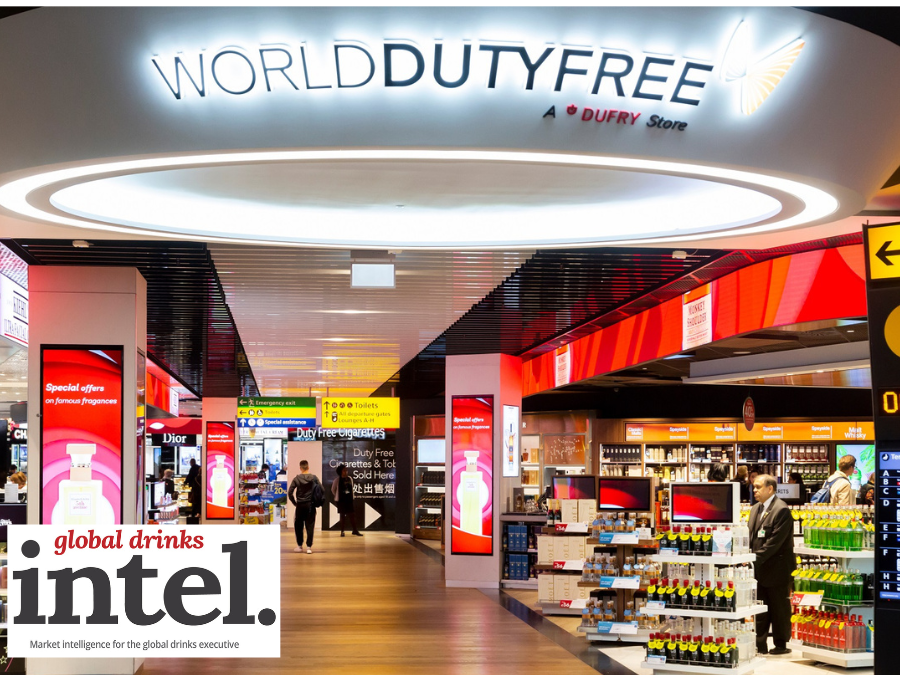
The world’s largest airport retailer, Dufry, which has a particularly powerful presence in Europe, saw its 2022 half-year sales leap by 147% to just over US$3bn. The EMEA region — the retailer’s biggest, accounting for roughly half of global sales — saw sales triple to $1.5bn, led by Mediterranean markets, including Turkey and Greece, as leisure travel demand came back.
“The liquor sales growth and trend in Europe have been focused mainly on the subcategories of whisky, both premium and super-premium, and also Irish and American whiskies,” a Dufry spokesperson tells Global Drinks Intel. “Tequila, rum, vodka and Champagne sales have also increased. In addition, we have seen a positive reaction to no- & low-alcohol products with encouraging levels of sales.”
For now, according to IWSR Drinks Market Analysis, no & low products remain at very small volumes in GTR. Retailer-led initiatives in European airports, however, could build the segment, going forward.
Economic crisis squeezes mid-price
More broadly across the region, the IWSR’s GTR manager Jairo López Suárez says: “In terms of consumer product preference, the possible reduction of business passengers post-pandemic, plus the current economic situation worldwide, has reduced the middle-priced brands in the 2022 sales mix. A reliable way to evaluate that impact is the massive price reductions that retailers are taking, even during holiday seasons.”
López Suárez remains hopeful, however, that the gains seen in most European markets — combined with the easing of some lockdown restrictions in China — are fermenting a strong recovery. “We expect noticeably higher volumes in the travel-retail channel for 2022 versus 2021,” he says.
There is good evidence of a European travel rebound. In July, airports association ACI Europe said its members handled an additional 660m passengers in the first half of last year, a rise of 247% versus the same period in 2021, with international traffic almost quadrupling. Ryanair also broke its passenger record for August, flying 17m travellers across Europe.
On the other hand, hub airports have been unable to cope with the huge demand due to staffing shortages. London Heathrow, for example, extended a daily passenger cap of 100,000 in the summer through to late October, while British Airways cancelled 10,000 flights from its winter schedule.
For European travel retail, then, the picture is still mixed, but brands are stepping up their activity on the basis that passenger numbers will continue to climb. Exclusives are on the rise again, backed by some heavyweight spending. For example, William Grant & Sons’ Glenfiddich Perpetual Collection of four single malt expressions was supported by a pop-up experience at Amsterdam’s Schiphol Airport throughout October, while Bacardi created a ‘whisky emporium’ in Istanbul Airport in partnership with retailer Gebr Heinemann. The operator’s director of purchasing for liquor, tobacco & confectionery, Ruediger Stelkens, says that “premium and exclusive whiskies are very much sought after” at the Turkish hub.
Tim Young, a former Brown-Forman executive who founded Young Spirit Consulting in 2021, tells GDI: “I’m excited to see that travellers are trading up to more premium spirits; no doubt they want to spoil themselves after the pandemic challenges. Travellers are looking for brands they know, but they also want to discover new ones.
“There is a fantastic opportunity for brand owners and retailers to tap into this exploration mindset.”
At Ian Macleod Distillers, its airline business has grown with the exclusive availability of a new flavour of Edinburgh Gin — Orange & Basil — on EasyJet flights during the summer. Another exclusive, Strawberry & Pink Peppercorn, is selling well in Dufry stores. The company also ran multiple activations in the UK and Europe between July and September, focusing on the gin brand’s position as a pioneer in the flavoured segment.
GTR director William Ovens comments: “Edinburgh Gin sales in Europe have been very positive this summer, driven by the significant increase in passenger numbers, new expressions and Brexit pricing.”
A Brexit bonus?
The Brexit boom has been evident on ferry and border routes. Accolade Wines’ EMEA channel sales director, Jeff Bond: “We have focused on our cross-channel business with DFDS, P&O Ferries and Eurotunnel. In 2021, we believed this channel would perform well after the pandemic and zoned in accordingly. A key reason was the reintroduction of duty free, and the ensuing generous alcohol allowances from the British Government for people travelling to the UK.”
The company’s cross-channel sales have risen for its mainstream brands, such as Hardys, Jam Shed, Kumala and Echo Falls, as well as premium ranges from Flagstone, Grant Burge and House of Arras. “We’re particularly pleased with our premium wine sales through DFDS, where we offer multi-buy offers, saving 20%,” says Bond. “People have had a revenge-spend mentality and that’s resulted in higher basket spends.”
Dufry confirms that spend-per-head has “certainly increased”, applying to several categories, not just spirits. “Demand for super-premium and luxury products is definitely helping to drive that trend,” the retailer says. “In terms of maintaining momentum, we’re working in close collaboration with brand partners to develop and implement in-store activations and introduce exciting, desirable new products, many of which are premium and exclusive.”
One newcomer to IWSR’s GTR Top 50 is Finland’s Koskenkorva vodka brand from Anora Group. “We saw an increased purchase basket, especially during, and just after, the pandemic, where travel frequency was much less than it is now,” says Anora’s director of duty free & travel retail, Bo Madsen. Today, we see luxury products working well next to more mainstream ones. The ‘COVID break’ has also given operators time to rethink how to best reach the consumer at all stages of their journey — including on- and off-line.”
At Camus Cognac, president Cyril Camus has also noticed the average ticket rising everywhere. “We’re experiencing pretty good times now in Europe,” he says. “The only shadow is that for categories like Cognac and single malts, the best buyers — for example, the Chinese and Russians — are still not travelling in the region. Some categories may take longer to return to pre-pandemic levels than others.
Confidence restored
Nevertheless, confidence is firmly back as the pandemic shake-out has left GTR operators clearer on their strategies. “A lot of people had time to research and better educate themselves about different spirits, especially craft spirits, so we’re seeing consumers making more educated purchases,” says John McDonnell, MD of international at Tito’s Handmade Vodka.
However, the horizon is not without clouds. Madsen says: “There is turbulence ahead with domestic inflation rates, but we still expect consumers will travel, both for leisure and business. Concepts, products and promotions must reflect situations in different markets.”
Accolade’s Bond adds: “We recognise the impact of inflation and the cost-of-living crisis across Europe, along with increased product transportation costs. We would be foolish to think we won’t be affected as people rationalise their spending.”
In light of the waning economic conditions, Young says: “Regional travel will continue to grow in importance. Brand owners should think about opportunities in border stores, ferries, cruise lines and regional airports.”
Ian Macleod Distillers is assured it can adapt enough to get close to pre-COVID sales levels during the winter “fuelled by more attractive duty-free pricing”. According to Ovens, European travel will have “even more appeal, given the savings” versus domestic pricing. “It’s important for the channel to communicate the value message,” he points out.
The IWSR also believes the European market is in a good position to rebound, although it may just take a little longer. The analyst has forecast the region will recover to pre-pandemic levels by 2024, but López Suárez warns that “uncertain challenges, like new COVID waves or an extended, unfavourable economic climate”, will delay that recovery.
If it’s just a pause, rather than another decline, the spirits industry will, no doubt, be only too happy. Particularly after what it has been through with COVID.
This article was initially published in the October issue of Global Drinks Intel magazine. For details on how to subscribe, click here.