

A convergence of consumer trends has set the scene for spirits-based RTDs to steal the limelight from hard seltzers. Can the sector capitalise and sustain its position? Olly Wehring reports.
The rise of the hard seltzer movement in the US has set the scene for the spirits-based ready-to-drink (RTD) sector to stage the comeback of all comebacks — and don’t the spirits brand owners know it.
A tidal wave of ‘new’ product development, not only from established companies but also from insurgent start-ups, has broken across the segment, capitalising on the category’s momentum not only in the US but also further afield.
On a global basis, RTDs have been growing at around 10% per year (+10% CAGR for the top 20 markets, 2010-21), according to IWSR Drinks Market Analysis, with a rapid acceleration just before and during the pandemic virtually everywhere. While IWSR says this shift was most evident in the US, which recorded a volume CAGR of 34% between 2016 and 2021, consumption is rising fast in a number of other countries, including Canada (+26.1% CAGR, 2016-21) and Japan (+10.6%).
By 2025, IWSR projects that hard seltzers will account for half of all global RTD volumes (up from 30% share in 2020), with flavoured alcoholic beverages (FABs) and premix cocktails/long drinks driving non-hard seltzer growth.
Could spirits-based RTDs return to the same level of prominence as in the early 1990s, when Bacardi Breezer and Smirnoff Ice ruled the waves?
“There’s no doubt that hard seltzers have played a part in attracting consumers to RTDs, but they’ve also helped develop general industry attention towards the RTD market,” admits Natal da Graça, CEO of ‘RTD-cocktail solution’ Coppa Cocktails Co.
Over at De Kuyper Royal Distillers, which has moved quickly to leverage its cocktail-related credentials, global marketing director Godelief van Erve agrees. “In the US, hard seltzers played an important role, of course,” she says. “For other continents such as Europe, they have not had the same impact as in the US, but they’ve brought a lot of new players and products to the category.”
The global MD of Pernod Ricard’s RTD & convenience business unit, Fredrik Syren, goes even further: “What the hard seltzer spike has done is put RTDs on the map,” he says. “Creating that awareness has been a great thing for the overall category.”
While spirits, more broadly, weathered the worst of the pandemic, spirits-based RTDs emerged victorious from the lockdowns, with a raft of consumer trends converging to provide deep and potentially sustainable fishing grounds in 2022.
Demands for convenience and safety amplified by pandemic
The consumer desire to keep up with cocktails while being compulsorily housebound resulted in Tequila, for example, having a bumper 2020. Cuervo, owner of namesake brand Jose Cuervo, had a standout year as consumers chose not to forego their Daiquiris and Margaritas despite the near-total absence of the on-premise channel. “The pandemic made us all rethink,” says De Kuyper’s Van Erve. “Consumers wanted to drink great cocktails despite closed bars and cafés.”
While consumers retained their appetite for cocktails during the dark days of lockdown, a willingness to experiment also arose, according to Da Graça. “Consumers were more open to trying a variety of cocktails they may not have normally had in their repertoire,” he says. “At Coppa Cocktails, we found that consumers who liked one or two of our cocktails ended up trying several, if not the whole range.”
Fast forward to today and those consumers with an established penchant for cocktails are mingling at the bar with those who were new to the more elaborate serves — both are keen to celebrate and both are impatient. “After lockdowns were lifted,” adds Da Graça, “we found the volume of in-home consumption stayed at the high levels of the pandemic, but also noticed that we grew in the on-premise, as consumers wanted quick service with fewer touchpoints.”
The RTD segment intersects neatly with consumer demands for convenience and safety, both of which have been amplified loudly by the pandemic. Pernod Ricard North America CEO Ann Mukherjee summed up the trend at the group’s Capital Markets Day event in June: “Convenience is huge in the US,” she told attendees. “People want convenience when they think about what they drink. While they like to make cocktails at home, they also like to have them in a can.”
While ‘I want it now’ is the buzz phrase in beverages, ‘I want it safe’ is equally deafening — again, thanks to COVID-19. The humble aluminium can provides the peace of mind that consumers are looking for away from the home, so much so that aluminium has been in short supply in several markets (most notably in the US, where craft brewers have felt the squeeze hardest, given their preference for cans coupled with their relatively weaker buying power compared to, say, Anheuser-Busch InBev and Molson Coors Beverage Co).
“The can is the predominant format today in the markets that we decided to focus on first,” says Pernod’s Syren. “We're still a small player and we were late to the party — we admit that. The can is the format we have to play with because we're small.”
The trends just keep coming, as Syren explains: “There’s also a responsible drinking opportunity,” he says. “When you make a gin & tonic at home, I don’t know if you make it at 5% ABV or you make it stronger. One of the reasons people love canned cocktails is it gives them control of their consumption — they know how much alcohol there is.”
De Kuyper’s Van Erve has also spotted the opportunity here. “The trend of no- & low-alcohol is an important driver for the RTD category,” she says. “This is particularly relevant to the younger legal-drinking-age (LDA) consumer: With RTDs, we see the younger generation having an accessible entry into cocktails, with clarity on ABV, calories and ingredients.”
Health & wellness, then, is certainly an area in which RTDs can make themselves known, although not without caution. “I don’t like to use the term ‘healthy’ when talking about alcohol, but a healthier proposition is definitely here to stay,” Syren adds. “Consumers don't want more calories, but they want more taste and they want to experiment more. That's where we think the long drinks and cocktails segment is really going to benefit.”
One of the lessons to learn from both the first coming of RTDs in the 1990s and the roaring rise of hard seltzers will have to be the need to move consumers up the value ladder. And yet, for a category based on scale, RTDs will struggle to play the ‘drink less but better’ tune, right? “I’m not sure I agree,” counters Pernod’s Syren. “What we're about is bringing premium, high-quality products to the market. Historically, the reason the group was reluctant [to enter the category] was because ‘alcopop’ was the common denominator for RTD. Today, you see more premium products and craft propositions in the market, so the group now has more appetite to play.”
Premiumisation, then, offers greater potential to those established spirits brands that extend into RTDs. Yet, the smaller companies are not perturbed, with some arguing that the craft phenomenon is alive and kicking, maybe less so in beer as it once was, but certainly in spirits and RTDs.
“More players and products will result in a wider choice,” says Van Erve. “It’s important, then, to differentiate on quality and taste, and to understand consumers’ needs. It will stimulate quality and innovation in the category, which is a positive development.”
But, what’s the user journey that brand owners envision for consumers? Are RTDs the ‘gateway drug’ to the parent brand? Pernod’s Syren: “We know the RTD consumer is younger than the average spirits consumer and, in most cases, the RTD version is going to be their first experience with our brands because it's much more affordable. Our hope, then, is they start buying the spirits brand. So, there's a recruitment piece that’s very exciting for us.
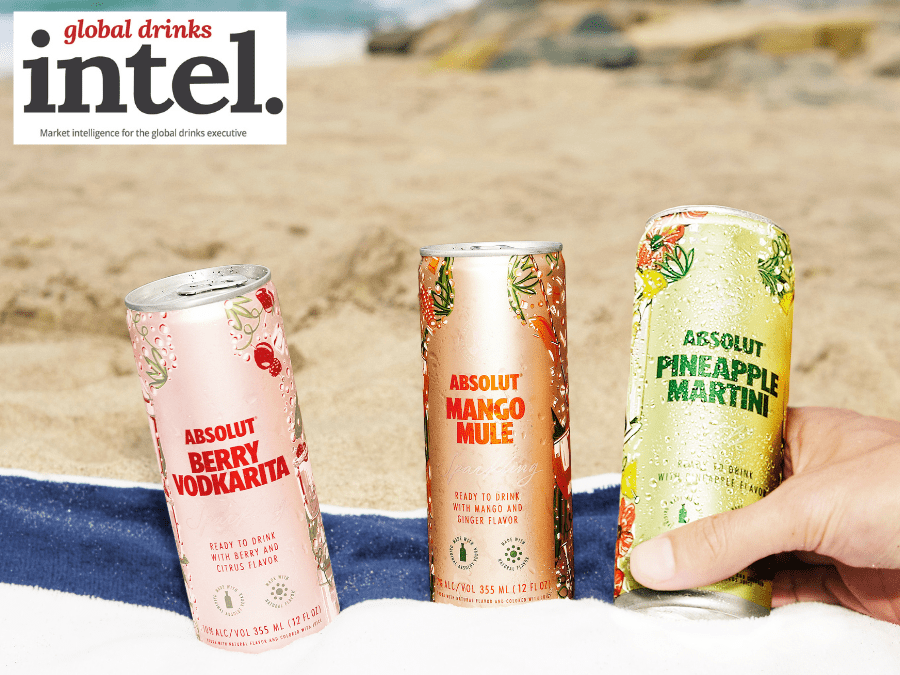
"There's also a loyalty piece,” he adds. “An Absolut drinker will hopefully buy the Absolut RTD, and then they can consume their favourite brand at more consumption occasions. “We’ve seen almost no cannibalisation. If the journey starts with the RTD, so we will move into spirits, while some will just be RTD drinkers, which is okay. But, the chance that some might move up to spirits and use both for different occasions is what’s attractive.”
Of course, for smaller companies coming into the category, such long-term outlooks are of lesser importance than the battle to secure sales today. “The variety of RTDs is so wide that the user journey may be different for every demographic,” says Coppa’s Da Graça. “We’ve seen consumer trial lead to repeat purchase and a curiosity to sample more of the [Coppa Cocktails] range.”
As for predictions, there’s little likelihood that RTDs’ astounding rates of growth — +42.3% in value terms in the US last year — are sustainable. Yet, according to IWSR, double-digit growth annually is very much on the cards for the next five years.
“I’d expect to see a shakeout at some point,” Syren predicts. “To come in like Mark Anthony Group with [US hard seltzer leader] White Claw is going to be much harder in two to three years. We’re already seeing the convergence of spirits players like ourselves getting more active in RTDs, as are the brewers. Then, you have the soft drinks companies entering the space — there isn’t going to be a lot of room for the small local players, over time.”
For now, though, there appears to be enough space for everyone in RTDs. “This is an important category,” says Syren in conclusion. “It's already bigger than spirits in the US.”
This article was initially published in the September issue of Global Drinks Intel magazine. For details on how to subscribe, click here.