


Sign In
  • News
    • Beer
    • Spirits
    • Wine
    • Environmental, Social & Governance
    • Financial Results
    • Marketing
    • Mergers & Acquisitions
    • New Product Development
    • From the Industry
  • Intel
    • Comment
    • Interview
    • Category Intel
    • Consumer Intel
    • Market Intel
  • Awards
    • Global Drinks Awards
    • New Product Awards
    • ESG Awards
  • Magazine
  • Newsletter
  • Subscribe
  • Contact
  • News
    • Beer
    • Spirits
    • Wine
    • Environmental, Social & Governance
    • Financial Results
    • Marketing
    • Mergers & Acquisitions
    • New Product Development
    • From the Industry
  • Intel
    • Comment
    • Interview
    • Category Intel
    • Consumer Intel
    • Market Intel
  • Awards
    • Global Drinks Awards
    • New Product Awards
    • ESG Awards
  • Magazine
  • Newsletter
  • Subscribe
  • Contact
Search
Banner for Global Drinks Intel ESG Awards - https://gdiesgawards.com/categories/


How successful is innovation at adding value in beverage alcohol? – Market Intel

IWSR
Last updated: 08/11/2024 at 4:07 PM
By IWSR
8 November 2024
10 Min Read

Data from IWSR shows that the nature and rate of innovation – as well as the impact on sales – vary significantly between beverage alcohol categories.


AI-generated image of the word 'New'
Credit: AI/Canva
SHARE

Despite a spike during the pandemic, the rate of innovation across beverage alcohol categories has continued to trend downwards.

In 2023, according to data from IWSR’s ‘Innovation Tracker’, the total number of global NPD launches fell for the third consecutive year, reaching a similar level to 2018 and a fifth down on 2020’s peak. IWSR analysis shows that the nature and rate of innovation – and revenue impact – varies significantly between categories.

The rate of innovation across categories

Spirits – which is historically alcohol’s most active category – accounted for over half of all product launches in 2023. The rate of innovation in beer, meanwhile, was less than 10% that of spirits.

“Although the rate of innovation is much lower for beer, the economics of beer are very different to those of wines and spirits,” notes IWSR‘s director of consulting, Luke Tegner. “In beer you need much larger volumes from each individual innovation in order to get a decent return. The beer industry is also more consolidated amongst a few players who tend to launch bigger, but fewer, launches.

“Brewers are faced with higher fixed costs of production and distribution (such as fridge slotting fees) as well, so while beer will have fewer innovations in numbers, they need to amortise costs across much higher volumes from each launch.”

When looking at the past ten-year period, brewers generated the highest overall value from NPD, doing so from a relatively small number of high-volume launches.

While the largest established categories account for the lion’s share of innovation in terms of number of launches and total sales, their mature nature means that proportionally the initial impact of new launches here is relatively small.

In beer, for instance, innovations typically add less than 5% to total sales by value within a year. Benefits are slower, but long-lasting, with innovations typically delivering incremental value over a long period. 
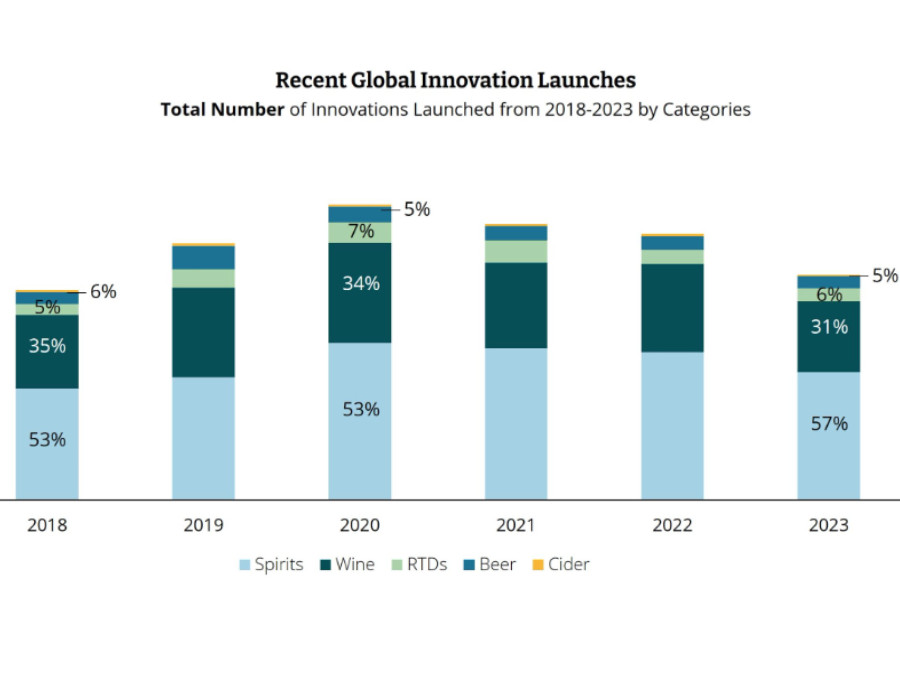
IWSR chart of recent global innovation launches 2018-2023
Credit: IWSR

Spirits drives the pace of innovation 

In terms of number of launches, spirits has dominated the innovation landscape, led by scotch whisky. For the last ten years, scotch has accounted for over half of all global whiskey/whisky innovations each year, and was the most active category again in 2023, with many brands rolling out new expressions.

Small volume, high value malt launches continued to target existing engaged consumers, and travel retail. American whiskey also saw significant activity, often driven by flavour innovations.
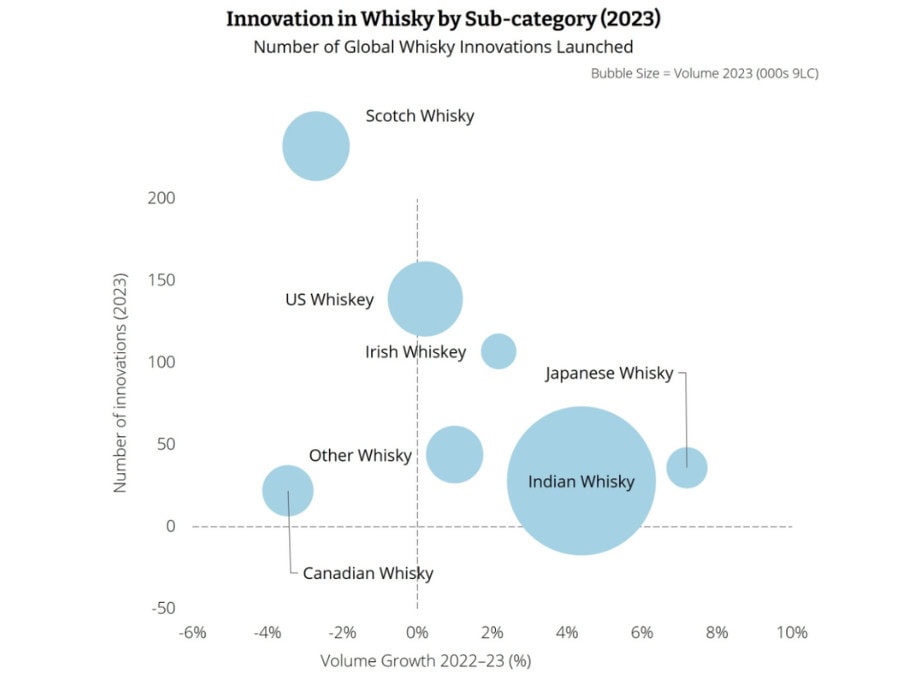
IWSR chart of number of global whiskey/whisky innovations by sub-category in 2023
Credit: IWSR

Gin, tequila and no-alcohol spirits have a smaller absolute number of innovations than whiskey/whisky, but as trending categories, innovations here have proportionally added more to these categories over the last ten years. Innovation in gin, however, has reduced as the category has become less trendy.

Tequila has seen significant flavour innovation, with new styles such as cristalino and non-traditional barrel finishes likes bourbon, red wine, French oak and Japanese mizunara driving growth.

Meanwhile, vodka brands have been active in releasing new flavour lines, but these do not always grow the wider category. New flavours are more likely to replace old ones as consumers look for unique, interesting options. 

Initial impact versus lifetime value 

The categories where innovations have the strongest initial impact are cider and, particularly, RTDs. During the pandemic, almost 20% of the latter category’s annual value was driven by NPD launches. 
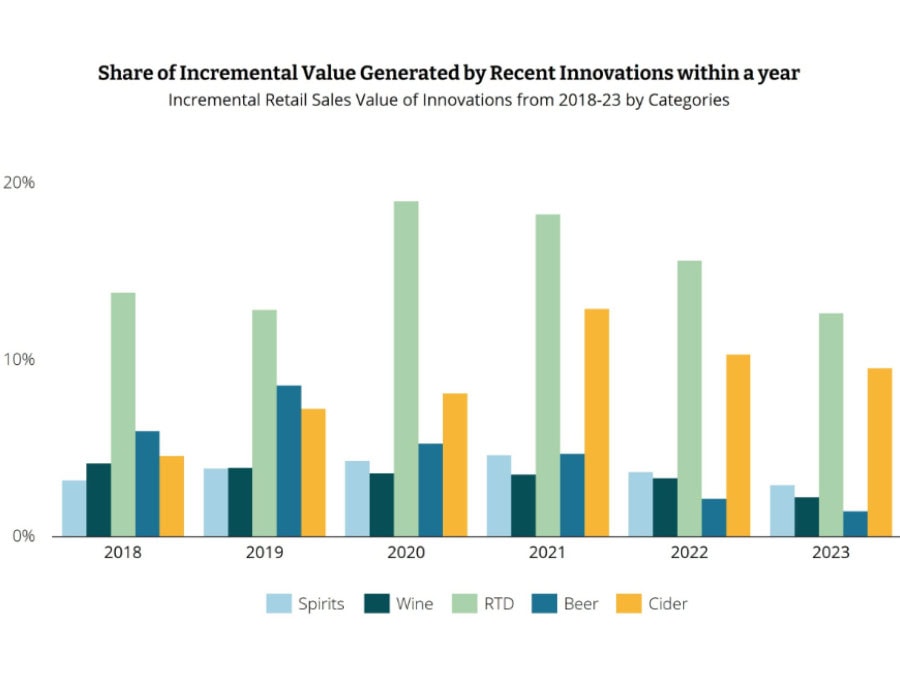
IWSR chart of share of incremental value by innovations in five alcohol categories 2018-2023
Credit: IWSR

Innovations still account for a far larger share of sales in RTDs than they do in other categories, but the drop-off in the number of launches in recent years has been significant. RTD innovations are 66% down from the category’s peak in 2021.

These figures suggest that consumer attitudes to launches in this category could be changing. The number of RTD brand lines available in the US, for instance, tripled between 2018 and 2022. But while RTD volumes in the US were initially positive, growing by double digits from 2018-2021, for 2022 the numbers were flat.

Some have drawn parallels with the US craft beer market, which saw rapid growth driving multiple brand launches, and then – even as the number of launches continued to increase – declining sales volumes.

“Consumers like trying new products,” says IWSR‘s head of RTD insights, Susie Goldspink. “As the category initially grows and establishes itself, the more new options there are, the better. However, there comes a tipping point.” 

The nature of the RTD category

It’s possible that some RTD segments have reached – or are close to reaching – this tipping point. As well as the growing numbers of brands, the short product life cycles may also be reducing the impact of new launches.

Individual innovations are contributing smaller initial volumes and gaining less year-on-year than in the past.

“Consumers love novelty and variety,” says IWSR‘s US division president, Marten Lodewijks. “But exploration needs to be tempered with brand building, and if brands are constantly changing their offering, consumers won’t understand what a brand stands for.”

The saturation effect is also compounded by the current economic challenges. If cost is an issue, consumers are more likely to revert back to what they know and like, rather than risk trying something completely new.

“This is best exemplified by how some larger RTD players tend to keep ‘hero’ SKUs in their portfolio so consumers have an anchor, i.e. innovation is intended to be incremental, not a substitute,” notes Lodewijks.

Consumers now almost expect RTD brands to deliver new products, so brands cannot ignore innovation outright. In Brazil, for example, a considerable lack of RTD innovation in 2021 and 2022 led to a marked slowdown of the category. Momentum picked up again when brand owners started investing in innovation early last year.

As such, RTD innovation strategies need to be well-thought out and positioned for local preferences. IWSR data shows that RTD products that do well tend to be either domestic or international brands that have developed very local flavour innovations.

In flavour-driven markets (such as Brazil), well-conceived new-to-world RTD brands that tap into a national taste preference can often gain share rapidly. Meanwhile, in brand-loyal markets (such as Australia or the UK) the barriers to entry are higher, and the rewards typically slower to achieve.

Planning innovation strategies

IWSR’s consulting team advise that the business case for investing in innovation varies hugely by category, and is also a function of whether consumers and the supply chain are actually demanding innovation.

“There needs to be a desire on the part of retailers and the on-premise to fill gaps in their listings, and to try new propositions,” says Tegner. “As more listings are occupied by established successful products that are making money for the supply chain, there is less demand to list new products and therefore less scope for innovations to achieve successful listings and rates of sale. As such, brand owners need to be strategic in how and why they invest in NPD.”

IWSR analysis points to three overarching use cases for innovation, and NPD strategies should be tailored accordingly:

  1. A category that needs or expects a wide variety of incremental innovation simply to drive rate of sale. Examples would be high-end whiskey/whisky (such as a new cask finish) and brands working in global travel retail
  2. A category where innovation is important, but the barrier to entry is high and incumbents are strong (for example, RTDs and beer)
  3. A category where the supply chain and buying public are very happy with the status quo and the returns on an innovation are low (such as wine)

“If our analysis tells us anything, it’s that innovation has historically been a key value driver,” adds Tegner. “While the current slowdown is likely symptomatic of brand owners responding to a cooling market, they should not step away from innovation entirely.

“Rather, now is the time for more targeted, considered NPD.”

For more in-depth data and current analysis from IWSR, click here

Previous Article Molson Coors Beverage Co logo 2022 Molson Coors Beverage Co set for full-year dip as Q3 struggles – results data
Next Article Pernod Ricard North America logo William Grant & Sons US lead switches to Pernod Ricard
MPU for Bayou Rum - https://bayourum.com/

The Newsletter

Sign up to receive our newsletter email

  • The very latest news from across the world's beverage alcohol industry
  • Cutting-edge intel from our in-depth category & market analyses, backed by benchmark industry data
  • The best insight on your competitors from our interviews with the industry’s leaders

This field is for validation purposes and should be left unchanged.

Follow on Social

Linkedin Twitter
Tall Tower for Le Tribute Pink Grapefruit - https://letribute.com/en-gb?srsltid=AfmBOooXoAFSrBVrsVtLnlySLXXjT62LG4oJ5imdqTABCraYG_SULm5V
Banner for Le Tribute Pink Grapefruit - https://letribute.com/en-gb?srsltid=AfmBOooXoAFSrBVrsVtLnlySLXXjT62LG4oJ5imdqTABCraYG_SULm5V

You Might Also Like

Bulleit '87

This week’s new spirits launches – 20-24 July 2026

24 July 2026
Proximo Spirits sales Q1 2022-Q2 2026 chart

Reprieve of sorts for Proximo Spirits as quarterly sales slides decelerate – results data

24 July 2026
Skyline of Italian city

How the spirits industry is weathering Italy’s unique challenges – Market Intel

24 July 2026
Computer and mouse

Canada greenlights inter-state direct-to-consumer alcohol sales

23 July 2026
Linkedin Instagram

What next?

  • Sign up to our FREE newsletter
  • Subscribe
  • My Account
  • Sign up to our FREE newsletter
  • Subscribe
  • My Account

About

  • Contact
  • Privacy Policy
  • Cookie Policy
  • Terms & Conditions
  • Contact
  • Privacy Policy
  • Cookie Policy
  • Terms & Conditions

Copyright © 2025 Global Drinks Intelligence Limited. All Rights Reserved

Built and Managed by Kukoo Creative

This website uses cookies to improve your experience. Read our privacy policy | Cookie settings | ACCEPT
Privacy & Cookies Policy

Privacy Overview

This website uses cookies to improve your experience while you navigate through the website. Out of these cookies, the cookies that are categorized as necessary are stored on your browser as they are as essential for the working of basic functionalities of the website. We also use third-party cookies that help us analyse and understand how you use this website. These cookies will be stored in your browser only with your consent. You also have the option to opt-out of these cookies. But opting out of some of these cookies may have an effect on your browsing experience.
Necessary
Always Enabled
Necessary cookies are absolutely essential for the website to function properly. This category only includes cookies that ensures basic functionalities and security features of the website. These cookies do not store any personal information.
Non-necessary
Any cookies that may not be particularly necessary for the website to function and is used specifically to collect user personal data via analytics, ads, other embedded contents are termed as non-necessary cookies. It is mandatory to procure user consent prior to running these cookies on your website.
Functional
Functional cookies help to perform certain functionalities like sharing the content of the website on social media platforms, collect feedbacks, and other third-party features.
CookieDurationDescription
li_gc6 monthsLinkedin set this cookie for storing visitor's consent regarding using cookies for non-essential purposes.
lidc1 dayLinkedIn sets the lidc cookie to facilitate data center selection.
VISITOR_INFO1_LIVE6 monthsA cookie set by YouTube to measure bandwidth that determines whether the user gets the new or old player interface.
yt-remote-cast-availablesessionThe yt-remote-cast-available cookie is used to store the user's preferences regarding whether casting is available on their YouTube video player.
yt-remote-cast-installedsessionThe yt-remote-cast-installed cookie is used to store the user's video player preferences using embedded YouTube video.
yt-remote-connected-devicesneverYouTube sets this cookie to store the user's video preferences using embedded YouTube videos.
yt-remote-device-idneverYouTube sets this cookie to store the user's video preferences using embedded YouTube videos.
yt-remote-fast-check-periodsessionThe yt-remote-fast-check-period cookie is used by YouTube to store the user's video player preferences for embedded YouTube videos.
yt-remote-session-appsessionThe yt-remote-session-app cookie is used by YouTube to store user preferences and information about the interface of the embedded YouTube video player.
yt-remote-session-namesessionThe yt-remote-session-name cookie is used by YouTube to store the user's video player preferences using embedded YouTube video.
ytidb::LAST_RESULT_ENTRY_KEYneverThe cookie ytidb::LAST_RESULT_ENTRY_KEY is used by YouTube to store the last search result entry that was clicked by the user. This information is used to improve the user experience by providing more relevant search results in the future.
Performance
Performance cookies are used to understand and analyze the key performance indexes of the website which helps in delivering a better user experience for the visitors.
Analytics
Analytical cookies are used to understand how visitors interact with the website. These cookies help provide information on metrics the number of visitors, bounce rate, traffic source, etc.
CookieDurationDescription
_ga1 year 1 month 4 daysGoogle Analytics sets this cookie to calculate visitor, session and campaign data and track site usage for the site's analytics report. The cookie stores information anonymously and assigns a randomly generated number to recognise unique visitors.
_ga_*1 year 1 month 4 daysGoogle Analytics sets this cookie to store and count page views.
YSCsessionYSC cookie is set by Youtube and is used to track the views of embedded videos on Youtube pages.
Advertisement
Advertisement cookies are used to provide visitors with relevant ads and marketing campaigns. These cookies track visitors across websites and collect information to provide customized ads.
CookieDurationDescription
__Secure-ROLLOUT_TOKEN6 monthsYouTube sets this cookie to manage feature rollout and experimentation. It helps Google control which new features or interface changes are shown to users as part of testing and staged rollouts, ensuring consistent experience for a given user during an experiment.
__Secure-YNID6 monthsGoogle cookie used to protect user security and prevent fraud, especially during the login process.
_fbp3 monthsFacebook sets this cookie to store and track interactions.
bcookie1 yearLinkedIn sets this cookie from LinkedIn share buttons and ad tags to recognize browser IDs.
yt.innertube::nextIdneverYouTube sets this cookie to register a unique ID to store data on what videos from YouTube the user has seen.
yt.innertube::requestsneverYouTube sets this cookie to register a unique ID to store data on what videos from YouTube the user has seen.
Others
Other uncategorized cookies are those that are being analyzed and have not been classified into a category as yet.
CookieDurationDescription
__Secure-YECpastYouTube sets this cookie to stores the user's video player preferences using embedded YouTube video
advanced_ads_visitor1 monthDescription is currently not available.
personalize_sync1 dayDescription is currently not available.
RBUUID2 monthsDescription is currently not available.
stackprotect1 hourDescription is currently not available.
syncTimeout12 hoursDescription is currently not available.
unique_session_id1 yearDescription is currently not available.
SAVE & ACCEPT
Powered by CookieYes Logo