

India’s beverage alcohol market has enormous potential for brand owners in the years ahead – but competition is fierce and the trading landscape remains highly complex with a very value-savvy consumer base, meaning that brands will need to navigate their path carefully while being ready to adapt to change.
As challenges persist in the global beverage alcohol market, the role of India as the planet’s most formidable growth engine has become even more vital – but what does it take to achieve success in this huge but enormously complex market?
Between 2019 and 2024, total beverage alcohol (TBA) volumes in India expanded at a CAGR of 3%, capped by a 6% gain in 2024 and a projected 4% increase in 2025, according to IWSR data. Growth is expected to continue in the years ahead, with volumes predicted to rise at a CAGR of 3% between 2024 and 2034.
This growth spans all categories, with spirits, wine and beer all expected to record CAGR expansion of 3% to 4% over the next decade. Gains for RTDs are projected to be stronger still, with a CAGR increase of 6% to 2034.
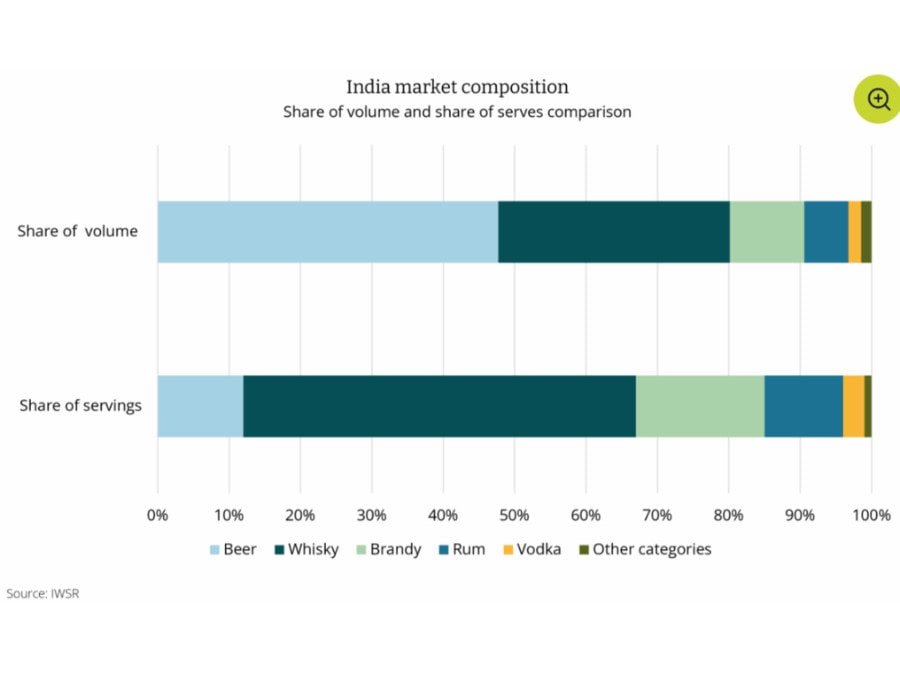
In volume terms, beer is the country’s largest alcohol category, but from a serves perspective, whisk(e)y accounts for more than half of servings.
Domestic products dominate beer and spirits, but imports are gaining ground. Between 2019 and 2024, imported spirits volumes grew at a CAGR of 16%, with a projected 9% gain in 2025. IWSR projections show a 8% CAGR gain between 2024 and 2029, and a 6% CAGR to 2034. Beer imports are pursuing a similarly impressive trajectory.
“India leads TBA expansion in developing markets thanks to such factors as socialising, ongoing premiumisation, improvements in retailing and new product development, with 15m to 20m new legal-drinking-age (LDA) consumers per year providing an expanding audience in what remains a dark market,” says IWSR‘s senior research consultant, Jason Holway.
“Spirits and RTDs saw continued growth in early 2025, with beer also posting steady volume gains. Wine’s performance is mixed: sparkling has grown a little, but still wine hasn’t yet broken out of its modest decline.”
What are the main challenges?
With an LDA population fast approaching 1bn potential consumers, there’s no doubting the scale of India’s potential, but this vast country is extremely nuanced, with state-level variations in taxation, regulation, distribution and retail. Alcohol is one of the most important generators of revenue for state authorities.
In the second half of 2025, the state government in Maharashtra, a relatively open state, introduced a new policy to boost local investments with Maharashtra Made Liquor (MML) emerging as a new category. Since launch, MML has captured significant demand, shifting volume away from established large-volume Indian-made foreign liquor (IMFL) brands.
“Another example of the role played by state-level regulatory processes would be in labelling,” says Holway, “Labels have to be registered – and paid for – annually state by state. This is one method that states use to ensure that only registered products are sold in their state, which is necessary when prices and availability can vary across borders. The current situation in Delhi (where many national brands have been unavailable for some time) and neighbouring Gurugram (Gurgaon) (where prices are notably cheaper – and labels specify ‘Only to be sold in Haryana’) is a perfect illustration of this reality.
“One important nuance at state level,” Holway continues, “is the degree to which the state is involved in the supply chain for alcohol. This can vary from full control of wholesale and retail through state beverage corporations, through hybrid models to auction/open market models. However, all states get involved in setting prices, influenced, of course, by their own excise rates. It’s very difficult to subsequently alter them, even when, in most but not all states, prices are renegotiated annually. Most states set Maximum Retail Prices and some set Minimum Retail Prices.
The Indian consumer
According to IWSR ‘Bevtrac ‘consumer research – which focuses on the relatively affluent urban population – the prevailing consumer sentiment remains highly positive, particularly with regard to personal finances and expectations of an increase in disposable income.
One important component of this bright outlook is an openness to take part in more social events – both work- and family-related – where consuming alcohol has become more acceptable. “In this context, showcasing taste and status through the choice of higher-quality brands is becoming more important, underpinning sustained uptrading,” says Holway.
That said, there is a growing gulf between younger age cohorts – who are more likely to attend more social events and to consume alcohol when they do – and older groups (Gen X, Boomers), who tend to entertain more at home, while also being more temperate in their consumption.
According to Bevtrac, 26% of Indian LDA+ consumers abstain from alcohol, and this level remained stable between September 2024 and September 2025. Growth in no-& low-alcohol is coming from drinkers, rather than abstainers. “There is no evidence of strong moderation tendencies in India, including among peer groups, although claimed future behaviour could be signalling change,” says Holway.
India’s drinks market is also notable for having a strongly ‘western’ composition, with spirits dominated by the likes of whisk(e)y, rum and brandy and with vodka and gin enjoying small but established and growing niches. However, there is a growing pride in ‘Indian-ness’ among consumers, benefitting the new generation of Indian single malt whiskies and higher-end domestic white spirits.
What’s new in the market?
While the ‘western’ composition of India’s spirits market tends to suppress the expression of regional flavours and variations, international brands are increasingly finding success by adopting local tastes in product innovations, incorporating flavours such as mango, chilli and jamun.
This is another example of the potential of ‘Indian-ness’ in the market. At the same time, the premiumisation of the local whisk(e)y offer – including both Indian single malts and blends – is pulling up consumer expectations and sustaining the interest of younger LDA cohorts in blended scotch, while malt scotch appears to be losing ground to Indian single malts.
Another growth area is agave-based spirits. Tequila is a particularly strong performer, acting as a hybrid product that bridges the clear and dark spirits market. Tequila’s success is having an indirect impact on wine consumption: 48% of still wine consumers are women, who are increasingly taking an interest in tequila and cocktails.
More positive for the imported wine category is the narrowing of the price gap between local and imported wines, due to the premiumisation of domestic products. This is making imported options more appealing to consumers – something that could be accentuated further by the signing of free trade agreements (FTAs) with the European Union and Australia, with similar agreements likely for Chile, the US and New Zealand. Meanwhile, the FTA signed with the UK is set to benefit scotch whisky and gin.
The influence of high-net-worth individuals (HNWIs) is also growing and expanding beyond tier one to tier two cities such as Chandigarh and Hyderabad. While this creates obvious opportunities for imported brands, local products are also exhibiting growing confidence, manifested in the launches of more limited editions and global travel retail channel exclusives with prices that match those of imports.
What happens next?
The Indian market remains highly fragmented and subject to changes that may dramatically alter the trading landscape, as is illustrated by the example of Maharashtra Made Liquor and its impact on high-volume brands.
Moderation may become an increasingly influential factor: Bevtrac consumer research suggests that all age cohorts are now happy to alternate between alcoholic and non-alcoholic beverages, whether at home or in the on-premise.
Drivers of this trend include affordability – now that consumers are going out more, they may want to make their money stretch further – health-oriented moderation and ongoing experimentation. In the second half of last year, according to the latest Bevtrac research, there were signs of a slowdown for some categories such as rum and wine – and Indian consumers expressed a stronger intent to try to cut back on alcohol in the future.
Most drinkers in India report either cutting back or maintaining their usual habits, though a notable portion say they are drinking more, and many mention buying nicer brands and pricier categories.
“Brand owners participating in the Indian market need to be constantly vigilant, ensuring that contingency plans are in place and they aren’t ploughing all of their investment into one location,” says Holway. “They need to maintain a detailed knowledge of the state-level situation and be ready to adapt to potential changes.
“Just navigating the market carefully isn’t a guarantee of success – India’s challenges are almost as great as its opportunities, but almost all major brand owners are looking at India as an imperative. Building winning go-to-market strategies here requires strong navigation of the local complexities, combined with a strong understanding of the category opportunities state-by-state.”