

Social
In Uruguay, AB InBev’s Fábricas Nacionales de Cerveza (FNC) division has launched a responsibility campaign in the off-premise channel to prevent alcohol sales to minors. The campaign encourages retailers to engage with underage drinking prevention by highlighting the importance of the legal purchase age of 18 years, both at point of sale and on social media. Launched through FNC’s ‘Zero Alcohol Footprint in Minors’ platform, the campaign complements FNC’s ‘In Other Words’ education programme, which has reached thousands of teenagers to discourage underage drinking since 2021, as well as parents and teachers.
Meanwhile in Peru, AB InBev’s Corona Cero brand has launched a collaborative campaign with street vendors in Lima to promote no-alcohol beer consumption as a responsible drinking alternative in the city’s public places. In addition to promoting responsible drinking, the activation has driven a positive transformation for Lima’s street drinks vendors, by providing them with complete upgrades for their carts with features such as mobile electronic payment systems and solar-powered refrigeration units.
Diageo has commenced a student-focused responsible drinking initiative in South Korea through its long running DRINKIQ. Making use of pop-up stalls on campus to reach young adults who are being exposed to alcohol for the first time at university, the campaign offers free Guinness 0.0 mocktail samples to students and encourages them to participate in a drink-driving prevention game.
In Vietnam, Heineken has signed a Memorandum of Understanding with the Da Nang City Police for a responsible drinking collaboration. The partners will organise a range of drink-driving prevention initiatives during the two-year project, including educational workshops and the distribution of printed materials to raise public awareness on responsible driving and motorists’ responsibilities under the law. Heineken will also provide the police with equipment and supplies to enhance their existing prevention efforts.
Environment
Asahi is participating in a Japanese Government-led project to improve global food security in Kenya. The company has contributed beer yeast agricultural material and water-saving rice cultivation technological support to the self-sufficiency pilot, with the first harvest of rice expected in June.
Meanwhile in the Netherlands, Asahi’s Koninklijke Grolsch has launched a platform to encourage multi-stakeholder engagement in sustainable water use. The project has reached out to the local community to promote ways of reducing water usage and to find innovative ways to treat and reuse wastewater.
In Laos, Carlsberg’s Lao Brewery Co is on course to reach its net-zero emissions target five years ahead of schedule, following an investment in a new biomass energy factory. The new facility will replace fossil fuels with steam at LBC’s brewery in Vientiane, aligning with the Lao Government’s push for renewable energy adoption, and marking another big step towards Carlsberg’s ambition of net-zero brewing by 2030.
Heineken’s Brau Union in Austria has teamed with freight technology company Einride to transition its freight operations to electric vehicle use. Following successful partnerships with Einride in Germany and the Netherlands, Heineken is now building on its first wave of eight electric vehicles in Austria with 20 more e-trucks. Heineken plans to reduce its CO₂ emissions in Austria by 1,800 tons by the end of 2026.
Kirin has partnered with Hitachi on joint research to generate forest-derived carbon credits in Japan. By combining Kirin’s “plant mass propagation technology” with Hitachi’s measurement and verification technology, the two companies will generate high-quality forest-derived carbon credits while simultaneously reducing greenhouse gas emissions and conserving biodiversity by protecting plantations.
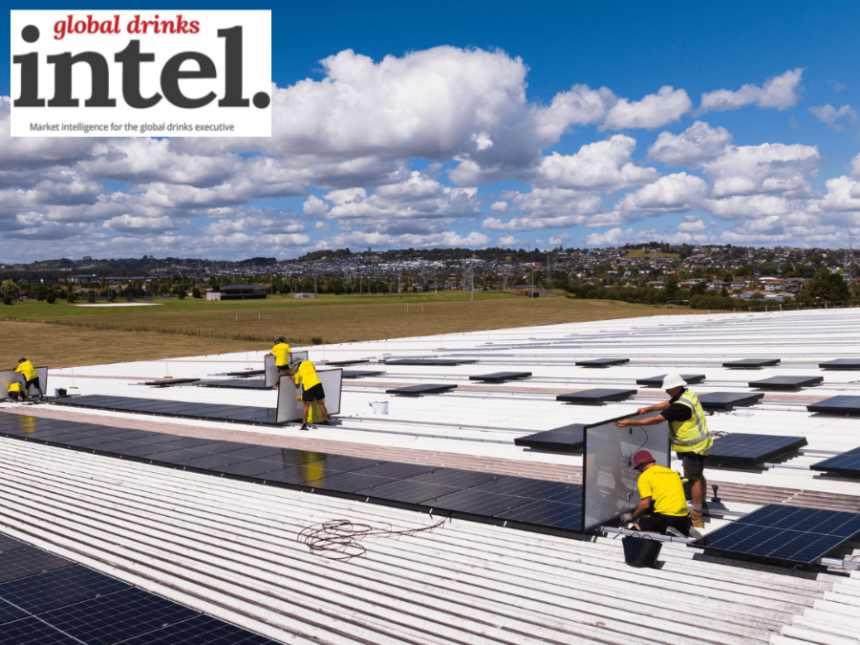
Over in New Zealand, Kirin’s Lion division has installed one of the country’s largest rooftop solar energy arrays at its The Pride brewery. The array will provide 14.4% of the brewery’s annual electricity needs, contributing to Lion’s ongoing commitment to decarbonisation.
In Japan, Suntory and The Coca-Cola Co are working with other industry partners to establish the ‘Japan Water Stewardship Leadership Group’. The members of the group are committed to advancing water stewardship in the country, and helping to build recognition and demand for responsible water management. Convened by the global Alliance for Water Stewardship, the group will address various water issues that have recently become apparent in Japan, including disasters caused by aging water infrastructure, rising water charges, and impacts on agricultural imports.
Governance
Diageo has partnered its Guinness brand with footwear specialists in Europe to launch the first soft-ground boot for female athletes ahead of this year’s Guinness Women’s Six Nations rugby tournament. The ‘Never Settle’ boots have been engineered specifically for the female foot and will be worn through the tournament by players from the UK, Ireland and Italy, who participated in research and testing on the boots.
Moët Hennessy recently organised an internal event in France to highlight the important topic of neurodiversity in the workplace. As part of the group’s commitment to inclusion, staff were invited to explore the impact of neurodiversity in daily life and in the workplace. Around 100 colleagues participated in the interactive session to discover how neurodiversity can be both a source of innovation and a challenge for individuals and teams.
Pernod Ricard is offering ten scholarships for young people to attend the One Young World Summit in Germany at the end of this year. One Young World is a global organisation and community that brings young leaders from around the world together at an annual summit for networking, mentorship, and impact-driven projects. The group will provide funding for ten committed young leaders working on projects to tackle harmful drinking, make social interactions and spaces safe, responsible and inclusive, or to encourage community building.