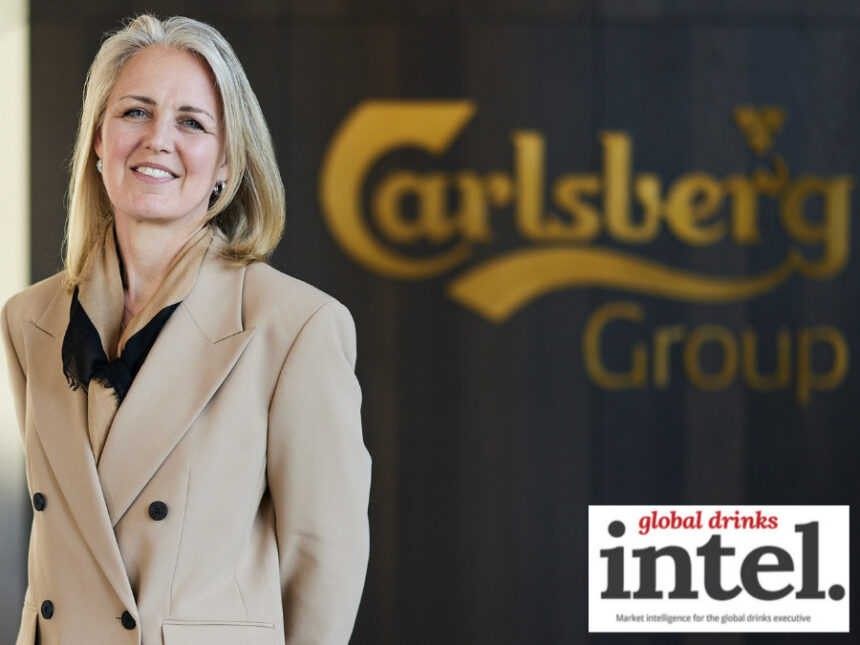
On Thursday, Carlsberg reported a 2.4% increase in sales from 2024 – a year in which the brewer hit the headlines by acquiring soft drinks specialist Britvic while also strengthening its relationship with PepsiCo as its bottler of choice across more of Europe. Following the results announcement, Global Drinks Intel editor Olly Wehring quizzed group CFO Ulrica Fearn about Carlsberg’s recent performance, as well as the company’s priority areas for 2025.
Your results announcement kicked off with a list of all of Carlsberg’s M&A achievements in 2024, yet the group’s rates of sales growth have been slowing of late. Is inorganic growth the way forward for Carlsberg?
The answer is no! There was a long list of major events that we executed in 2024 – they will the shape the future of the group. But, Carlsberg is very much a company that is focused on its performance and solid profit development and growth, year in and year out. That will continue.
It’s been a challenging time, but we’re satisfied with our results in a difficult market. We have certain spots in the portfolio that have been faring worse than others – the consumer in both Asia and Europe is still uncertain, and we lived through that throughout the year.
Coming out with modest volume growth of 0.4% in a year like that is good. As we look into 2025, we’re seeing a probably more stable consumer environment, although there are still uncertainties around consumer sentiment.
The recent acquisition of Britvic marked a major shift in acquisition strategies within beer. Is it fair to call the purchase a volume play?
No, I don’t think so. There’s a scale play in terms of the operating model, but it’s not a pure volume play in the sense of buying growth. There are two sides to this.
It’s about buying into a growth category; Structurally, carbonated soft drinks is growing and that’s what we’re buying into. With the purchase, we’re doubling our exposure to the soft drinks category, from 16% to about 30%.
In the UK, our combined model will make us one of the biggest soft drinks and beer companies. We intend to reap as much of the benefit from that as we can, across the value chain. Of course, this is an operating model we know quite well from the Nordics and in parts of Asia. It works really well for us and gives us growth opportunities through the P&L. We’re now implementing that in the UK.
There’s also the potential to have a more strategic partnership with PepsiCo (for whom Britvic is the UK bottler), to understand whether there’s anything more we can do with that. We’re now PepsiCo’s largest bottler in Europe and one of their biggest in the world. So, that’s the strategic part.
What potential do you see geographically with PepsiCo?
Well, we haven’t got a very clear roadmap at this point. We’re biting off quite a lot with what we’ve already done! The first focus will be to integrate Britvic. We did also announce that we’ll become PepsiCo’s bottler in Kazakhstan and Kyrgyzstan in 2026; that will double our business in Kazakhstan and we’re going to spend EUR100m (US$104m) to set that up.
If there are any opportunities beyond these that can complement what we’re doing today, we’ll continue to have conversations, but those are our two big priorities for now.
How structural a change in the consumer landscape do you see that a soft drinks purchase by a brewer suggests?
What it does do is give us a wider portfolio across different occasions with the consumer. There are lots of trends that our growth categories are really trying to pick up on; premiumisation is one, alcohol-free beer is another and beyond beer is a third. This picks up on the last one, which is soft drinks.
If you start looking across those growth categories, our portfolio is now represented, morning to evening, in different occasions. That’s where we’re trying to get to here. It’s not a shift structurally, it’s more of an add, to complement.
How comfortable are you with Carlsberg’s presence in alcohol-free beer?
We had 6% volume growth from alcohol-free last year, which in a market that’s flat across the world is pretty good. So, we’re pleased with that. That level of growth in a year when our portfolio was flat is very respectable. We very much believe in our alcohol-free beer portfolio.
This is a category that started off very small and is still building – that takes time. It will tip over at some point, when the category becomes even more established. I think we’re on the verge; you see sections for alcohol-free beer in supermarkets now and there’s more than one choice in a pub. This is about building a category as well as building our offering within that category.
Our approach works, as well. We’re using extensions, both of our international and local brands, and we’ll continue to do that in a category that’s gaining velocity. I have to say, we’ve come quite a long way since I joined Carlsberg (at the start of 2023).
Finally, China is proving to be a problematic market for everyone in alcohol. How much longer do you see that turbulence lasting and when can we expect to see China delivering what we’ve long been promised?
That’s the million-dollar question! I won’t call the turnaround in China.
We have seen some signs of stabilisation and we’ve had a solid start to 2025. On the other hand, the Chinese consumer does remain challenged and the sentiment remains unchanged, at a very low level. We’re a little bit in the hands of what’s going to happen in the external world here. What the government comes up with will determine what’s going to happen in China into the next year. We still see uncertainty.
But, we also continue to invest. We believe in China in the long term, we believe our position can be much bigger going forward and we continue to invest for that.