

New Jersey/Napa. One of the largest wine retailers in the New York metro area, New Jersey-based Gary’s, used lockdown to expand its online presence. Now, as Roger Morris reports, there’s no turning back
“On 20 March, our stores were really crowded because people were anticipating a lockdown,” says Gary Fisch, founder and CEO of family owned Gary’s Wine & Marketplace, with stores in New Jersey and California. The first onslaught of Covid-19 in the US had consumers fearing they would have to self-isolate for an unknown duration with not enough to drink. “I felt just horrible for our staff, so we closed down all our stores that night,” Fisch says. “The next day, 21 March, we went totally online.”
The coronavirus pandemic has been a wild ride for Gary’s and other bricks-and-mortar retailers in the US who metaphorically began removing a few of those bricks in their walls and running internet cables through the openings.
Last year also saw major market changes in which alcoholic beverage categories were hot and which were not, along with shifts in which brands of spirits, wines and beers were being sold, how and where they were being purchased. The types of consumers who were buying and their purchasing patterns have also altered.
“The pandemic put everything that was happening on acceleration,” Fisch says. “The ‘bottom-shelf’ spirits — the ones you use in the well [for generic restaurant cocktails] — took a nosedive. Craft spirits were hit hard, too. Fortunately, the big spirits brand names accelerated.
“Tequila went through the roof,” Fisch continues, “and it’s been high-end tequila that is selling. Gin has not made gains, and flavoured vodkas continue to go down, losing sales. American whiskies are doing well, as is Scotch. We bought a boatload of Scotch before the tariffs were enacted [in October 2019]. As soon as stock would sell out, I kept ordering more. I bought about $200,000 worth of Scotch in 2019 to protect the business.”
The experience inside Gary’s stores and with its online sales mirrored what was happening across the US in 2020. According to a Distilled Spirits Council of the United States (Discus) report released virtually in late January:
■ Tequila and mezcal sales in 2020 were up 17.4% to $4bn, with mezcal continuing to be an important part of the combined category.
■ American whiskey continued its upward growth curve, with sales up 8.2% to $4.3bn. Within that category, rye has received increasing consumer attention in recent years and increased its sales by 16.9% to $275m.
■ Cognac sales rose 21.3% to $2.4bn. And, as with Gary’s tequila sales, consumers were buying the good stuff, especially baby boomers, as purchases of super-premium spirits represented 40% of total revenue growth. “The increase in spirits sales revenue reflects consumers’ willingness to spend a little extra on super-premium spirits during the past year since they were not travelling, going on vacations or dining out as often,” said Discus chief economist David Ozgo.
As Fisch notes, the pandemic accelerated sales trends already taking place in the American retail spirits business. At the same time, the Covid experience also spun out a set of market shifts that affected everyone in the hospitality industry, from the heavily wounded on-premise sales — down almost half by a disastrous -44% — to the way that traditional wine and spirits retailers, such as Gary’s, plan to do business in the future.
A trade veteran, Fisch has seen the alcohol industry progress through many changes, though none as severe as those that happened last year. In 1987, he opened the first Gary’s Wine & Marketplace in Madison, New Jersey, which is in the near suburbs of New York City. Over the years, he added stores in Bernardsville, Closter and Wayne to become one of the largest wine retailers in the New York metropolitan area. It is likely he would have added more locations except that New Jersey limits the number of stores under one owner.
Two years ago, in 2019, Fisch, a wine lover who spends a lot of his time in Napa Valley, saw an empty Dean & DeLuca store in St Helena, after the fine foods firm hit a rough spot and was forced to close operations there. Fisch, who says he used to shop at the store while in Napa, found the location and the opportunity too tempting to resist. So in October 2019, Gary’s became a bicoastal retailer.

The store was an instant draw to locals and, more importantly, tourists thronging to Napa Valley. Especially popular was its automated tasting station, serving 24 wines by the glass that allowed customers to sip as they shopped.
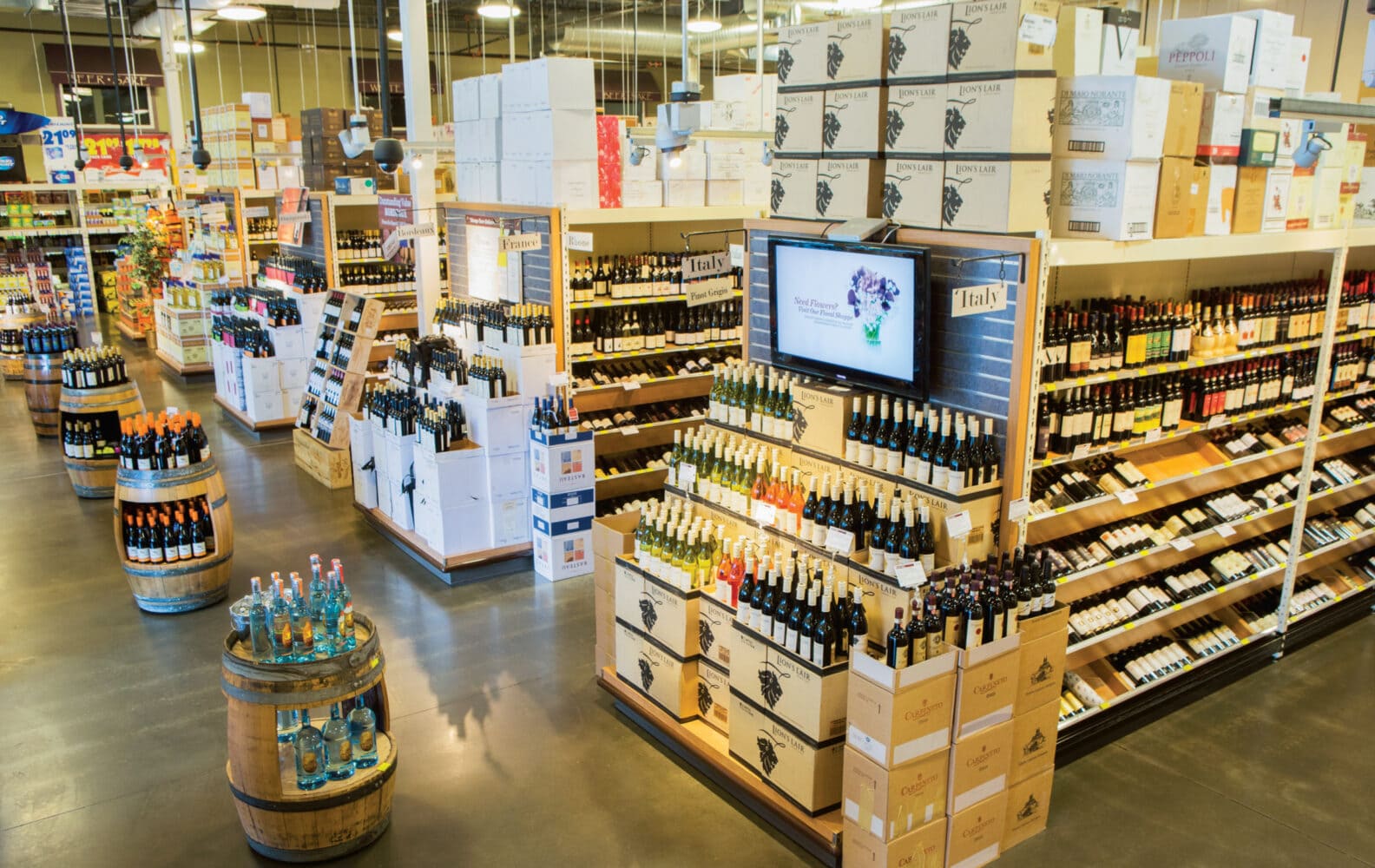
“Our business model has always been based on giving customers a selection,” Fisch says. To that end, Gary’s Napa Valley lured consumers in with its extensive product range — more than 300 SKUs of spirits, 80 of beer, 400 of American wines and more than 80 SKUs of ‘fine wines’ from around the world with price tags starting at $250 a bottle. Add to that the appeal of Gary’s marketplace of foods for entertaining, led by a large selection of cheeses and delicatessen meats.
Pivot to online sales via Gary’s website and app
With about $65m in annual sales and a new store coming online, 2020 looked to be a promising opportunity for Gary’s to dramatically increase storewide sales. But, of course, less than five months after its opening, Covid-19 either temporarily mandated the closing down of retail stores or drastically limited how they could sell product.
“Napa Valley has been a nightmare,” Fisch says, especially since the shutdown of travel that fed Napa’s hospitality business — which reached 3.85m visitors in 2018 — slowed visitors to a trickle.
Unlike Gary’s New Jersey customers who were locked in, the customers Fisch was counting on in Napa were locked out of getting there. With stores reopening, mask wearing and social distancing are necessary in Napa, as it is elsewhere. “We had wine taps for samples that we can’t use now,” Fisch says. “I had one lady who said she so enjoyed our wine samples and asked, ‘Why don’t you do that anymore?’ Obviously, that isn’t safe at present. My concern is that I’ve had to fight to keep people employed there.”
As tasting rooms across California also closed or were limited, Fisch opened his shelves to Napa producers who previously sold only direct-to-consumer (D2C). Still, the beverage retail business in 2020 quickly discovered it had a flexibility during lockdowns that restaurants and the empty tasting rooms of wineries, brewpubs and craft distillers did not have.
While restaurants could have curbside takeaway — including the emerging business of ready-made cocktails —and limited outdoor seating, bricks-and-mortar retail stores have had the opportunity in most states to pivot and concentrate on lucrative online sales.
One of the first things Fisch noticed was that his customers behaved differently online than they did in an actual retail store. “Inside a store, they may be influenced by a display or a promotion [for inexpensive or new brands],” he says. “In a store, they are interested in experimentation, but on an app they go from experimentation to seeking name recognition. ‘Oh, here’s Johnnie Walker Red. That’s a good brand,’ and that’s what they buy. With wine, it was even more the case — Josh, Santa Margherita, Kendall-Jackson, their sales all went up.”
High-end wine and spirits sales remained strong to business people, a trend Fisch thinks will continue after the pandemic eases. “Before the pandemic, these people were travelling all over the world and were eating and drinking in the best restaurants,” he says. “Now that they are having to stay at home, they don’t want to do it drinking cheap wines. I don’t think those sales will come back down soon.”
During the lockdowns, Gary’s, like many other retailers, conducted online promotion events, such as virtual tastings, for consumers and for businesses. “Of course, it’s much more difficult to hold online tastings for spirits,” Fisch says, “although we did have a Scotch tasting in New Jersey and one for a new whiskey that went well.”
In the first days of the pandemic many American retailers had concerns about how quickly consumers would adapt to shopping online and wondered whether, once they did, if it would be a short-lived love affair. But home-bound consumers did not hesitate to go digital. More than 35,000 users downloaded the Gary’s Mobile Marketplace app last year.
Although it is a family-owned retail chain, Fisch says: “We can compete on the national stage given our wide selection, low prices, white-glove customer service and operational excellence.”
As with most retailers — traditional or online — shipping is an expensive and important part of the customer transaction and one that Gary’s had to balance through either volume sales or loyalty plans — or both. Gary’s customers have the option of ordering online either by accessing the company’s website for selections, which are localised according to store, or through the company’s app.
The shipping solution Fisch arrived at was Gary’s Plus Membership, which allows consumers — ‘guests’ in online sales parlance — to attain unlimited free shipping on all orders for a one-time annual fee of $48.99. Alternatively, those who lived close to one of the stores could access local delivery for a onetime fee of $19.99. In addition, members of the program received a 15% discount whenever purchasing six or more Gary’s Direct wines — those shipped directly from a winery to its stores without a middleman — as well as getting discounts on virtual wine classes led by one of the stores’ wine experts. Fisch found the average online customer made purchases from either the Gary’s Wine website or its mobile app a minimum of three times during the year.
It is estimated that during the first three months of the pandemic, the US alcoholic beverage business experienced a growth in e-commerce business that had not been predicted to be reached until around 2030. This was reflected in Gary’s experience. The company reported that 35% of total sales in 2020 were placed online, compared with 12% of sales in 2019.
Furthermore, customers placed 46,193 local delivery orders and 65,488 curbside pick-up orders online in 2020. Mobile adoption accounted for much of the growth, with 56% of online orders placed through the Gary’s Wine mobile app.
When Fisch closed his Gary’s stores voluntarily in March 2020 at the beginning of the pandemic, he had no idea how long the lockdown would last. It turned out that the padlocks stayed on for two months. As with other businesses, when Gary’s did reopen, social distancing, compulsory masks and added sanitation were all practiced, and fewer customers were allowed inside at any one time.
Significant reduction in SKUs
Even before reopening, Fisch made the decision to temporarily reduce the number of SKUs in his stores, both through attrition and by evaluation. During the pandemic, some brands were not reordered when they ran out. “I told the stores to have a -20% reduction of old SKUs of spirits, wines and beers.”
With the pandemic restrictions ending, Fisch plans to grow the number of SKUs again, as he prides himself on offering a diverse selection, but he will evaluate which old SKUs will disappear from inventory and which new ones will take their places. “As an example,” he says, “while box wine sales were big, there were a lot of brands that weren’t selling and will be eliminated.”
Yet, even with the explosion of online business, 2020 was not a banner year for Gary’s at all levels. “For the year, volume was up, but the bottom line was down,” Fisch says simply. In addition to the temporary problems with the Napa expansion, online sales also came at a price. “We hired 85 new people — pickers and packers and delivery people,” he says. “In a store, the customer picks what he wants and takes it to checkout.
Online, someone has to fill that order.”In addition, there was the expense of acquiring trucks for local deliveries. Yet Fisch does not sound discouraged. The continued growth of the online business holds great promise and Fisch thinks the business might also grow in the traditional way. “I have a 28-year-old son, Mike, who has a lot of energy, who graduated from Wharton [the prestigious business school at the University of Pennsylvania]. Just as soon as we had purchased the Napa store, he was on the phone to check the availability of a Dean & DeLuca store that had closed in Georgetown, Washington.
It was a beautiful historic property, but we decided in the end not to do it,” Fisch says. “We’re a family business, and we have to move cautiously.” Considering what was to come, it turned out to be a fortuitous decision.
Yet Fisch is quick to add that, with young blood in the business, growth in the number of Gary’s Wine & Marketplace stores may still be in the offing. “There are still 48 other states where we don’t have a store,” Fisch says. “Expansion is still on the table.”
Key takeaways
■ Consumer shift from experimentation to safety of name recognition.
■ Huge pivot to sales via online and apps.
■ Consumers seek to treat at home, favouring super-premium price points.
■ Tequila and American whiskies doing very well. Gin and flavoured vodka less so.
■ 2021 likely to see significant retailer reduction in SKUs to remove non/slow-sellers.