

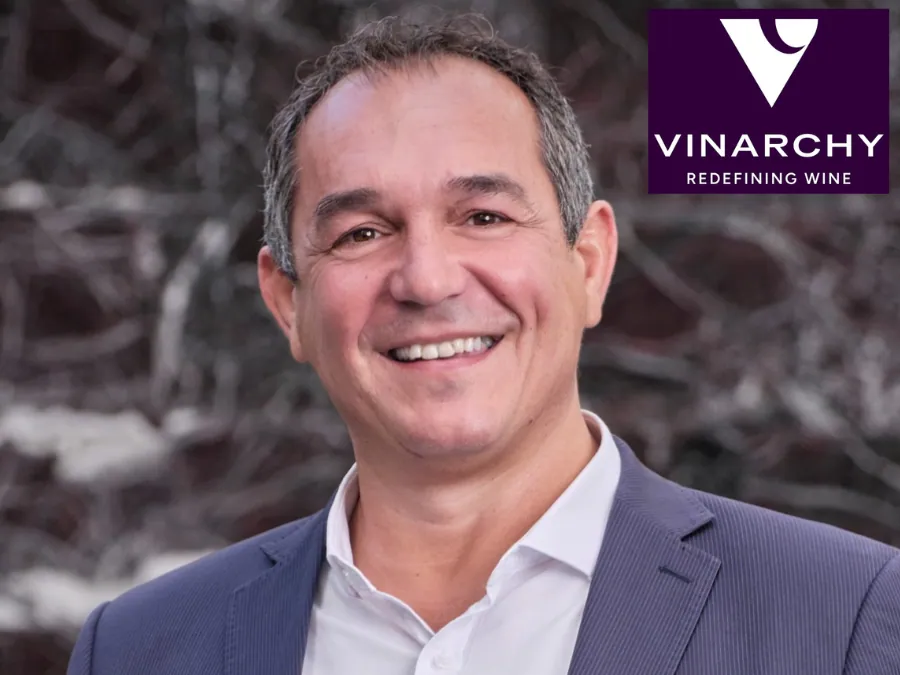
Vinarchy has been with us for all of 16 months, coming into being in April last year when Accolade Wines was united with the bulk of Pernod Ricard’s former wine assets. Four months later, Danny Celoni (below) left the relative comfort of the CEO-ship of Carlton & United Breweries in Australia to take the helm at the newly-created wine business. Global Drinks Intel editor Olly Wehring caught up with Celoni last month to hear about his first year in charge.
What actually is Vinarchy?
Vinarchy came together from the amalgamation of Accolade Wines with Pernod Ricard’s Australasian and Spanish wines. The name comes from the Latin for ‘wine’ and ‘leadership’.
The intent was that we believed there was a great opportunity to bring two organisations, each with strong portfolios, together to create a global footprint of brands that were very much complementary to each other.
We’ve wanted to make sure that the way we show up in the industry is very respectful to wine’s heritage, while at the same time acknowledging the fact that we need to do some things fundamentally differently in order to overcome the headwinds that we see in different parts of the world.
What’s the ownership structure?
Vinarchy’s largest shareholder is Bain Capital (Special Situations), with a number of other smaller investors in the overall structure.
We’ve seen a lot of senior recruitment announcements from Vinarchy in recent months. What have you been building?
Zooming out a bit, the first major part was to bring to life the full end-to-end integration. We had two businesses that were complementary, but also had different strategies and cultures, as well as different mindsets on what their wine portfolios meant for them. We had to consolidate this and get a laser-sharp strategy in place. That strategy has the consumer as pillar one, the customer as pillar two and the organisation as pillar three.
We then wanted to be clear on how we organise ourselves globally, which we’ve now done with an east/west model; the UK’s our biggest market, then there’s ANZ (Australia and New Zealand) followed by a smaller cluster of markets around Asia along with the US. We looked at all our assets, then applied our synergies and optimisation agendas on the basis of our strategy and with a view to getting our liquids as close to the consumer as possible to allow for agility, speed and innovation.
Where we are now is around growth acceleration.
This sounds like a really big piece of work.
Traditionally in wine, you’ve seen wine makers create wine that gets bottled with a brand on it that then goes off and gets sold. We want to be an organisation that is first and foremost focused on the consumer. Our portfolio strategy needs truly global brands, which we’ve got in Jacob’s Creek, Hardys and Campo Viejo. We’ll execute consistently across those three globally.
Supporting them are our local growth brands, which when combined with the global brands, make up our core. By anchoring ourselves to winning more penetration and driving more frequency in the category overall, we’ve identified our portfolio and our innovation strategy and engineered that back into what our supply chain footprint needs to look like for us to deliver on that agenda.
We’re distributed in over 100 countries around the world and we’ve got operations in 15 countries. Our priorities have been to stabilise and turn the UK back into growth, to build on the momentum in Australia and New Zealand, and to consolidate our market penetration footprint, all with clarity on the portfolio strategy that we’re looking to execute.
You talked late last year about the need to consolidate the portfolio.
We saw that we had finite investments that were spread way too thin. With about 150 brands overall, our tail was way too long. Today, we’re down to around the mid-80s. Based on our global pillar brands, our local priority growth brands and the innovation agenda we want to drive, we needed to ensure our investment would be impactful and not too thin.
We’ll continue to review the portfolio moving forward, to stay clear on which of our brands have the potential to make a difference in the category based on consumer behaviour. I don’t have a specific number of brands in mind, but I know this will be a continuous process.
Where has this tail actually gone?
The first thing is to manage and deploy the inventory we’ve got in a very surgical and deliberate way across the globe where it makes sense. We certainly don’t want to be flooding the market with cheap wine, left, right and centre, just because we’ve rationalised our portfolio.
With the raw materials, like bottles and caps, even excess grapes, we redeploy towards the wines that were either in our existing portfolio or into our innovation pipeline.
What’s Vinarchy’s proportion of owned grape production to third-party grape growers?
We source our grapes from a combination of owned, leased and long-term grower partners across our key wine regions. We have strong, longstanding relationships with grape growers and wine suppliers in Australia, New Zealand, Spain, South Africa and other major wine-producing countries.
This diversified sourcing model provides flexibility, quality and resilience across our global portfolio, while allowing us to access the right grapes and wines to meet consumer demand and support our innovation pipeline.
With Jacob’s Creek, Hardys and Campo Viejo, are you finding that consumers have a price ceiling in mind for these established brands?
We absolutely see a premiumisation ladder that has a high ceiling, but consumers don’t always anchor themselves to a particular price bracket – it depends on the occasion. There’s certainly a pricing hierarchy that operates within the category, be that GBP10 (US$13.55) and under, and GBP11 to GBP15. We know that our centre of gravity is in the middle somewhere. We don’t want to be anchored in value-end wine – we think other people can do that really well, but it’s not where we want to create our speciality.
We think we can make great quality liquid for great brands and through the right innovation pipeline with enough margin for our customers and, more importantly, at the price consumers want to pay. It’s about balancing all these elements.
Price-wise, with good, better, best, our centre of gravity is in the better part.
Members-only intel
Keep reading this members-only article – and every one like it
- ✓All paywalled news and interviews
- ✓Category and market data
- ✓Monthly GDI magazine
- ✓Full archive + daily newsletter
Secure checkout · Cancel any time · Company invoices available
Already a member? Log in
See all plans, incl. 10-reader and corporate
Check if your company already pays for you Your company may already give you free access.
Corporate subscribers: AB InBev, Bacardi, Campari Group, Diageo, Moët Hennessy, Pernod Ricard, Proximo Spirits, Suntory Spirits Group, William Grant and Sons.
Activate company accessNot ready yet? Get the headlines free in our daily newsletter.
Sign up free