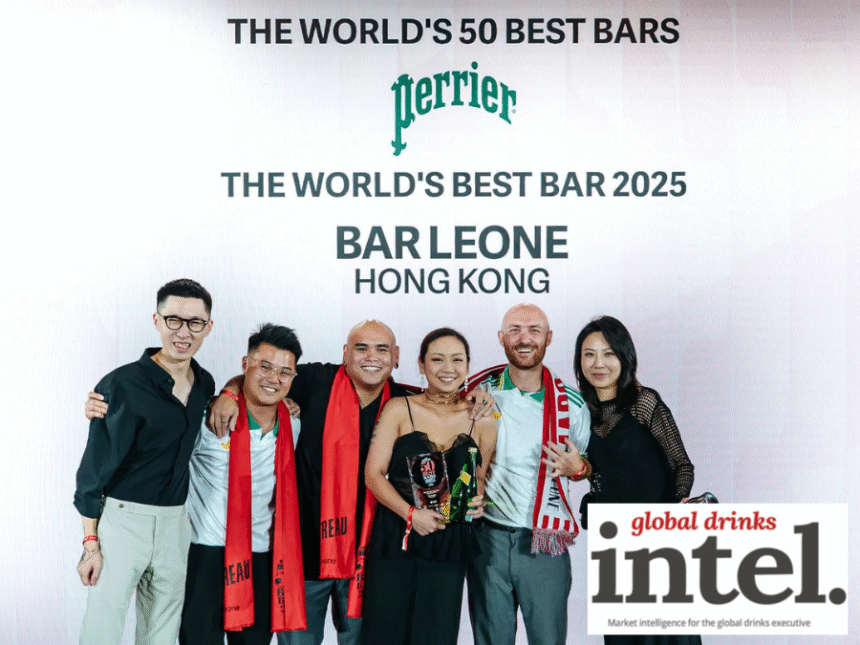
So there we have it. The World’s 50 Best Bars for 2025 have just been announced and the number one is not in London, New York or Paris. It is no longer even in Mexico City. This year, the title has travelled to Asia, and the crown has been taken by Bar Leone in Hong Kong.
Taken at face value, it’s easy to dismiss this as a (very) good bar winning an unquestionably prestigious award, yet an award that’s bestowed on a certain type of bar that appeals to a certain type of judge, for whom there’s a plethora of influential bars to be seen at and industry gurus to be seen with.
But, let’s suspend our scepticism for a moment. For I believe that, far from a grand but hollow feather in the cap of the Asian on-premise channel, the decision to recognise Bar Leone reflects a tectonic and, frankly, overdue shift in the sphere of influence away from Western markets into Asian ones that are vibrant, thriving and future-proofed.
Let’s get a few myths out of the way, though. Firstly Asia, much like Africa, Latin America or whichever cluster of countries industry experts like me state as being ‘the next big thing’, is not one market. It’s heterogeneous, vast and culturally diverse. It spans countries in which population booms, economic growth and an openness to alcohol create near-perfect market conditions, but also countries in recessions, countries with prohibition and (many) countries where route-to-market complications make it all but impossible to have any control over any in-market strategy.
Even if an ambitious international drinks brand is able to partner with a distributor able to overcome some of those challenges and navigate the diverse local landscape, the challenges do not end there. The hospitality sectors in Asia are among the oldest and most well-established in the world, with ingrained drinking cultures and habits that are difficult to shift.
Local incumbents dominate the on-premise choices of consumers in the region, be they the ubiquitous indigenous spirits such as baijiu, soju, shochu and sake, or, indeed, the go-to choice for most in the region; domestic beer, the top pick in nearly all on-premise venues across the continent.
However, should you successfully plot a route through those challenges, then there are genuine – and lucrative – opportunities. Going back to those prestigious World’s 50 Best Bars, there are more entries this year from Asia Pacific (14 in total, across six cities) than there are from the Americas (13, across seven cities).
This points to the shape of the opportunity in parts of the region. Emerging and evolving levels of affluence in cities such as Seoul, Singapore, Bangkok and Tokyo have resulted in a demand for luxury drinking experiences – often centred around the precious and increasingly rare – moments of tranquillity, relaxation and enjoyment. Indeed, in South Korea, 55% of consumers state that they choose luxury drinks as a way to treat themselves, with the top need-state being relaxation and reward.
The opportunity goes far beyond prestige alone, into what is a vast, wide and deep hospitality sector in Asia. Taking the South Korea example again, away from the 16th best bar in the world, there are 457,027 other on-premise venues in the country. To put that in perspective, that’s one licensed venue for every 113 residents (the UK, as a comparison, has one per 700). This is a channel that, rather than taking its lead from the West, should be celebrated for what it is: a unique, sprawling and influential network of bars, restaurants and watering holes loved by locals and visitors alike.
This is an on-premise channel that’s loved and celebrated, which boasts the highest visitation rates in the world; a place where connections are made and in which socialising takes centre stage. It’s a sector where consumers go to take a break from intergenerational residences, to celebrate, to commiserate, to take a moment and to have fun.
It’s also a sector where some of the highest growth levels of predicted frequency occur, led by India, China, the Philippines and Vietnam, but also one in which consumer behaviours are changing and in which economic strains are impacting visitation rates in the likes of Japan and Oceania. Even within individual countries, there are vast differences between rural and urban, and modern and traditional venues.
Much like the continent as a whole, then, Asia’s on-premise is not a single on-premise sector, but a diaspora of sectors in a diaspora of countries and cities. Iif you can cut through the noise and pinpoint the right opportunity for the right brand, and execute with street smarts and tap into local expertise, then prosperity will follow.
This article is available to Global Drinks Intel members only.
Click below for details on how to join the Global Drinks Intel community.
Already a member?
Log in here to read the article in full.
If you work for any of the following corporate subscribers to Global Drinks Intel, head here to activate your access.
- AB InBev
- Bacardi
- Campari Group
- Diageo
- Moët Hennessy
- Pernod Ricard
- Proximo Spirits
- Suntory Global Spirits
- William Grant & Sons