



Winner – Copalli Rum
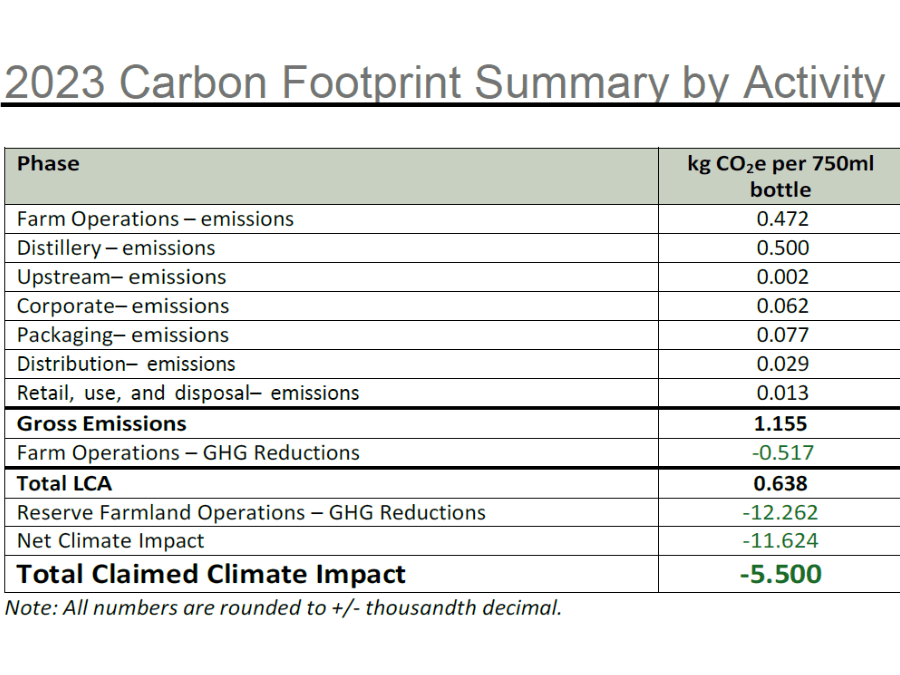
Copalli claims a verified carbon footprint of -5.5kg CO2e per bottle – which the rum producer describes as a conservative estimate, with actual measured performance of –11.624kg CO2e in 2023. The calculations are based on a cradle-to-grave Life Cycle Assessment (LCA) of Copalli’s operations, conducted by Earthoptics and verified by Preferred by Nature in 2024.
The analysis evaluated the company’s greenhouse gas (GHG) footprint from raw material extraction to end-of-life disposal, following widely accepted international standards, including the Greenhouse Gas Protocol, ISO 14040/14044 and PAS 2050. It also evaluated soil carbon stocks to measure atmospheric GHG removals in 2023 in Copalli’s sugarcane fields and adjacent agricultural areas.
The totals arrived at were extrapolated across Copalli’s 2023 production volumes, using 75cl bottle equivalents to arrive at the per-bottle emissions data.
The company’s carbon-negative credentials are built on its organic and regenerative sugarcane farming, which involves recycling organic matter into the soil, plus avoiding synthetic fertilisers, pesticides and field burning, thus improving soil carbon stocks year by year. Copalli says independent sampling and testing confirm that the fields store atmospheric carbon in the long term, directly contributing to climate mitigation.
Copalli also repeats its LCA annually, with the aim of ensuring that progress is not a one-time claim, but an ongoing commitment. The goal of the business is to scale up production while maintaining or improving its net-negative performance, with a “conservative” forecast of at least -5.5kg CO2e “for the foreseeable future”.
Distillery operations are built around circularity and emissions reduction, including the use of bagasse (the fibre left over after sugarcane pressing) to power the biomass boiler, and the recycling of vinasse (a liquid byproduct of distillation) and boiler ash as organic fertiliser. Water for proofing comes exclusively from captured rainwater, while bottling, blending and ageing all take place on-site, reducing transport emissions.
In terms of Scope 3 emissions, all Copalli’s bottles are made from 100% recycled glass, reducing upstream emissions from virgin material extraction, and the company avoids unnecessary secondary packaging elements such as inserts or gift boxes. Copalli says it “continues to explore opportunities” to influence suppliers, logistics partners and downstream customers to reduce Scope 3 emissions, which are measured in its LCA.
Our judges said: “Copalli is carbon-negative, and the company provided detailed evidence of its Life Cycle Assessment (LCA), showing the sequestration of regeneratively grown sugar cane. This provides a good blueprint for others to follow.”