In October, Black History Month served as a timely opportunity to turn the spotlight onto some remarkable brands that deserve recognition – brands from black-owned brewers who, at a time when craft beer sales are in a state of stagnation, could shape the future for this predominantly white, male-driven industry.
If craft beer is to thrive – and cease losing ground to canned spirits – it’s crucial it taps into new audiences. Indeed, according to US trade organisation the Brewers Association, people of colour‚ including black, indigenous, Hispanic and Asian consumers, have been identified as craft beer’s largest untapped market.
In 2022, the craft brewing industry accounted for nearly US$29bn in beer sales in the US – almost one-quarter of the category’s $120bn sales in the market. Yet, from a balance perspective, things are profoundly out of kilter. Non-white Americans represent about 14.5% of US craft drinkers, according to a 2018 Harris Poll, and of this, black Americans account for about 12%. However, according to the Brewers Association’s 2021 diversity survey, only 0.4% of the country’s craft brewery owners identify as black, 4% are indigenous, 2.2% Hispanic and 2% Asian, while 93.5% are white.
Work is being undertaken to increase diversity – in May, the National Black Brewers Association (NB2A) launched, with the aim of increasing the number of African Americans in the brewing industry at all production levels, especially ownership.
For some, the suggestion that new consumers would rally behind black-owned breweries might appear to be a big leap. But we’ve witnessed consumers voting with their wallets in this way in other areas. In 2022, for example, black-owned small businesses reported a 23% increase in annual revenue, according to recent data from Score – more than double the growth rate recorded by US small businesses overall. Black-owned small businesses also added employees at double the rate of all other US businesses.
What we should acknowledge, then, is that black-owned breweries are uniquely positioned to craft taste profiles that resonate with minority consumers.
Typically, when considering consumers versus demographics, I advocate an attitudinal approach. However, taste profiles are one instance where a return to demographic profiling may be warranted. This is where some of the finest black-owned brewers are thriving.
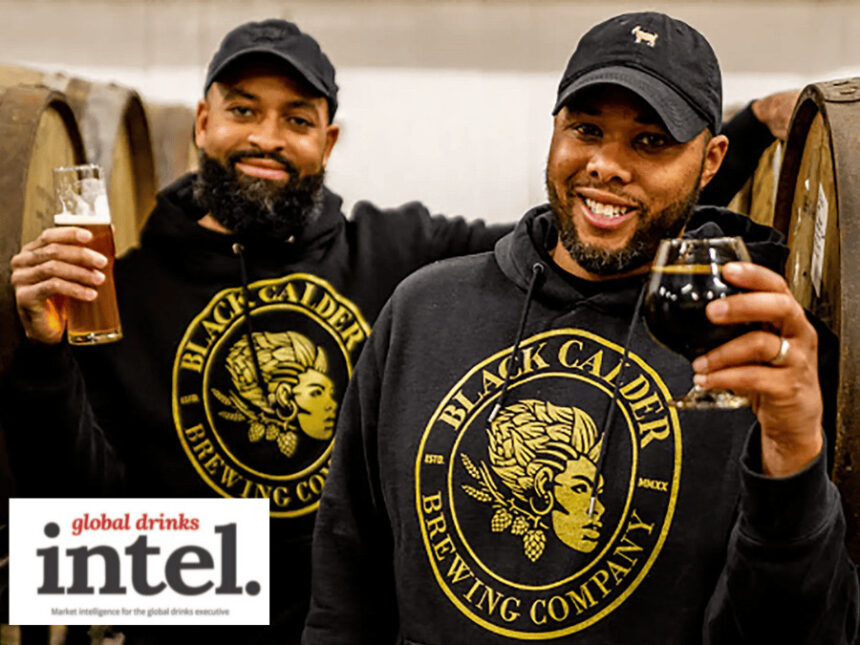
Black Calder Brewing Co is Michigan’s first black-owned brewery. Jamaal Ewing and Terry Rostic speak passionately about addressing imbalances in the beer industry. The company’s logo, for example, is inspired by Mbaba Mwana Waresa, the Zulu goddess of fertility, harvest, rainbows and, of course, beer. The brewery recently released Sip Sip, a pale ale with flavours of mango and guava. ‘Sip sip’ is a Bahamian phrase meaning ‘gossip’. Just like the tradition, this brew is all about coming together, sharing stories and celebrating unity. Far more than ‘just’ a beer company, Black Calder sees itself as a platform for innovation, art, culture and inclusion.
Next up is Rhythm Brewing Co, owned by Alisa Bowens-Mercado, the first black woman to own a brewery in Connecticut. A keen salsa dancer, the New Haven brewer would look out at the dance floor and see a diverse group of people and wanted to bring that same diversity to the beer industry. Rhythm Brewing uses hops imported from South Africa, which means, says Bowens-Mercado, “when you sip on our beer, you’re really sipping on history”. Her mission is to become the first nationally distributed black woman-owned beer brand in the US.
The lack of representation of brewers of colour is just as big an issue in the UK, where only a handful of craft breweries are black-owned and/or operated. London’s Eko Brewery stands out as an excellent example of tailoring taste profiles to demographics. Founded by couple Anthony and Helena Adedipe in 2018, Eko brews beers that authentically represent their rich African heritage. The name is inspired by the historical moniker for Lagos, Nigeria’s bustling capital.
Notably, Eko’s beers deviate from the use of hops. Instead, the company incorporates traditional African ingredients such as maize, sorghum and cassava – a starchy root vegetable beloved in Latin American, Caribbean and African cuisines that, as a key ingredient, imparts a fullness to the beers much like how flaked oats or wheat enhance creaminess in other brews.
Eko also uses coconut palm sugar, an ingredient used in palm wine – a beloved beverage across Africa. When introduced to beer, it adds a distinctive flavour that balances the bitterness. It’s a clever blend of tradition and innovation, which resonates with the spirit of Africa.
Let’s raise our beer glasses, then, to Black History Month. But let’s also consider how, as an industry, we could learn from the best black-owned breweries to write a new future and find new growth potential.