


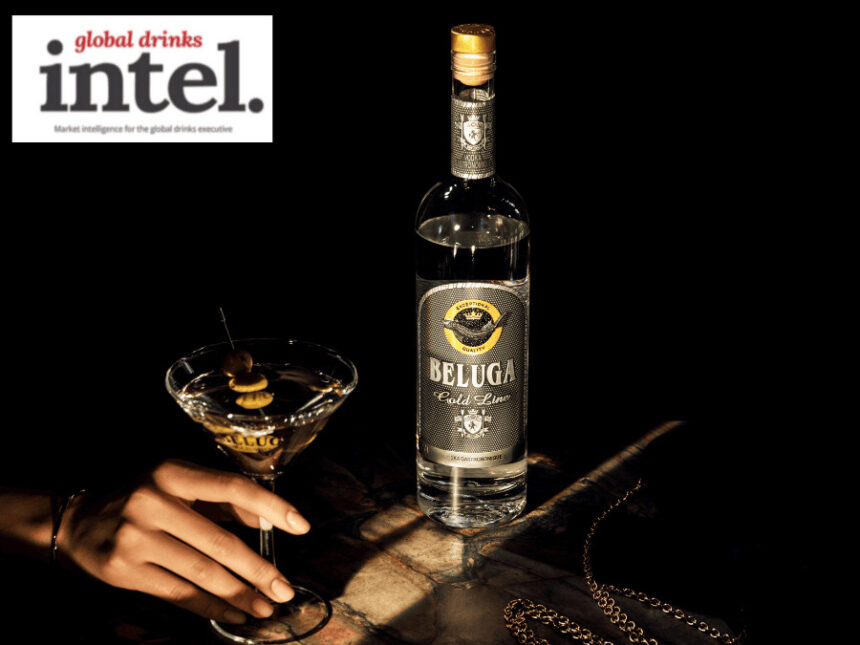
Andreas Ioannides has worked in vodka for 20 years. Now the global business development MD at Beluga owner Noblewood Group, he tells Global Drinks Intel how he has helped to distance the vodka brand from its Russian past.

Global Drinks Intel: You’ve got an enviable history in the vodka category.
Andreas Ioannides, Noblewood Group MD of global business development: I started with [Stoli vodka brand owner] SPI Group in 2003 as regional director for Asia. Then, after three years, I moved to the same role in Europe for seven years. In 2012, I took over India, the Middle East & Africa before becoming the company’s MD for international distribution in 2015.
I left SPI in 2021 and joined Beluga in January 2022 before moving to Noblewood Group as MD earlier this year, following its creation and the acquisition of the Beluga trademark. Based in Dubai, I currently look after most of the international business, from the UK, Cyprus, India, the Middle East, Africa, Asia Pacific, Latin America and the Caribbean.
I’m here to build long-term distribution relationships for Beluga. Our vision is to double the business in the next three to five years, increase our market share and become the number three super-premium vodka behind Grey Goose and Belvedere. We have a clear and consistent price positioning globally, which is slightly above Grey Goose.
I’ve been doing this for the last 20 years and I’m here to repeat the success we had with my previous company.
GDI: How has the vodka category evolved over the last two decades?
AI: While we’ve seen some established brands survive through the years, we’ve also witnessed a lot of new brand launches – some of which have gone on to become global players, selling millions of cases. At the same time, some vodka brands have been inconsistent in their positioning – some up, some down – and in their strategies.
What’s been most interesting for me is that in the last decade, we’ve seen consumers shift to super-premium brands in vodka and become more selective. They’ve also become more educated about what they drink.
At the same time, particularly post-Covid, consumption occasions have changed, shifting from the on-trade to the off-trade, while e-commerce has gained a more significant share.
GDI: Where is Beluga now in volumes terms?
AI: Bearing in mind that we only started producing Beluga out of Montenegro in April this year, we’re already looking to have volumes of around 250,000 nine-litre cases by the end of 2023 – for a ‘start-up’ company, that’s not bad at all!
I believe next year is going to be really exciting. We still have some empty spots to fill when it comes to routes-to-market, but we’re looking to establish a springboard for accelerated growth in the years to come.
GDI: The vodka category doesn’t lend itself to ‘accelerated growth’ nowadays, though. Is Beluga’s opportunity purely geographical or within the category itself?
AI: It’s a combination. Beluga has unexploited territories, such as the US, where it’s a relatively small brand, considering the importance of the super-premium segment – more than 50% of super-premium vodka sales are in the US.
Then, look at markets like Israel, where the brand exceeds 100,000 cases: The super-premium vodka category in Israel is bigger than the premium category. So, we’ll look to invest behind Beluga’s brand equity to increase our market share in particular countries.
In the past, Beluga was available in around 80 markets and we’ve already expanded to over 100 countries. So it’s a combination of both.
GDI: How do you expect Beluga to take market share from other firmly established super-premium vodka brands?
AI: Beluga’s an established global brand already – it’s not something that came to the market all of a sudden. Of course, it has a new origin of production but before the war, it was the number two super-premium brand in global duty-free, for example.
Our priority has been to make sure we have the capacity first, then establish the route to market. Now, global consistency is really important, in brand advocacy and consumer education on Beluga’s quality credentials. There’s a lot to be done but with a long-term focus. The reason I joined Beluga is because of its long-term focus rather than short-term imperatives.
GDI: How has Beluga handled the consumer challenge from previously promoting its Russian provenance?
AI: If we look at the origins of other super-premium brands, it’s not relevant. Beluga is a true international vodka brand. Of course, we’ve witnessed a pushback in some particular markets, but we’re here to explain to consumers that Beluga has nothing to do with Russia – It doesn’t have any ties to the government or to the war.
The fact that it’s now produced in Montenegro isn’t something we really shout about because at the end of the day, the way we want to promote and establish Beluga is as an international vodka brand in the super-premium category. That’s how we look at it.
GDI: What are Noblewood Group’s wider aspirations?
AI: We want to stay in super- and ultra-premium spirits and we’re looking to expand into new categories – we are looking for a super-premium rum and a super-premium gin.
GDI: By organic or inorganic means?
AI: We’ll look internally first of all. The priority has been to establish Beluga internationally, but in the first six months of 2024, we’re looking to create something in two other categories. I’m hoping that by the end of Q1, we’ll be able to make some announcements about what we’re going to be looking to produce.
GDI: What’s keeping you awake at night right now?
AI: To be honest with you, it’s the excitement! I want to be able to say I put my small stone into the global development of this super-premium brand. Yes, there are challenges, so I’m thinking of ways to overcome them. We have a very clear vision of how we want to achieve what we want to achieve.
Ultimately, you’ve got to enjoy what you do!