

This article has been available to Global Drinks Intel subscribers since May. For details on how to join them, please click here.
In the global travel retail channel, Asia Pacific has roared back to life in recent months, albeit from a low base in 2022. However, the key southern Chinese province of Hainan lost momentum last year, while investment in the duty-free destination continues.
Following the worst of the pandemic, Asia Pacific was last out of the gates, but this is very much a region that the wine and spirits industry has high hopes for when it comes to global travel retail.
While the channel appeared to have learned to survive without being overly dependent on the high-spending Chinese, this lesson seems to have been largely forgotten. Major beverage alcohol companies continue to invest heavily in the locations that the Chinese will likely travel to, now that they’re free to go abroad again following January’s reopening of the country’s borders.
Where they will go this year in large numbers remains guesswork, depending on how quickly air schedules can be reinstated and on how cautious the Chinese remain about long trips. It’s easy to forget that while Covid-19 infection rates fell in the West, in the second half of 2022 they soared to new heights in China, with deaths sky-rocketing at the start of this year. The World Health Organization puts the country’s Covid deaths at more than 120,000, most of these occurring at the turn of the year.
The psychological impact means that Chinese travellers will probably not travel too far, with intra-Asian destinations, plus Greater China [which includes Hong Kong and Macau], considered ‘safer’ and more convenient. That’s good news for the tropical island of Hainan, the southernmost province of mainland China. During the Covid confinement years, Hainan became a duty-free playground for nationals who were unable to leave the country, with resulting booming sales – until last year.
According to the Hainan Provincial Bureau of International Economic Development, total sales in the region’s duty-free store across all categories amounted to CNY48.7bn [US$7.2bn] in 2022, well below the 2021 figure, which exceeded CNY60bn [about $8.9bn]. The decline was due to various mainland regional and city lockdowns last year that hit travel to the island.
Will Hainan top $10bn?
This year, the province expects sales to reach CNY80bn [$11.9bn]. It remains a location where wine and spirits brands are eager to enter and expand, ever since the sectors were added to the list of approved categories that could be sold duty-free. This occurred in mid-2020 when the personal duty-free allowance was tripled to more than $14,500.
In February last year, duty-free stores also launched a postal delivery service, enabling purchases to be sent to the customer’s end destination if they are leaving the island. For weighty categories like beverage alcohol, this will be a big advantage. According to data from one of the biggest duty-free operators on the island, the top five imported spirits categories by sales in Hainan are whisky/whiskey, Cognac, baijiu, vodka and rum. The five leading imported spirits brands by sales are Johnnie Walker, Hennessy, Moutai, Rémy Martin and Glenfiddich.
Not everyone thinks Hainan is back on a winning streak. “During the pandemic, Hainan become the most relevant holiday destination for Chinese citizens,” says Jairo López Suárez, GTR manager at beverage alcohol data specialist IWSR Drinks Market Analysis. “With travel restrictions lifted in early January 2023, we are likely to see a significant reduction of sales in Hainan this year, but we expect it to remain a relevant tourism destination for a large portion of the Chinese population.”
He adds that the island will retain substantial liquor volumes, although the mix could move towards lower-priced products. This position is partly based on the fact that only about 15% of China’s 1.4bn population – very likely also the wealthiest – currently hold a passport and are now more likely to travel abroad – even if they don’t go far.
It’s too early to say whether López Suárez has been proved correct, but some figures favour the analyst’s view. Sales data from 21–27 January, the week preceding the Lantern Festival [which marks the end of Lunar New Year celebrations], show that Hainan’s duty-free sales reached $234m, just 6% more than the same period in 2022. Yet, during the period, there were 10% more retail visitors.
Planning ahead
Christopher Liang, founder & CEO of Hong Kong-based Paragon Liquors, which counts Silkie Whiskey from Ireland and New Zealand’s Gladstone Wines as part of its portfolio, tells Global Drinks Intel: “We had anticipated Hainan’s rise as the new SAR [special administrative region] of China. Central support has been given to further open up international trading and establish a free trade economic zone for ‘China’s Hawaii’.”
Liang set up a Hainan office in 2021 in preparation for increased beverage sales across the province “and into the neighbouring hinterland of South China”. He says: “The market for wine and spirits is customarily dutiable, and the tax concessions promoted in Hainan, notably at duty-free malls, will certainly be attractive. As Hainan opens up to more international consumers, consumption of Western wine and spirits will soar.”
Other factors are also driving growth. Over the years, Hainan has been turned into a low-tax innovation and entrepreneurial hub designed to attract luxury brands, manufacturers, logistics players, international schools and the like. But the biggest change is yet to come: At the end of 2025, the island will go through what’s called the ‘seal-off’, when retailers will no longer have to partner with local Chinese operators to import duty-free goods, thereby liberalising the sales channel.
“Given the relaxation of Covid-19 measures this year,” says Liang, “we predict a bump in tourism footfall and services spending as bars and nightlife, particularly in the southern metropolis of Sanya, are reawakened.”
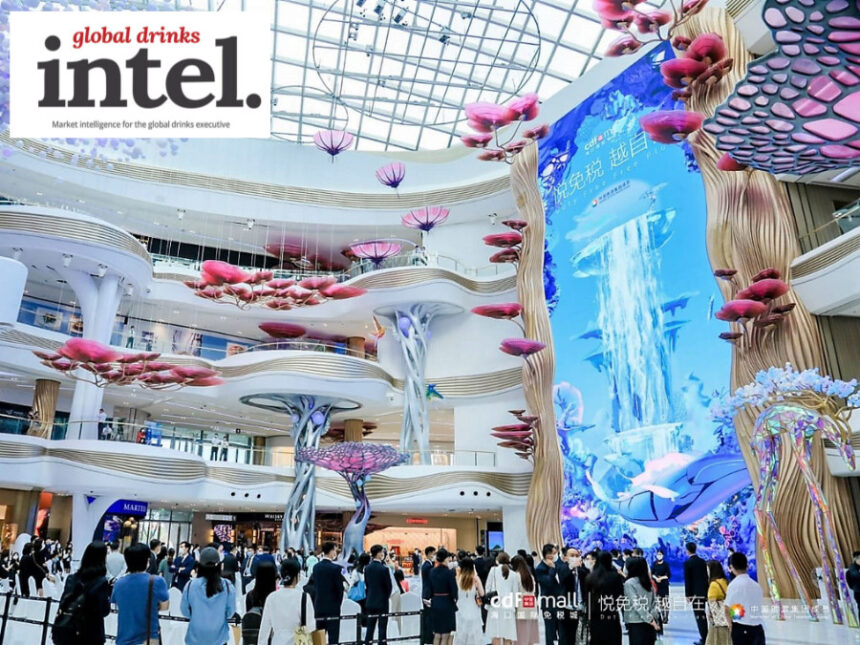
Sanya is the main tourism and duty-free hotspot on the island, where China Duty Free Group [CDFG] operates an enormous shopping complex. The retailer opened an even larger duty-free mall – the biggest in the world, called Haikou International Duty Free City – in autumn last year in the island’s capital. The 280,000 sqm structure hosts an array of high-end spirits brands and their owners, including Camus, Courvoisier, Diageo [with a ‘smart’ whisky boutique], Martell and Rémy Martin. There’s also a Moutai ‘experience’ store featuring rare collectibles, alongside China’s first Whisky Museum.
Diageo’s whisky boutique opened at the end of March featuring rare blended and malt whiskies, a sampling area, and bespoke gifting. “We’re incredibly proud of this boutique, of its ambition for our luxury Scotch portfolio,” says the group’s GTR MD, Andrew Cowan. “We know that it has a bright future as a beacon for rare and exclusive whisky gifting.”
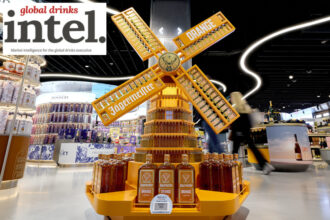
As well as the expected top-end players, others also see opportunity in the market. Mast-Jägermeister’s GTR VP, Tobias Witte, says: “Hainan is a long-term investment for Jägermeister and is performing well.”
Elsewhere, Scotch whisky bottler Douglas Laing & Co, which has created a range called ‘Remarkable Regional Malts’, is seeing good pick-up. Hannes Koch, who represents the brands in GTR, says: “We are with CDFG as well as Ever Rich and Tasa Meng. CDFG likes educative, disruptive, quality bottlings like this regional range.”
The broader picture
More widely in Asia Pacific, major GTR retail operators such as DFS Group are looking to add new liquor categories. “We’re bringing newness to our assortment by introducing new spirits categories, specifically rum and tequila, into our ‘Masters of Wines & Spirits’ collection for the first time,” CEO Benjamin Vuchot tells Global Drinks Intel. “We know customers are not just looking for traditional luxury drinks icons, but also more niche brands.”
Earlier this year, the retailer ran a month-long ‘Masters of Wines & Spirits’ event in Macau’s City of Dreams at the DFS T Galleria. More than 100 rare fine wines, spirits and Champagnes were on display from 50 brands and their owners, including Moët Hennessy, Diageo, The Macallan, Dictador and Penfolds.
Commenting on Asia, William Grant & Sons senior GTR insights & analytics manager Soekendro Harjono says: “We’re seeing that travel retail consumers are becoming younger and ready to spend more on products and experiences. Offering digital interaction is as important as tangible products and key to sales conversion. Given Asia is a strong driver of spirits’ growth, this also shapes our strategy and plans in the region.”
William Grant has subsequently put more higher-end spirits expressions into duty free, while increasing brand awareness at various consumer touchpoints, both online and offline. Examples include the limited-edition The Balvenie The Week of Peat [19-year-old single malt] and the Glenfiddich Perpetual Collection, which has been the subject of pop-up outlets in across several Asian GTR locations.
Mast-Jägermeister’s Witte says: “Asia-Pacific is now seeing the return of passengers and we’re optimistic that 2023 will be a positive year. Markets are moving at different speeds: India is performing particularly well, and we are seeing encouraging signs in Chinese airports.”
In South Korea, Lotte Duty Free had a big liquor rebound with Q1 sales up by 87% year on year, with single malt sales more than tripling. The IWSR expects the fastest travel retail recoveries for liquor to come from the markets that relaxed their Covid-19 travel restrictions earliest, such as India, South Korea, Malaysia and Singapore.
Meanwhile, China’s full reopening in early January means “we should see noticeable growth of sales in 2023”, according to López Suárez. Where in the region that growth occurs fastest is the big question.
This article has been available to Global Drinks Intel subscribers since May. For details on how to join them, please click here.