

This article was initially published in the October issue of Global Drinks Intel magazine. For details on how to subscribe, click here.
The sale of alcohol in Mormon-influenced Utah is in the process of being modernised, with click & collect and a wine club. Roger Morris reports.
Less than two years into her job as executive director of the Utah Department of Alcoholic Beverage Services (DABS), Tiffany Clason has charted a path of modernisation for the agency by better assessing the needs of consumers who want to buy alcohol as well as those whose occupation it is to sell or serve it.

That wouldn’t seem to be an unusual aim for someone in her position, except that more than 60% of the residents of the US state are members of The Church of Jesus Christ of Latter-day Saints — better known as Mormons. The religion doesn’t approve of its members, which includes most of the state’s politicians, drinking alcohol. As a result, DABS has been accused of not always being attuned to the preferences of those who do partake.
“I think it’s important that we changed the name this summer from the Department of Alcoholic Beverage Control to Alcoholic Beverage Services,” Clason says. In fiscal 2022 – to the end of July – the agency returned to the state US$184m in revenue on sales of $522m, a margin of 35.2%. Fiscal 2023 is also showing good preliminary numbers.
During her time in office so far, Clason has walked a straight administrative path with all the agility of a sober driver being asked to take a roadside sobriety test; determined to meet the desires of moderate drinkers without encouraging the overuse of spirits, beer and wine. When asked during her confirmation hearings early in 2021 whether she drank alcohol, the Louisiana native said that she did — but only “in moderation”.
In 2021, 89 of the state’s 103 lawmakers belonged to the Church of Latter-day Saints, which has dominated Utah politics since persecuted members of the church settled there in 1847. Today, just over 60% of Utahns (more than 2m people) are members — representing around a third of the total number of Latter-day Saints in the US.
“I’m very excited that the governor and the legislature approved a record level of funding that will help us move forward on several fronts,” Clason tells Global Drinks Intel. “Part of it will be directed to online programmes, part for compliance and licensing and part of it for retailing with investment in special orders.”
Clason has a background in the retail food business but more recently has worked in directing campaigns for politicians of both major parties — Republicans and Democrats — in her home state and in Utah. In early 2021, she was appointed by Utah Governor Spencer Cox to replace outgoing DABS director Sal Petilos and was subsequently confirmed by the state’s legislature.
Utah not immune to premiumisation
Utah is one of 17 ‘control states’ among the US’s 50 primary political units, so-called because either all or the majority of retail transactions involving the sale of alcoholic spirits, wine and sometimes beer are directly controlled by the state government. In ‘open states’, private businesses perform those functions. In Utah, all retail sales of beverage alcohol, including spirits, wine and beer over 5% ABV (defined as ‘heavy beer’), are performed through state-run stores or as on-premise sales through outlets that are directly supplied and licensed through DABS. Beer under 5% ABV can be sold through supermarkets and other retail outlets.
As with most states, open or controlled, Utah’s DABS annual alcohol sales have been performing well recently. In fiscal 2022, total bottles sales — regardless of type of alcohol contained – were up by just over 3%, from 43.7m units in 2021 to 45m bottles in the 12 months to the end of July. More encouragingly, average price per bottle went from $11.83 to $12.34, a hike of 4.3%. “We have seen no slowdown in the trend toward premiumisation in recent months,” Clason reports, in spite of recent inflation and other economic pressures.
Distilled spirits continue to be the major sales driver, accounting for 56% of total alcohol sales ($290.9m in 2021), followed by wine at 34% ($173m), ‘heavy’ beer at 5% ($28m), package stores attached to licensed manufacturers at 5% ($18.5m) and flavoured malt beverages at 1% ($7m).
Tequila on the rise, although vodka still rules
On-premise sales, primarily in restaurants, have been recovering quickly after COVID-19 truncated or momentarily halted their businesses during much of 2020 and 2021, accounting for 11% of total Utah alcohol sales at $55.3m.
“We have temporarily continued to extend restaurants’ use of outdoor areas of service, which was instituted due to COVID,” Clason says. Many states and municipalities permitted extended outdoor restaurant seating as a health measure during the pandemic and are now making decisions whether to permit further use of these sometimes public spaces. In spite of its overall sales gains, DABS estimates a loss in sales of around $4.5m while its retail outlets were temporarily closed due to the pandemic.
DABS categorises its sales rankings on an integrated basis, and in 2021, the top ten categories were: vodka, whisky, beer, Bourbon, Tequila, rum, Cabernet Sauvignon, Chardonnay, cordials and Pinot Noir. This year, however, Tequila has moved up to third place, behind vodka and whisky, while the other categories remained in the same order.
Utah ranks its top brand sales by SKUs, and in 2021 Tito’s Handmade Vodka (1.75-litre) topped the pile with more than $4.7m in sales. Barton’s Vodka (1.75-litre) was a distant second with $3.4m, while Patrón Silver Tequila (75cl) was third with $3.3m. Tito’s Handmade Vodka (1-litre) and Crown Royal Canadian whisky (1.75-litre) rounded out the top five.
The next five SKUs were Jack Daniel’s Tennessee Whiskey (1.75-litre), Tito’s (75cl), Smirnoff Vodka (1.75-litre), Jameson Irish whiskey (75cl) and Jack Daniel’s Tennessee Whiskey (1-litre).
Sourcing for Utah’s alcohol sales is overwhelmingly from US producers, accounting in 2021 for almost 73% of total sales ($126.7m) across spirits, wine and beer. Italy was a distant second with about 9.6% ($16.7m) and France was third at 3.4% ($5.97m). Other source countries were, in descending order, Argentina, New Zealand, Spain, Australia, Chile, Portugal, Japan, Germany, South Africa, Austria and Greece.
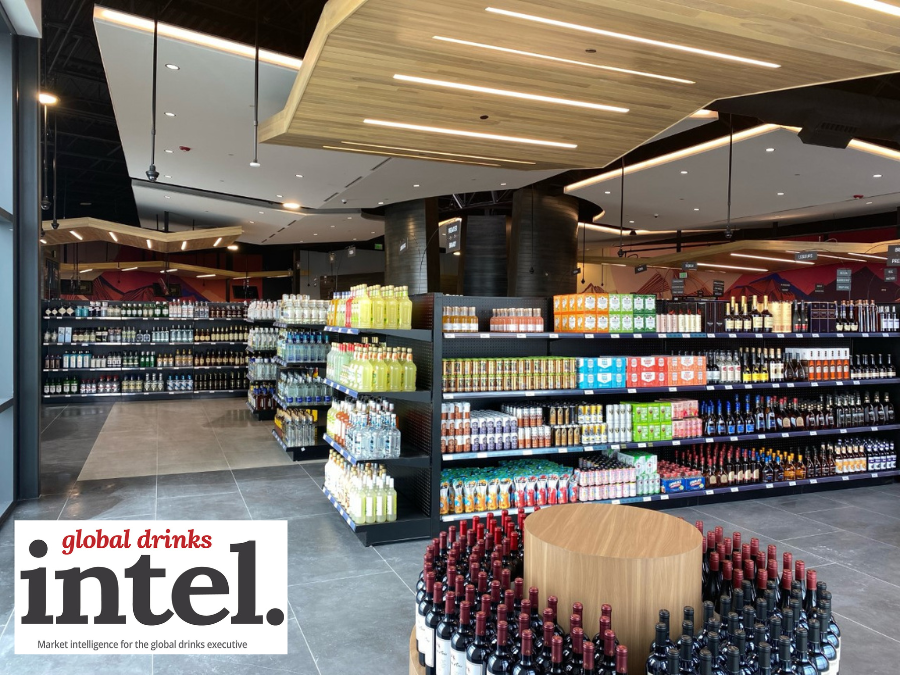
“Presently, we have 51 stores and funding for two more,” says Clason. “We’re seeking funding for an additional two.” DABS has about 650 full- and part-time employees, but, like many hospitality businesses, has had difficulty in recruiting to full strength following the pandemic. However, COVID had one positive side for Utah: “We saw a boom in tourism,” according to Clason, “because people wanted to get out in the open air, and Utah is known for its ski resorts and scenic national parks.”
Nevertheless, Clason’s agency faces serious challenges to modernise DABS, which has fallen far behind in technology utilisation over the years. Between November 2021 and December 2022, the department commissioned Honey Communications to conduct an audit of both internal and external stakeholders. The agency found that DABS has a “great need for infrastructure advancement”, with most of its systems still operating through a paper system, with on-premise licensees having to drive to Salt Lake City to file their applications.
Honey Communications also found that many stores do not have either WiFi or the technology needed for a business today. Other infrastructure challenges have arisen due to the growth in sales. “The current warehouse won’t be able to meet the increased demand and changing demographics of Utah,” according to the audit report. “Addressing these challenges proactively will be paramount to DABS’s continued success.”
Modernisation moves
It comes as no surprise, then, that Clason is excited about two new programmes that, she believes, illustrate DABS’s commitment to improving customer service. “One is click & collect, where consumers can buy online and then pick up at their closest stores,” she says. There is a wide disparity between stores in what is being offered in terms of SKUs, and Clason believes the new feature will help out. “The other programme is a Utah Wine Club, where consumers who subscribe can order club products for later pick-up,” she says.
DABS is also introducing a third “rare and high demand” programme, similar to set-ups in other states where consumers can register to buy hard-to-get products at a standard 88% markup, with a computer programme choosing those who have won the right to purchase.
Partly as a nod to DABS’s policy of not promoting, but just fulfilling, alcohol sales, the agency does not run sales or special promotions. However, it does reduce prices for closeout (clearance) sales — which are referred to as ‘special price adjustments’ – with the agreement of producers.
“Right now, one big priority is a new warehouse,” Clason says. “Although the current one is state-of-the-art, it’s already at capacity, and it will take a year to a year-and-a-half to get a new one online.” For a state liquor commission where a majority of residents don’t drink alcohol, trying to keep up with consumer demand is not a bad problem to have.
This article was initially published in the October issue of Global Drinks Intel magazine. For details on how to subscribe, click here.
123 https://staging-drinks-intel-com.stackstaging.com/spirits/its-been-continuous-crises-ever-since-campari-group-ceo-bob-kunze-concewitz-speaks-exclusively-to-global-drinks-intel/