

This article was initially published in the October issue of Global Drinks Intel magazine. For details on how to subscribe, click here.
Champagne and sparkling wine producers face a new set of challenges as they rebuild their sales in Global Travel Retail, but they remain committed to the channel. Richard Woodard reports.
Champagne and sparkling wine’s reputation for resilience has rarely been as valuable as it is today in the Global Travel Retail (GTR) channel as the marketplace slowly recovers from the huge difficulties of the COVID-19 pandemic during 2020 and 2021.
Brand owners are overwhelmingly optimistic as they rebuild their sales in the channel, but there is also a recognition that the resurgence remains patchy — and threatened by the prospect of further difficulties on the horizon. Continued restrictions in Asia, the war in Ukraine and spiralling inflation are all causes for concern moving into 2023 — and there is a marked difference in the prospects and challenges faced by Champagne, as opposed to generic sparkling wine.
“Champagne suffered a particularly steep decline in GTR in 2020, thanks in part to its exposure to airline business through in-flight pouring and consumption in airline lounges,” IWSR Drinks Market Analysis points out. “For the same reason, its recovery from 2022 onwards depends largely on the return of air travel around the world.”
Outlook for Champagne
After the steep declines of 2020, the volumes for Champagne (excluding sparkling wine) increased by 100% in 2021, with IWSR projecting further rises for 2022 (+68%) and this year (+42%). “Whereas spirits volumes in GTR are not expected to recover to pre-pandemic levels until 2025, [we] expect Champagne to accomplish this in 2023, spearheaded by renewed growth in Europe,” says the IWSR.
This positive picture is reflected within the marketplace itself. “This summer, airline traffic in many major international routes exceeded pre-COVID levels,” reports Christophe Juarez, CEO of Terroirs et Vignerons de Champagne (TVC), the co-operative that owns Nicolas Feuillatte and Castelnau.
Domestic flights in the US are “back to normal”, Juarez says, while traffic in Europe is at 86% of its 2019 peak, with a strong emphasis on tourist destinations, such as Italy and Spain. However, he adds: “Asia is still struggling due to steady restrictions in China and Japan.”
Elsewhere, Champagne Lanson’s GTR sales more than doubled last year versus 2021, in line with a strong recovery in domestic markets, says Edouard de Boissieu, the house’s head of travel retail. With that in mind, the winemaker launched Le Vintage 2012 in celebration of the variant’s tenth anniversary at the TFWA World Exhibition & Conference in Cannes in October.
De Boissieu says Champagne Lanson continues to be “committed to GTR as a vital channel” for its business and observes that — chiming with IWSR’s analysis — the segment is currently overperforming within the channel’s overall wine and spirits category.
This is welcome news for a company keen to expand its GTR footprint beyond the traditional heartland of Europe. “Regionally developing our business in Asia and Oceania is a key priority for Champagne Lanson moving forward," says De Boissieu. "Along with Hainan, we see locations such as Hong Kong, Singapore, Sydney, Melbourne and Auckland as all offering huge potential for us.
“We're particularly excited about the opportunities in Australia and New Zealand (both strong Champagne markets) as our domestic sales continue to outperform the market in general, with sales in 2021 up 10% — and 2022 is turning out to be even better.”
Myriam Renard, senior international sales director at Vranken Pommery Monopole, is similarly optimistic, proclaiming that “the recovery is definitely here”. She adds: “The summer months have been excellent, [as is] the forecast for the end of the year. The strong rebound in demand [in GTR] comes from all channels (primarily airport shops, cruise lines and airlines).”
New opportunities
Amid all this positivity, however, there are signs of some far-reaching changes in the trading environment. Like Renard, TVC’s Juarez highlights cruise lines, where he says the recovery to date has been “spectacular”, with lines such as Carnival, Royal Caribbean and Holland reaching pre-COVID passenger levels since March last year.
“It remains an extremely dynamic segment where luxury goods will grow substantially in the future," he says. "It's the perfect showcase for visibility and brand-building. People are keen on spending time and money on an in-depth shopping experience. Where on Earth have you got such a captive audience for a long period of time?”
More fresh GTR opportunities are emerging as the market increasingly looks beyond the obvious big names from Reims and Epernay. At Champagne Drappier, deputy MD Charline Drappier observes: “As the opportunities have multiplied, our experience is that it has opened the segment of super-premium Champagne (first-class Champagne pours) to smaller houses like ours. We were able to secure even more quality-driven in-flight pours.”
She adds that the business has secured more listings with border shops — in Latin America, for example — as the segment expands. “Airport retailers have shown a growing interest in our Champagnes, a sign that the offer is evolving,” Drappier says. “We have signed with an important player in French airport retail, with a selection of our cuvées on the shelves in Q4 2022 — a situation that was hard to imagine two years ago, when the selection had no space for smaller, boutique houses like ours.”
Challenges of high demand
Perhaps the biggest issue facing Champagne in GTR is satisfying unexpectedly high demand. In recent years, there have been three small harvests (2017, 2020 and 2021), leaving producers short of stocks for the months ahead. Juarez expects allocations to occur as a result, and Renard, de Boissieu and Drappier all highlight the issue.
“We faced a 48% volume decline in airline sales in 2020 versus 2019, and 2021 was still -25%,” Juarez points out. “Today, the recovery is so unexpected that we are short for the end of the year (2022). So, volume scarcity and huge inflation rates are challenging our ability to answer accurately to new tenders, given the uncertainty of the future.”
Non-Champagne sparkling wine
Could this pressure provide an opportunity for non-Champagne sparkling wine to cash in and fill the gap? Possibly, although these businesses are not immune to the broader issues currently confronting the GTR channel, as Sandra Janetzki, senior VP of global export at Henkell Freixenet, observes.
“We've seen GTR sales return to good levels since mid-2021, especially in Europe, which has been our best-performing region,” she says. “Asia remains a challenge due to the impact of COVID-19 and the continued travel restrictions in the region.”
However, the recovery at European airports has been less robust than originally hoped, Janetzki cautions. “Geopolitical developments such as the Ukraine-Russia conflict and global supply chain issues —especially the supply of raw materials, cost of glass and other explosive price hikes in all areas of our business — are all causing disruptions to our GTR business,” she explains.
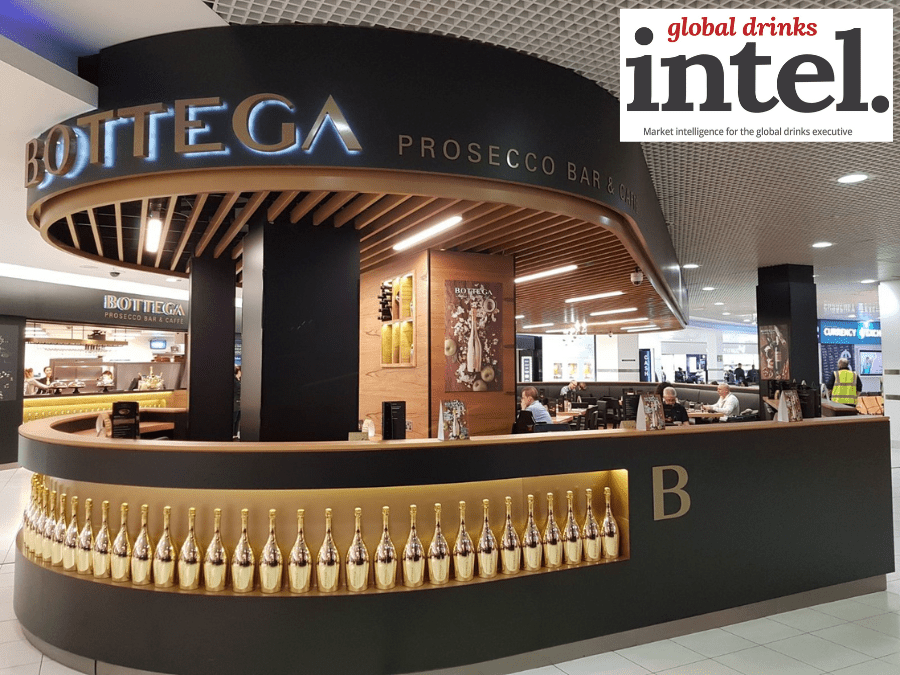
Bottega founder & MD Sandro Bottega echoes Janetzki’s comments, noting that, in the first half of 2022, the business achieved almost the same turnover in GTR as in pre-pandemic 2019. “The prospects for the next two years are good," he says, "even if the unknowns of this difficult historical period are looming and can lead to a sudden change in the trend.”
For Bottega, the year began slowly, before demand took off in the three months to the end of June (although not in Asia, where restrictions persisted). “In the second quarter of 2022, the following channels are doing well in the airline market: pouring, pre-order online, buy-on-board and home delivery,” he reports, while adding that onboard duty free is still suffering.
Europe remains key to this ongoing recovery, Bottega believes. “Certainly, Europe continues to be the reference market for sparkling wines in GTR,” he says. “Consumers’ awareness and the consolidated oenological tradition make the old continent a reference market, which gives great satisfaction, but at the same time demands quality. The duty-free points of sale of the main European airports ... continue to represent the cornerstone of our GTR business.”
Janetzki confirms that passenger spending in European duty-free is “going in the right direction, even if airlines and airport operators have difficulties managing the growth”. She adds: “The performance of the airline business correlates with the holiday and touristic season. We're seeing good growth across our brands’ miniatures offer — and this is an area we were already targeting for growth pre-pandemic, which is returning relatively quickly.”
Impact of business travel declines
However, there are bigger question marks over the stuttering recovery in business passenger numbers — a key high-spending demographic that offers lucrative opportunities for Champagne and sparkling wine brands alike. While Henkell Freixenet focuses strongly on marquee brands Freixenet, Mionetto and Henkell in GTR, the company also pursues opportunities for smaller, premium products from the likes of Segura Viudas, Schloss Johannisberg and Alfred Gratien.
“The speed of recovery of our GTR business is impacted by changes to business travel habits — more meetings take place virtually, and companies are reducing their costs by undertaking less business travel,” says Janetzki. “This means fewer business travellers are spending in duty-free, and the wine category has been hit hard by this. We expect business travel to bounce back — it’s just a matter of time before these higher-spending business travellers come back to the store.”
That underlying optimism about GTR pervades the Champagne and sparkling wine industries, with all of those involved expressing a strong commitment to the channel, whatever its recent difficulties and ongoing challenges and changes.
Janetzki flags Henkell Freixenet’s strong presence within in-flight pouring, mentioning products such as Fürst von Metternich, Mionetto Il Spritz, Segura Viudas and Kuemmerling, as well as Menger-Krug, which is offered by Lufthansa as a welcome drink in business class. She also highlights the company’s strong market presence globally across sparkling wine, with GTR continuing to be a key component in that mix.
“As we target further growth and sparkling wine category dominance over the next few years, we are increasingly using the GTR channel to leverage our global icon brands,” Janetzki says.
“GTR is always about a focus on our strategic international brands, and the opportunity to grow their presence in global markets.”
This article was initially published in the October issue of Global Drinks Intel magazine. For details on how to subscribe, click here.